

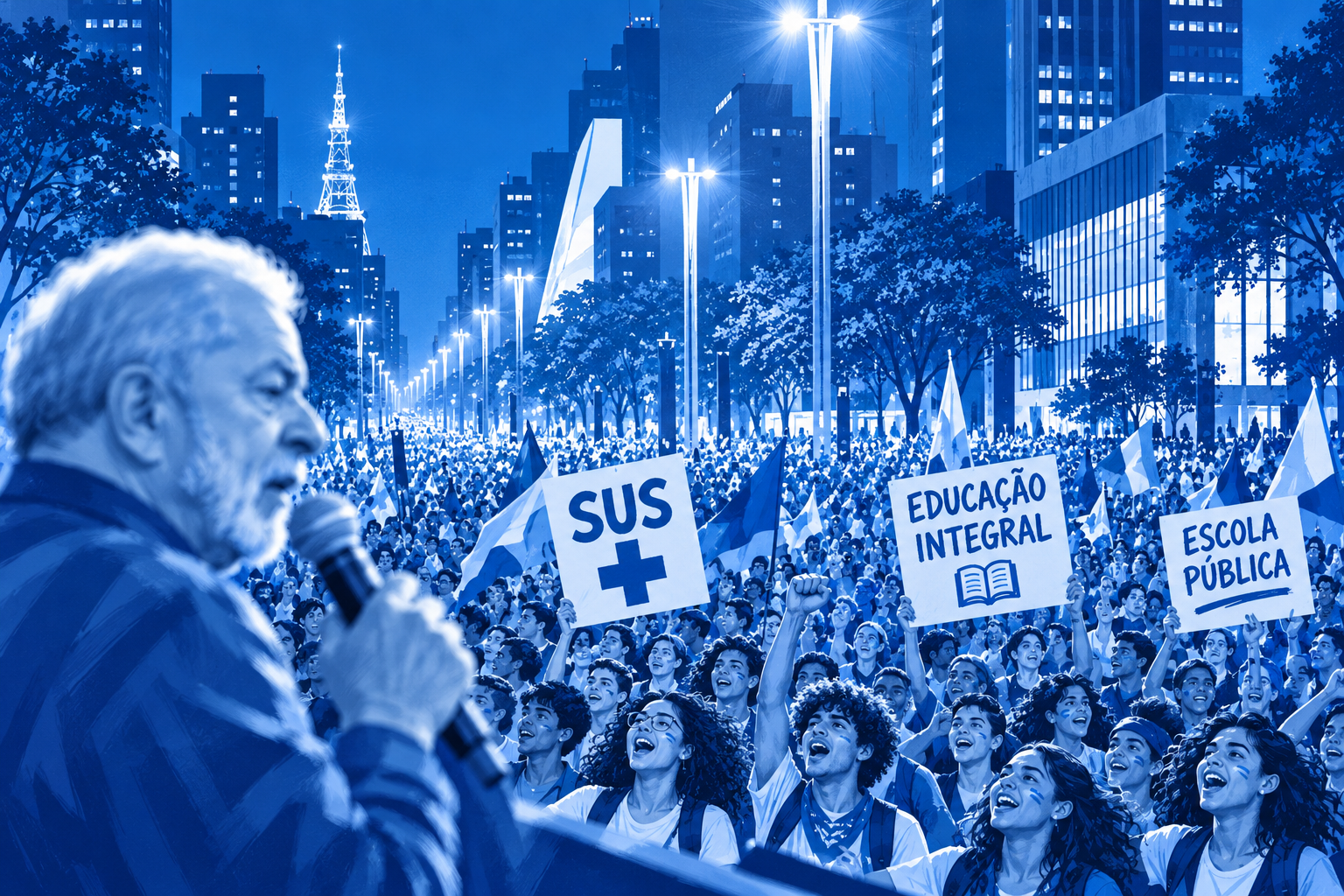
Luiz Inácio Lula da Silva’s unprecedented victory for a fourth presidential term drew strength from a force that opinion polls failed to fully anticipate: the mobilization of people in the streets. Across Brazil, demonstrations featured a striking presence of young people organized through student unions, university groups and movements defending public education. Many also carried banners and wore T-shirts supporting the SUS, Brazil’s universal public healthcare system, in contrast to Flávio Bolsonaro’s vision of “Einstein-standard” healthcare, a reference to the prestigious private Albert Einstein Hospital. For these young voters, Lula’s election to what he describes as his final term was about more than choosing a president. It was about defending public services they believed were under threat.
The demands have a familiar ring. At the beginning of the mass protests that shook Dilma Rousseff’s government in 2013, students and workers called for “FIFA-standard” healthcare and education — a pointed reference to the billions spent building and renovating stadiums for the 2014 World Cup. Those protests ushered in a period of political turmoil that would culminate in Rousseff’s impeachment and the rise of the far right. Thirteen years later, Lula is promising to make full-time public education universally available through high school and further expand access to the SUS. If he hopes to leave a legacy comparable to his achievements in fighting hunger and poverty, he must avoid disappointing a new generation that invested its hopes in his victory. Today’s support could become tomorrow’s demand for results.
In Brazil, the challenge begins with the numbers. The federal government’s proposed 2027 budget allocates R$272.2 billion to healthcare, precisely the constitutionally mandated minimum, and R$141.2 billion to education, just R$2.4 billion above its legal floor. No less than 91.7% of projected primary spending consists of mandatory expenditures, leaving the government with little discretion over additional resources. That room for maneuver could shrink further as pension benefits, payroll costs and other legal obligations continue to grow. Making full-time education universal means hiring teachers, feeding students and keeping schools open for longer hours. Expanding the SUS requires doctors, equipment, medicines and permanent operating budgets. The question is not simply how to launch new programs, but how to pay for them year after year.
Lula will have to find room for his promises within an already strained budget. Brazil’s fiscal framework caps real annual growth in spending subject to the rule at 2.5%, limiting the government’s ability to expand investment and public services. The president could negotiate a relaxation of that ceiling, but changing the law does not change the arithmetic: allowing more spending does not mean finding the money to finance it. Without permanent revenue sources or a reassessment of existing priorities, expanding social programs could push up public debt and interest rates, ultimately undermining the state’s ability to finance healthcare and education in the future. The question, then, is not merely how much Lula can spend, but what he is prepared to change to deliver on his promises.
There is an alternative, although it may prove politically harder than rewriting the fiscal rules: confronting Brazil’s extensive system of tax breaks and subsidies. In 2026, federal tax expenditures and financial and credit subsidies amount to nearly R$800 billion, including incentives for industry and subsidized rural credit. Not all of that money can realistically be recovered, but Lula could review benefits granted to business sectors, demand measurable results and channel some of the savings and additional revenue toward healthcare and education. He could also negotiate a reallocation of congressional earmarks, a difficult undertaking with an increasingly hostile Congress. A structural reform of mandatory spending, which absorbs almost the entire budget, is unlikely to find much political appetite within Lula’s Workers’ Party government. That leaves a combination of subsidy reform and a carefully limited adjustment to the fiscal framework, without jeopardizing debt sustainability. The obstacle is not merely economic. It is a political choice between protecting entrenched benefits and financing the promises made to a new generation.
That does not mean the answer lies exclusively in raising more revenue and spending more money. A gradual expansion of full-time public education, initially focused on the most disadvantaged communities, could combine federal funding, state and municipal participation, and measurable learning targets. In healthcare, integrated patient waiting-list systems, expanded access to specialist care and better use of spare hospital capacity could deliver faster results than simply building new facilities. Greater efficiency does not eliminate the need for additional funding, but it allows each real spent to deliver more services. An economically credible approach would combine these improvements with sustainable funding, performance targets and a reliable path toward stabilizing public debt.
Lula’s challenge, therefore, is not to choose between meeting young people’s expectations and reassuring financial markets. It is to demonstrate that fiscal responsibility and high-quality public services can be part of the same agenda. His re-election has given him the political capital to negotiate changes that would have been far more difficult without an electoral victory. But turning promises into results will require confronting entrenched interests, including those among his own allies. The young people who filled São Paulo’s Paulista Avenue and Rio de Janeiro’s Copacabana Beach did not take to the streets to defend a fiscal formula. They took to the streets to defend their own future.


Leave a Reply