
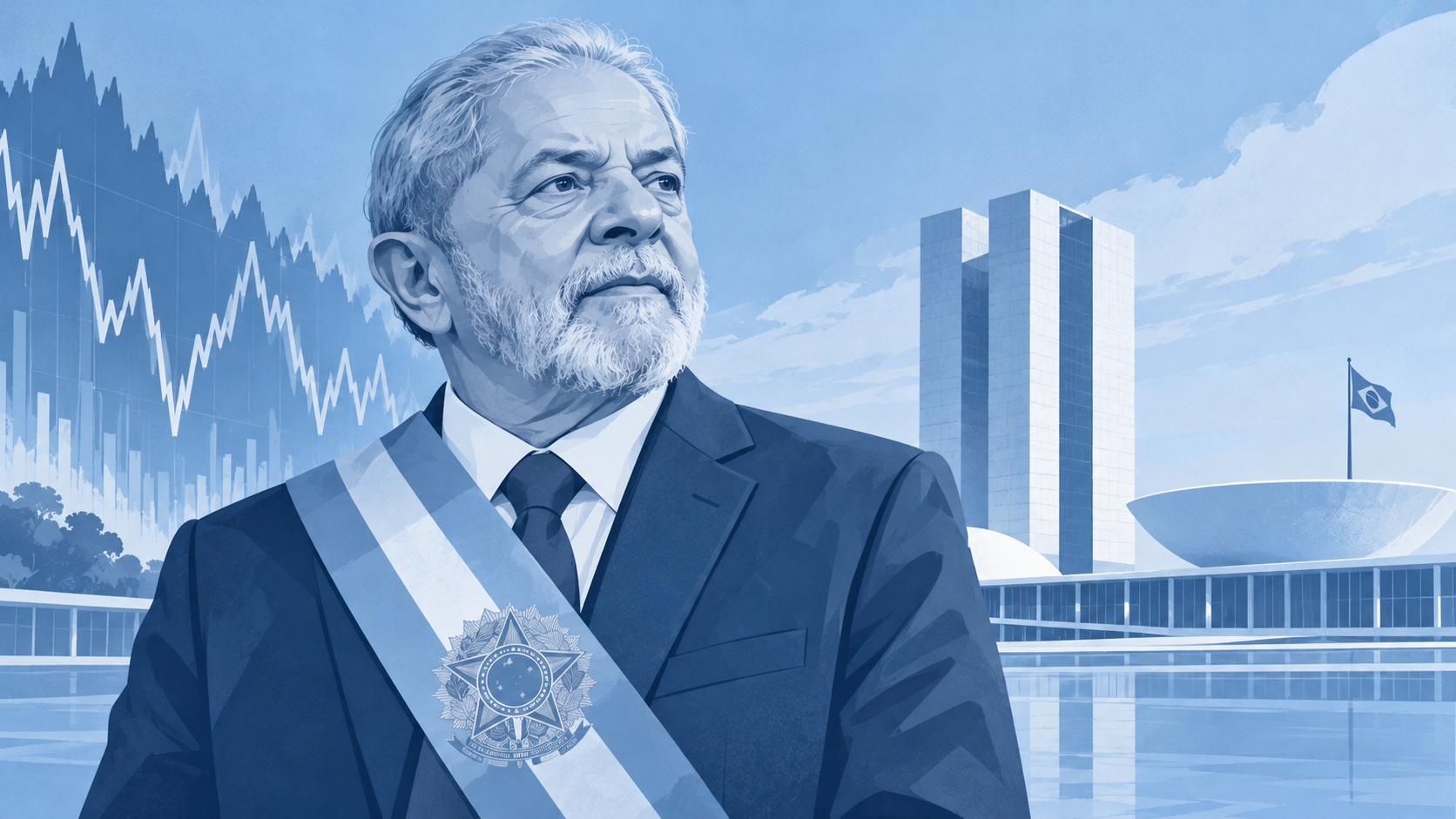
There is a fundamental flaw in judging Luiz Inácio Lula da Silva’s election victory by how financial markets respond this Monday. The dollar may rise against the Brazilian real, stocks may fall, and interest-rate futures may price in a higher risk premium. None of this should be dismissed: financial instability has real consequences for businesses, consumers, and investment. But there is an essential distinction between the price of financial assets and the value of democratic institutions. Financial markets are not a higher authority empowered to pass judgment on democratic choices, nor do investors’ electoral preferences necessarily coincide with the national interest. Investors had largely bet on a change of government and must now reassess their positions. Losses on a misplaced bet are not, in themselves, evidence that voters made the wrong choice.
The deterioration of Brazil’s public finances is a genuine problem, and Lula cannot afford to ignore it. Gross public debt reached 82.9% of GDP in August, while nominal interest payments amounted to the equivalent of 8.86% of GDP over the preceding 12 months. These figures demand a credible response. But attributing high interest rates exclusively to rising government spending is an oversimplification. Monetary policy also responds to inflation, expectations, international conditions, and the cost of servicing public debt itself. Indeed, there is a vicious cycle between high interest rates and indebtedness that cannot be explained by fiscal indiscipline alone. Similarly, claiming that hundreds of billions of reais were spent solely to secure reelection — without distinguishing actual expenditures from budget authorizations, extraordinary measures, and their respective economic effects — substitutes political accusation for serious analysis. Brazil needs fiscal responsibility, not a selective interpretation of its economic problems.
Equally questionable is the narrative that capital has abandoned Brazil because it has been systematically mistreated. The international diversification of Brazilian wealth reflects a range of considerations, including security, liquidity, investment opportunities, and currency protection. Turning these portfolio decisions into a definitive verdict on a particular political party confuses asset allocation with political allegiance. More importantly, a market economy depends on foundations that do not immediately appear in stock quotations: legal certainty, regulatory predictability, institutional independence, respect for contracts, and political stability. A government perceived as business-friendly may generate substantial short-term gains, but those benefits become difficult to sustain when the functioning of institutions depends on the preferences of whoever occupies the presidency. International experience shows that lasting economic confidence requires more than ideological alignment between governments and investors.
This is precisely where the election result demands a different perspective. Lula defeated Flávio Bolsonaro by more than 4.4 million votes, yet the losing candidate announced that he would not recognize the outcome and intended to seek its annulment. Challenging electoral decisions through the courts is legitimate when supported by evidence and sound legal grounds. Turning electoral disputes into a pretext for delegitimizing the will of the voters is something else entirely. Lula’s victory does not eliminate that threat, but it preserves the continuity of a government that recognizes the constitutional order, rather than handing power to a political alternative whose relationship with democratic institutions already posed serious concerns and potential risks. Nor does a conservative majority in the Senate, by itself, constitute an institutional crisis. The legislature is elected to represent political pluralism, scrutinize the executive, and negotiate the country’s direction. An institutional crisis is not a president facing an opposition-controlled Congress. It arises when a political movement behaves as though democracy is legitimate only when it wins.
None of this gives Lula a blank check. His fourth presidential term will begin under severe fiscal constraints, with high interest rates, modest economic growth, and a Congress that will demand considerable negotiating skills. The president will need to present a credible strategy to stabilize public debt, improve the quality of government spending, raise productivity, and create the conditions for a sustainable decline in interest rates. Above all, he must demonstrate that fiscal responsibility and social commitments are not mutually exclusive. But to argue that Lula has no room to maneuver whatsoever is to disregard the political capital generated by a victory that defied the expectations of many pollsters and investors. His campaign also improved its communication with voters on social media and strengthened its mobilization on the streets. Moreover, the ability of different branches of government to negotiate and reach compromises is not a flaw in the system; it is precisely what defines a functioning democracy. Governing will be difficult, as it would be for any president confronting the composition of Brazil’s Congress and the economy’s structural imbalances. Difficulty, however, is not the same as impossibility.
The most serious mistake is to portray the preservation of democracy as an achievement whose economic cost may be too high. The question should be framed the other way around: how much would a further deterioration of Brazil’s institutions cost the country? What are confidence in electoral rules, judicial independence, and the assurance that political power will continue to change hands through the ballot box worth to those who invest, produce, or work? There can be no sustainable prosperity when these foundations become negotiable. Markets may react negatively to Lula’s victory, and his government has an obligation to address legitimate economic concerns. But the dollar’s exchange rate this Monday will not determine the historical significance of Sunday’s election. Democracy is not an asset to be liquidated at the first sign of a loss. It is the institutional foundation that allows every other asset to retain its value over time.


Leave a Reply