
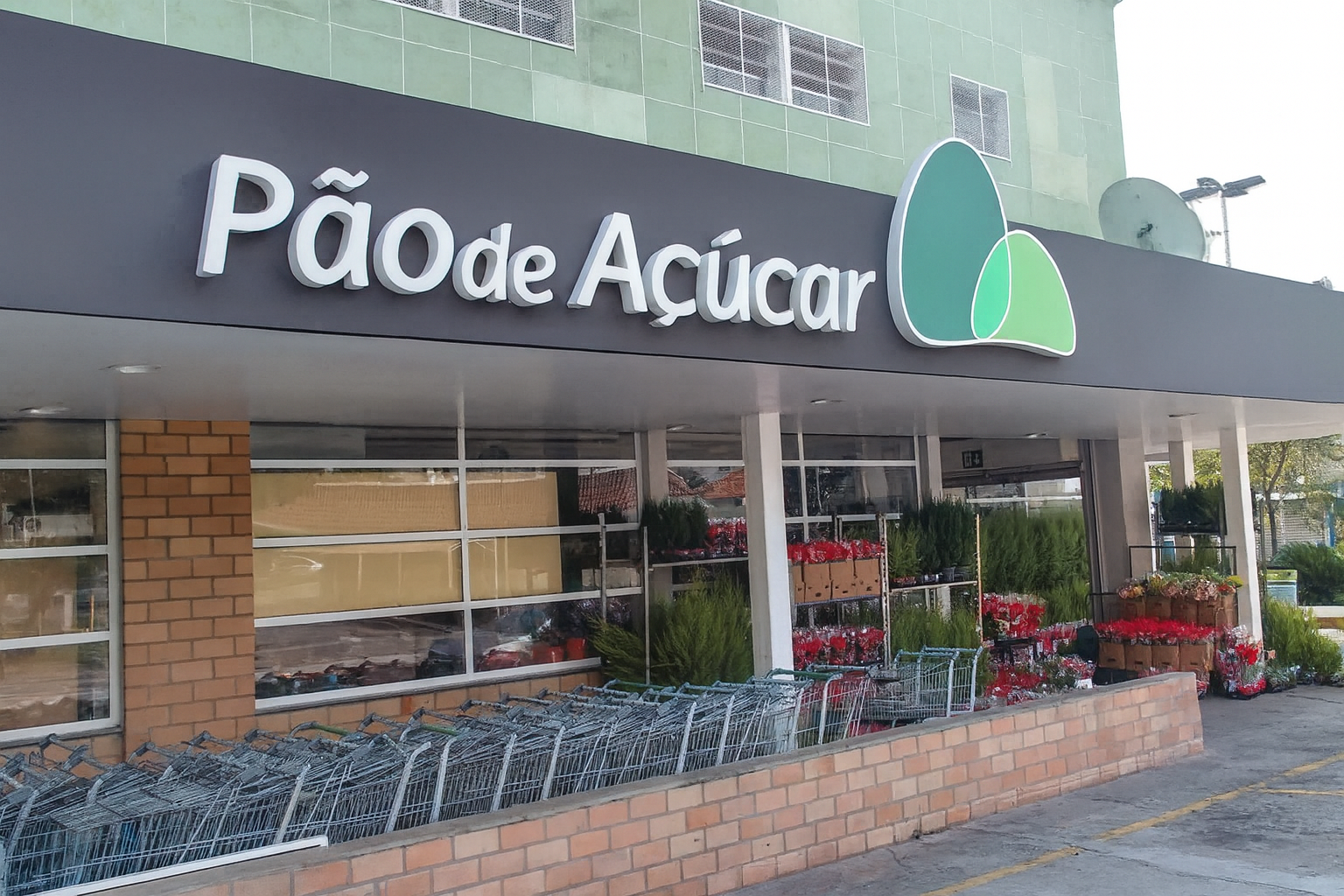
By Brazil Stock Guide – Grupo Pão de Açúcar’s (GPA) adjusted EBITDA rose 7.3% in the second quarter even as sales declined, while the Brazilian retailer’s quarterly loss widened and its out-of-court restructuring plan pointed to a 68% reduction in pro forma net debt and leverage of 1.3 times. The figures were disclosed by the company in its earnings release on Tuesday.
The operator of Pão de Açúcar and Extra Mercado stores, listed in São Paulo under the ticker PCAR3, reported adjusted EBITDA of R$450 million, compared with R$419 million a year earlier. The adjusted EBITDA margin increased 1.7 percentage points to 10.6%.
Gross revenue fell 7% to R$4.71 billion, while net revenue declined 9.6% to R$4.23 billion. The company attributed the contraction to the discontinuation of its Aliados direct-sales model, a reduction in fulfillment activities at distribution centers and the prioritization of more profitable e-commerce channels.
Loss widens despite stronger operating margin
GPA’s loss from continuing operations widened 15.5% to R$204 million from R$176 million in the second quarter of 2025. Including discontinued operations, the loss attributable to controlling shareholders increased 16.2% to R$252 million.
The company said the year-earlier result had benefited from a nonrecurring tax-related compensation. Excluding that positive effect, GPA estimated that the loss from continuing operations would have declined 28.5%.
Net financial expenses after IFRS 16 rose 26.4% to R$385 million, equivalent to 9.1% of net revenue. Financial income dropped to R$33 million from R$117 million, reflecting a lower average cash balance during the quarter.
Gross margin expands as GPA shifts its sales mix
Gross profit increased 0.6% to R$1.29 billion despite the revenue decline. Gross margin climbed 3.1 percentage points to 30.5%, supported by changes in the ICMS tax framework for some products, improved e-commerce profitability, lower logistics costs and the closure of the Aliados operation.
Retail-media revenue grew 39% from a year earlier, also contributing to the margin expansion. Selling, general and administrative expenses fell 2.6% to R$883 million after reductions in headcount, advertising spending and less-efficient contracts.
Same-store sales declined 0.8% after adjusting for calendar effects. Pão de Açúcar recorded a 1.2% decrease, while Extra Mercado posted growth of 0.4%. Same-store sales at proximity formats fell 2.3%.
GPA said store availability was temporarily affected by negotiations associated with the out-of-court restructuring. Product shortages peaked in May and began to ease afterward, allowing sales to return to growth in June, helped by demand linked to the FIFA World Cup.
E-commerce revenue falls under profitability strategy
Online sales declined 16.2% to R$504 million as GPA reduced its exposure to third-party marketplaces and concentrated on its own digital channels.
Sales through GPA’s first-party operation fell 2.9%, compared with a 25.3% contraction on third-party platforms. E-commerce accounted for 11.1% of total sales, down 1.6 percentage points, while the first-party channel’s share of online revenue increased 6.5 percentage points.
Debt plan targets 68% reduction in net borrowings
GPA ended June with net debt of R$3.65 billion, including non-discounted credit-card receivables. Pre-IFRS 16 leverage stood at 3.9 times adjusted EBITDA.
On a pro forma basis, incorporating the restructuring terms and R$298 million from the planned sale of its stake in financial-services venture FIC, net debt would fall by about R$2.5 billion to R$1.18 billion. That represents a 68% reduction, while leverage would decline to 1.3 times.
The restructuring would extend the average debt maturity to 6.4 years from 2.1 years and reduce scheduled payments through 2028 to about R$400 million from R$5.2 billion. GPA also expects its average borrowing cost to fall to the CDI interbank rate plus 0.5% from CDI plus 1.8%.
Efficiency plan reduces spending and investment
GPA captured R$244 million in cost efficiencies during the first half, equivalent to 58.9% of its R$415 million annual target. The savings came from workforce reductions, renegotiated information-technology contracts, lower advertising expenses and logistics improvements.
Second-quarter adjusted capital expenditure fell 52.5% to R$76 million. First-half accounting capex totaled R$162 million, down 55%, as GPA suspended its expansion program and reduced spending on technology, logistics and store renovations.
Operating free cash flow excluding loyalty program Stix totaled R$363 million over the 12 months through June, compared with R$347 million a year earlier. Free cash flow on the same basis improved by R$269 million, narrowing to a negative R$24 million.
GPA signed an initial agreement with its main non-operating creditors in March and presented a revised restructuring plan in May with support from holders representing 57.49% of eligible claims. About 97% of creditors selected one of the proposed repayment alternatives, and the company expects court approval during the third quarter, followed by the issuance of new debentures and the raising of additional funds.


Leave a Reply