By Brazil Stock Guide – What began as the collapse of a small Brazilian bank has turned into something far larger: a financial investigation that now reaches the country’s Supreme Court, the federal police, the attorney general and the presidential campaign.
Banco Master was placed into liquidation by Brazil’s central bank in November 2025 after what the regulator described as a severe liquidity crisis, a significant deterioration in its financial condition and serious violations of banking rules. Its former controlling shareholder, Daniel Vorcaro, became the central figure in a sprawling investigation into alleged financial fraud, political influence and the movement of billions of reais through banks, investment funds and public entities.
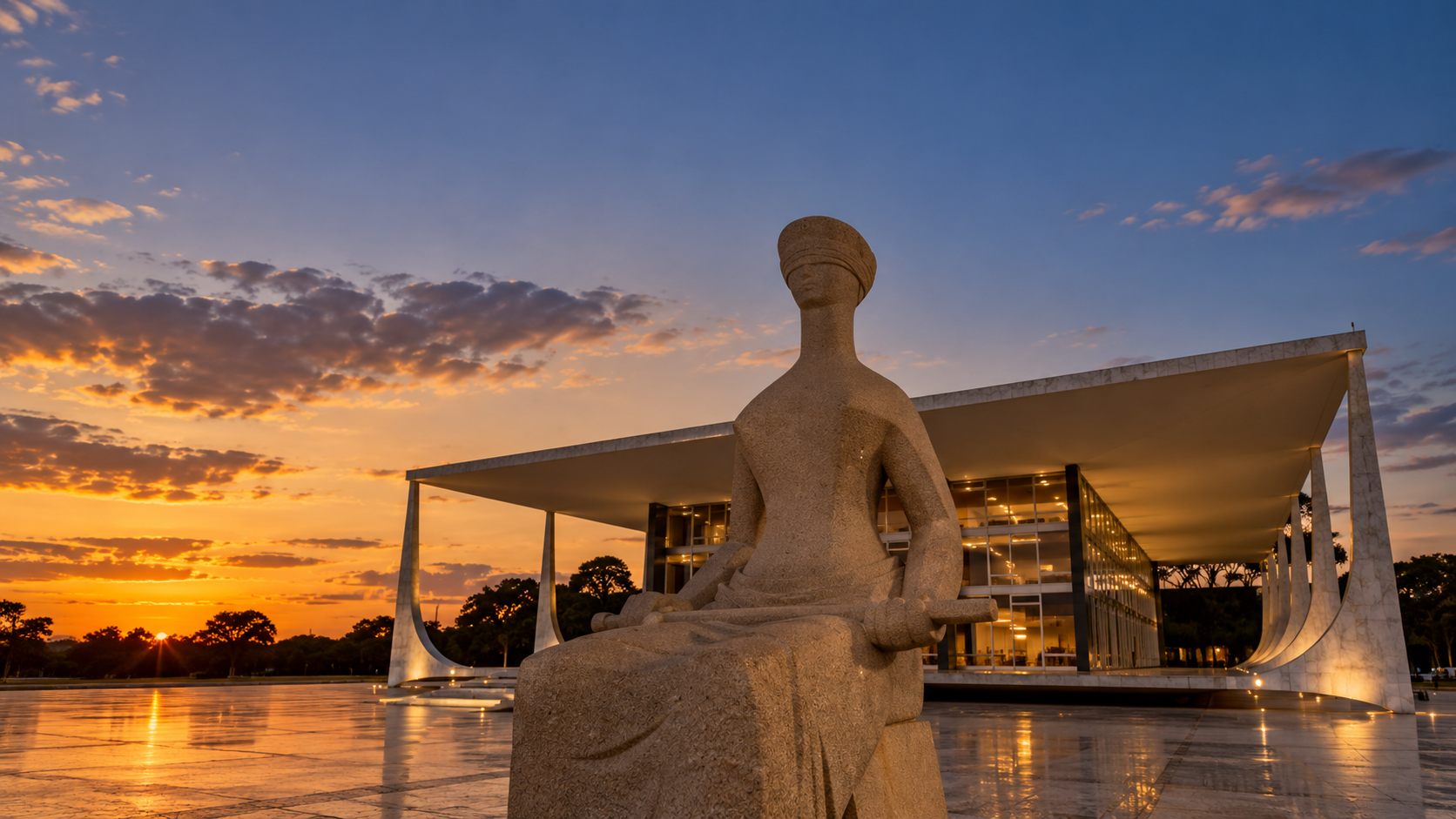
Less than a year later, the investigation has triggered what may be one of the most serious institutional crises ever faced by Brazil’s Supreme Federal Court, or STF — the country’s highest court.
Justices Alexandre de Moraes and André Mendonça are now openly challenging each other over the handling of the Master investigation. Attorney General Paulo Gonet has questioned the legality of parts of the probe. Federal Police chief Andrei Rodrigues has been drawn into the dispute. And Chief Justice Edson Fachin has opened a separate proceeding demanding explanations from all four.
Moraes, who was appointed to the Supreme Court by then-President Michel Temer in 2017, had previously held senior justice and public-security posts under São Paulo Governor Geraldo Alckmin — now Brazil’s vice president — before serving as Temer’s justice minister. Mendonça, a former justice minister under Jair Bolsonaro, was appointed to the Supreme Court by Bolsonaro in 2021.
The court is effectively being asked to determine whether one of its own justices should be investigated while simultaneously examining whether the justice who exposed the allegations exceeded his authority.
The dispute is no longer only about reputations. It could determine which evidence remains legally usable, who is allowed to oversee the investigation and whether parts of one of Brazil’s largest financial investigations in years survive procedural challenges.
And it is happening less than a month before the October 4 presidential election, with President Luiz Inácio Lula da Silva and Senator Flávio Bolsonaro now separated by just one percentage point in one major runoff poll.
From a bank failure to an institutional crisis
Banco Master was never one of Brazil’s largest banks. At the time of its liquidation, the Master conglomerate represented just 0.57% of total assets in Brazil’s financial system, according to the central bank. But its failure produced an extraordinarily large financial footprint.
Brazil’s deposit-guarantee fund, the FGC — a privately funded institution maintained by the banking industry — provisioned R$40.6 billion to compensate creditors of Banco Master, Master de Investimentos and Letsbank. About 800,000 investors were eligible for reimbursement. Including later failures and assistance involving other institutions connected to the episode, the FGC estimated a combined impact of about R$57.4 billion on its reserves.
The public-sector exposure made the story still more sensitive.
BRB, the bank controlled by the government of Brasília’s Federal District, acquired about R$12.2 billion in loan portfolios from Master that investigators say contained fraudulent or falsified credits. Brazil’s central bank has estimated a potential capital shortfall of as much as R$5 billion at BRB, whose last reported equity was roughly R$4.9 billion.
Public pension money was also involved. Investigators say RioPrevidência, which manages pensions for civil servants in Rio de Janeiro state, invested roughly R$3.7 billion in funds and financial instruments linked to Master. The STF later authorized searches as investigators sought to reconstruct how those investments were approved and whether public officials received improper benefits.
Master was therefore small in systemic banking terms but enormous in financial, political and institutional consequences. That distinction matters. The question is no longer simply how a relatively small bank failed. It is how its network of transactions came to involve a state-owned bank, public pension money, politicians, investment funds, senior officials — and eventually members of the Supreme Court itself.

Who investigates whom
For foreign investors, Brazil’s institutional structure adds another layer of complexity. The Federal Police, or PF, performs functions broadly comparable to a federal investigative agency. The Attorney General’s Office, or PGR, decides whether to bring certain criminal cases involving senior public officials. The Supreme Federal Court, meanwhile, is both Brazil’s constitutional court and the court of original jurisdiction for some of the country’s most senior authorities.
That means evidence involving a Supreme Court justice cannot necessarily be treated in the same way as evidence involving an ordinary suspect. André Mendonça became the rapporteur overseeing central parts of the Master investigation earlier this year.
The crisis exploded after Mendonça unsealed a Federal Police report containing material extracted from Vorcaro’s seized devices.The material included references to Alexandre de Moraes, one of the country’s most powerful and politically exposed judges.
Moraes became internationally known for overseeing investigations involving Bolsonaro and his allies following efforts to overturn the result of the 2022 presidential election. That made him an icon of institutional resistance to Bolsonaro’s supporters — and, simultaneously, their principal judicial antagonist.
Now Moraes himself is under scrutiny.

The Moraes problem
The most politically explosive issue concerns Vorcaro’s relationship with the law firm of Moraes’ wife, Viviane Barci de Moraes. A contract between Master and the firm was worth more than R$130 million, according to public reporting and material contained in the investigation. The new Federal Police material also suggests an unusual degree of personal access between Vorcaro and Moraes, including contacts in which the banker appears to have sought advice or assistance as pressure on Master intensified.
The material has raised suspicions that Moraes may have helped Vorcaro or discussed legal strategy with him. It also suggests the justice had knowledge of, and may have participated in revisions to, the contract involving his wife’s firm. But there is an important distinction between access, inference and proof of an official act.
The publicly available material does not yet conclusively establish that Moraes issued a judicial decision, pressured an investigator or exercised the authority of his office in return for money paid to the law firm. That distinction is central to the crisis.
Parts of the police analysis rely not on recovered, complete WhatsApp conversations but on inferences drawn from screenshots, timestamps and subsequent responses recorded on Vorcaro’s devices. The material discussed publicly shows circumstances suggesting that Vorcaro received replies, but not necessarily the full underlying exchange.
A separate legal analysis of the 218-page police document has also highlighted its own stated limitations. According to that review, the report says it was not exhaustive and notes that investigators had not at that stage conducted specific investigative acts directed at judges or prosecutors. The analysis also argues that much of the attribution of individual messages rests on technical inference rather than messages directly recovered in complete conversations.
That does not make the report irrelevant. Nor does it clear Moraes. It means the document should be read as an investigative analysis that may justify further inquiry, rather than as a judicial finding that misconduct has already been proved.
Moraes has not publicly admitted wrongdoing. His wife’s law firm has said its work was legitimate and that the contract ended with Master’s liquidation.
For the court, however, the reputational problem exists even before any criminal conclusion is reached: a banker at the center of a multibillion-real fraud investigation had a lucrative commercial relationship with the family of one of Brazil’s most powerful judges while apparently maintaining direct access to him.
The Mendonça problem
The difficulty for the STF is that questions now also surround the justice overseeing the investigation. Mendonça has acknowledged meeting Vorcaro once, in March 2025, before becoming rapporteur of the Master case. He said the meeting took place at the banker’s initiative and that he merely listened to what Vorcaro had to say.
That encounter has nevertheless become relevant as the relationship between Mendonça and the Federal Police leadership deteriorated and as he pushed investigators to examine material involving other senior authorities.
The situation escalated after Moraes submitted another Federal Police document to Chief Justice Fachin accusing Mendonça of directing investigations selectively and potentially using his position to pursue political or personal targets. But this second document has limitations of its own.
Public reporting describes it as an internal “scenario analysis,” with low confidence and “no evidentiary value.” It was not signed by a Federal Police delegate and contained a series of hypotheses about Mendonça’s handling of investigations.
Moraes nevertheless cited the document in asking Fachin to examine whether Mendonça may have committed abuse of authority, misconduct or a crime of responsibility. The result is an extraordinary institutional symmetry.
Mendonça is questioning whether Moraes improperly helped Vorcaro. Moraes is questioning whether Mendonça improperly manipulated the investigation designed to expose him.
Meanwhile, the Attorney General’s Office argues that Mendonça may have exceeded his authority by directing investigative steps involving officials with privileged jurisdiction without following the required procedure.
That is where the dispute becomes dangerous for the Master investigation itself.
How the probe could be derailed
The greatest risk is not that the entire Master case suddenly disappears. It is that pieces of evidence, investigative orders or entire branches of the inquiry become trapped in prolonged litigation over how they were obtained.
Brazilian law provides specific safeguards when investigators encounter evidence involving judges or other officials with special jurisdiction. Fachin has explicitly asked the Federal Police to explain whether those requirements were observed.
Gonet has challenged parts of Mendonça’s conduct and asked that the court consider invalidating investigative material or procedures that he argues exceeded the justice’s powers. Fachin has said those questions may ultimately need to be decided collectively by the full court.
That creates several potential legal battles. If a court finds that evidence involving a justice was obtained without proper authorization, defendants could seek to exclude it. If a justice is deemed conflicted or legally impeded, cases may need to be reassigned. If investigative steps are ruled invalid, defenses may challenge evidence subsequently derived from them.
None of those outcomes is automatic. But together they create precisely the kind of procedural uncertainty that can slow a complex financial investigation for years.
The irony is difficult to miss: an inquiry created to determine whether Vorcaro improperly influenced public institutions may itself now depend on those institutions proving that they investigated him properly.
PF and PGR are now part of the dispute
The conflict no longer stops with two justices. Attorney General Paulo Gonet and Federal Police Director-General Andrei Rodrigues are also mentioned in the underlying material.

Vorcaro appears in messages seeking help or access involving both men. But the evidence publicly disclosed so far does not establish that Rodrigues acted on those requests. Indeed, the Federal Police ultimately arrested Vorcaro and continued the investigation.
The same evidentiary distinction applies to Gonet. Social contacts and references in messages can be politically damaging without proving that the attorney general took an official action for the banker.
The dispute has nevertheless generated a fresh institutional conflict. An association representing Federal Police delegates has asked Gonet to recuse himself from proceedings concerning police conduct in parts of the Master investigation in which his own name appears.
Fachin has now requested formal written explanations from Moraes, Mendonça, Gonet and Rodrigues. His order stressed due process, the right to a defense and the need to avoid prejudging the accusations.
In other words, four of the most important actors responsible for investigating or judging the Master affair are now themselves being asked to explain their conduct.
The money trail is still the real story
While Brasília debates jurisdiction, procedure and judicial ethics, the original question has not gone away: Where did the money go?
That may ultimately matter more than the political war surrounding the investigation. One potentially important development is the cooperation of people linked to financial structures used by Master and Vorcaro. Investigators are trying to reconstruct flows through investment funds, companies and intermediaries that may show who ultimately received the economic benefits.
Part of that trail leads outside Brazil. Vorcaro financed Dark Horse, a film project about Jair Bolsonaro. Flávio Bolsonaro has acknowledged helping obtain financing for the production. A report from Brazil’s financial-intelligence unit, Coaf, subsequently identified an additional US$1.6 million payment in September 2025, after Flávio had publicly said Vorcaro’s financing had ended in May. The new transaction brought identified transfers associated with the project to at least US$12.3 million, or roughly R$65 million at the time.
Messages also raised the possibility of another payment in October. Investigators are examining a U.S.-based structure through which part of the money moved and are seeking greater visibility into the ultimate beneficiaries.
That is an important distinction. The existence of payments to the film project is documented. It does not by itself establish that Flávio Bolsonaro, Eduardo Bolsonaro or another family member personally received money improperly.
The film’s producer has said the funds were fully disclosed to the courts and were used for production. The unresolved issue is beneficial ownership and final use of the money. If investigators can obtain U.S. banking and corporate records, that part of the Master case could become far more consequential than the political speculation now surrounding it.
The Master scandal reaches the ballot box
All of this is unfolding at the most sensitive possible moment. Brazil votes for president on October 4. A Quaest poll released September 2 showed Lula with 37% in the first round, Flávio Bolsonaro with 30% and author and psychiatrist Augusto Cury with 10%. Renan Santos had 3%.
A Datafolha poll conducted on September 1 and 2 showed the same broad structure: Lula at 38%, Flávio at 33%, Cury at 8%, Ronaldo Caiado at 4%, Renan Santos at 3% and Romeu Zema at 2%.
The most important number, however, may be the runoff. Quaest found Lula at 42% and Flávio Bolsonaro at 41%, a technical tie within the survey’s two-percentage-point margin of error. Only a few weeks earlier, Lula had held a clearer lead.
Cury’s sudden rise adds another variable. He remains far behind the two leaders but has emerged as the main outlet for voters seeking an alternative to the Lula-Bolsonaro polarization. Caiado, Zema and Renan remain smaller candidates but could matter in the distribution of votes and endorsements in a runoff.
The Supreme Court crisis therefore arrives precisely as the presidential race becomes genuinely competitive.
How the same scandal can hurt — and help — Flávio Bolsonaro
For Flávio Bolsonaro, Master is a double-edged political risk. The direct risk is obvious. Vorcaro financed a project closely connected to the Bolsonaro family. Flávio participated in securing funding. Payments continued longer than he initially said publicly. And investigators are still examining the U.S. money trail.
His father, former President Jair Bolsonaro, is currently serving his sentence under house arrest after being convicted in the case over the attempted coup following the 2022 election.

That gives Lula’s campaign a straightforward argument: the leading opposition candidate has his own relationship with the banker at the center of the country’s biggest financial scandal in years. But the institutional crisis creates the opposite political effect.
Moraes has spent years at the center of the Bolsonaro movement’s narrative that Brazil’s Supreme Court abused its powers and used judicial investigations politically against the right. The allegations involving Vorcaro now allow Flávio to tell voters that the justice who oversaw the case that led to his father’s conviction
Flávio and other presidential candidates have already demanded action against Moraes. Zema, Caiado and Renan Santos have also used the scandal to attack the court or demand an investigation, while Cury has called for greater judicial accountability and institutional reform.
Thus, the very investigation that exposes Flávio’s ties to Vorcaro can simultaneously strengthen one of his most powerful political messages: that the Supreme Court itself needs to be checked. That is why the electoral impact is so difficult to predict.
Lula has a different problem
Lula is not facing the same direct financial exposure in the Master affair. His risk is institutional. The Supreme Court — and Moraes in particular — played a central role in the judicial response to the attempt to overturn Lula’s 2022 election victory and the January 8, 2023 attacks on Brazil’s democratic institutions.

For part of the electorate, that created an association between the court and the defense of democratic order. For another part, especially Bolsonaro supporters, it created an association between Moraes and political persecution. A scandal damaging the court’s credibility therefore weakens an institution that has been central to Brazil’s political balance over the past four years.
Lula has tried to keep some distance. He has publicly argued that everyone should be investigated and that no one should be protected, rather than offering a personal defense of Moraes. Reuters reported that people close to the president see distance from the justice as politically important.
That leaves Lula with his own dilemma. Defending Moraes too aggressively could make the president inherit the justice’s political liabilities. Remaining silent while the court is weakened could help an opposition movement that has spent years attacking the STF.
Fachin’s dilemma
The immediate burden now falls on Edson Fachin. As chief justice, he must protect the integrity of the court without appearing to protect individual justices. Investigating Moraes could further damage the STF and expose internal divisions that were once kept largely behind closed doors.

Refusing to investigate him could be worse. It could convince a large part of the country that Supreme Court justices operate under rules different from everyone else. Reuters described the dispute as potentially the most serious test of the court’s credibility since Brazil returned to democracy four decades ago. Fachin himself has said that circumstances surrounding both the judicial handling of the investigation and the underlying facts require institutional action “without haste.”
The court now has to do something exceptionally difficult: examine allegations against its own members while preserving the legitimacy of the investigation that produced those allegations.
The risk for Brazil
For foreign investors, the Master affair should no longer be understood merely as another episode in Brazil’s political polarization. There are now two overlapping crises.
The first is financial: determining how Master accumulated its liabilities, why suspicious credit portfolios were acquired by a state-controlled bank, how public pension funds became heavily exposed, and where money moved through a complex network of banks, funds and companies ultimately ended up.
The second is institutional: determining whether the Federal Police, the Attorney General’s Office and the Supreme Court can investigate that money trail according to rules strong enough to survive judicial scrutiny when people inside those same institutions appear in the evidence.
Each crisis makes the other harder to resolve. The closer investigators get to powerful officials, the greater the number of conflicts and procedural challenges. The more the institutions turn against one another, the greater the opportunity for defendants to attack the legality of the investigation.
And every new revelation now occurs in the middle of a presidential election in which Lula and Flávio Bolsonaro are effectively tied in a runoff. The most important risk is therefore not simply that a Supreme Court justice may be investigated, that one piece of evidence may be thrown out, or that one candidate may gain a few points in the polls.
It is that Brazil could reach the end of one of the largest financial scandals in its recent history without producing an institutional answer broadly regarded as legitimate about who did what, who benefited from the money and who should be held accountable.
The Banco Master investigation began as a test of financial supervision. It has become a test of the Supreme Court itself — and, weeks before Brazilians choose their next president, a test of whether the country can keep a criminal investigation separate from an increasingly bitter fight for political power.


Leave a Reply