
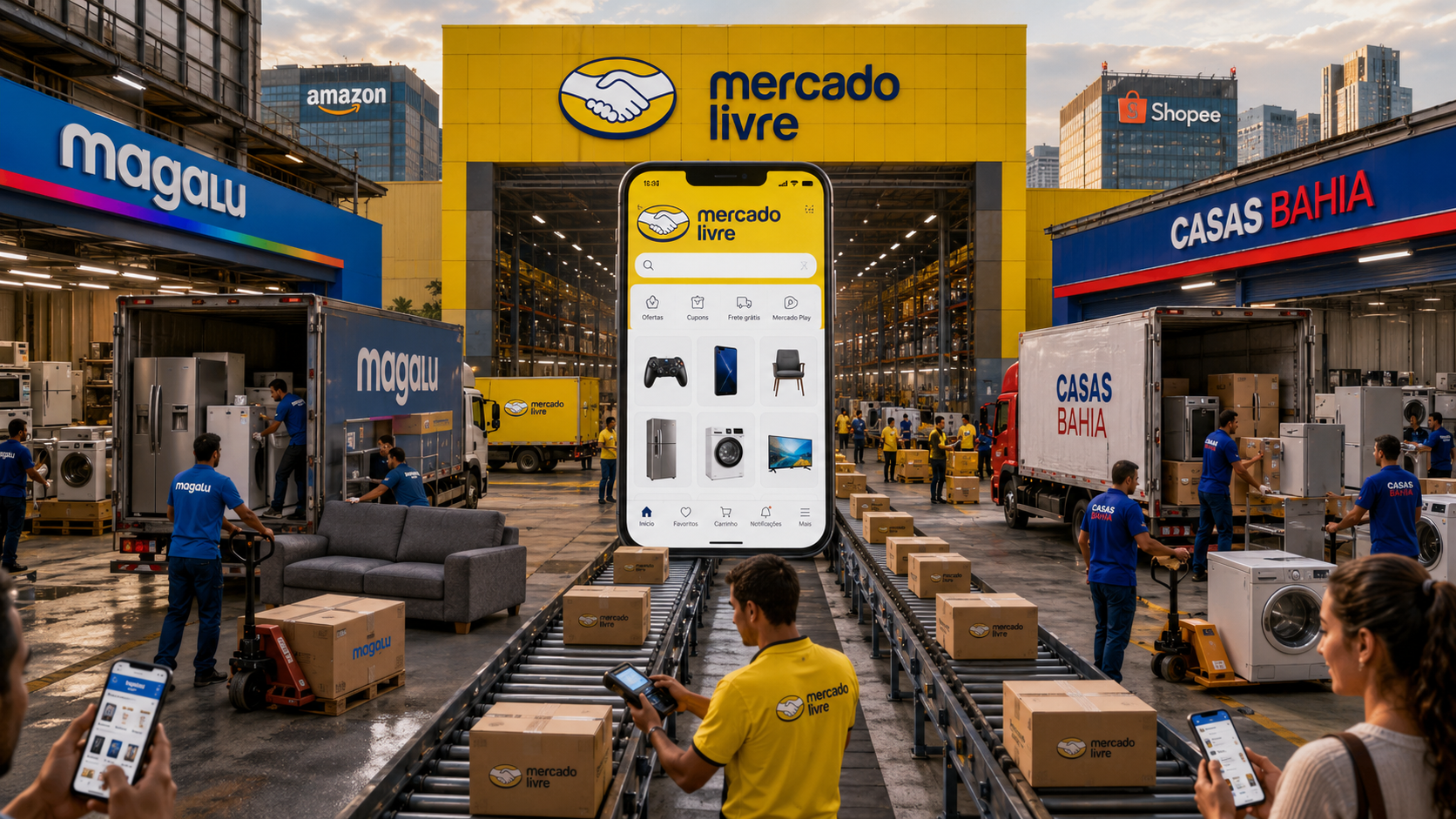
By Brazil Stock Guide – For years, Brazil’s largest traditional retailers spent heavily trying to build marketplaces capable of competing with Mercado Livre. Now they are increasingly selling inside it. Magazine Luiza (MGLU3) will start offering about 27,000 first-party products on Mercado Livre (MELI), including furniture, appliances, televisions, computers and smartphones, as well as merchandise from Época Cosméticos and KaBuM!. All deliveries will initially be handled by Magalu’s logistics arm, Magalog.
On the surface, it is another distribution agreement between two large retailers. But the deal points to a broader transformation in Brazilian e-commerce: power is increasingly shifting toward the platforms that control traffic and customer acquisition. Less than a year after Mercado Livre struck a similar partnership with Casas Bahia (BHIA3), Brazil’s dominant marketplace is becoming an increasingly important distribution channel for the same traditional retailers that spent much of the past decade trying to build competing digital ecosystems.
The numbers help explain the shift. Mercado Livre generated an estimated R$185 billion in marketplace GMV in Brazil in 2025, according to Retail Think Tank. Magazine Luiza ranked third, behind Shopee, with R$45 billion. That gap changes the economics of online retail. Inventory can be bought, warehouses can be built and delivery networks can be expanded. Audience is harder to replicate.
The marketplace becomes the mall
“The marketplace is increasingly becoming the digital equivalent of the shopping mall. The retailer may own the store, inventory and brand, but the mall owner controls the foot traffic”. says an analyst. “In Brazilian e-commerce, Mercado Livre, Amazon and Shopee increasingly occupy that position.”
The more consumers concentrate their shopping on a handful of platforms, the more important those platforms become to sellers. More sellers increase assortment and price competition, attracting more consumers and reinforcing the network effect. That creates an increasingly difficult question for traditional retailers: how much should they continue spending to bring consumers to their own websites when those consumers are already shopping somewhere else?
Magazine Luiza Chief Executive Frederico Trajano has been unusually explicit about the problem. He said audiences have become more fragmented while customer acquisition costs have risen amid greater competition between platforms. Magalu needs to regain scale online, which still represents roughly 70% of group revenue. The answer is increasingly to take Magalu’s inventory to the customer rather than paying to bring the customer back to Magalu.
A strategic reversal
That represents a significant change from the strategy pursued by Brazilian retailers during the e-commerce boom. Magalu, Casas Bahia, Americanas and others spent years building marketplaces, attracting third-party sellers and investing in technology and logistics in an effort to create broad digital ecosystems. The ambition was to become destinations rather than simply retailers.
That race now appears increasingly concentrated around a handful of platforms. Magalu itself has moved away from the ambition of being a generalist marketplace, focusing instead on specialized businesses such as Netshoes in sporting goods and KaBuM! in gaming and technology. At the same time, its own inventory is spreading across rival platforms. The company began expanding this strategy in 2024 through agreements with AliExpress, Itaú Shopping, Americanas and Livelo, and accelerated it in 2026 with Amazon and now Mercado Livre.
Growth without buying the customer
The urgency is visible in Magalu’s numbers. Physical-store sales rose 10.3% in the second quarter to R$5.1 billion, while e-commerce sales fell 11.9% to R$9.3 billion. Total sales declined 5.1% to R$14.5 billion. Magalu expects partnerships with Amazon and Mercado Livre to help return online operation to growth as early as the fourth quarter.
The Mercado Livre agreement attempts to solve problems. Magalu estimates that roughly three-quarters of customers buying its products through Mercado Livre will be new to the retailer, suggesting relatively low cannibalization. In practice, the company is paying Mercado Livre for access to consumers it believes it would otherwise have difficulty reaching economically.
There is also a financial advantage. Selling through partner platforms can improve Magalu’s financial-expense dynamics because the retailer will not necessarily be responsible for financing the end customer. That makes the trade-off increasingly attractive: Magalu gives up part of the economics associated with owning the customer relationship in exchange for greater reach and lower acquisition costs.
Casas Bahia was already there
Magazine Luiza is not the first Brazilian retail giant to make that calculation. Casas Bahia already has an agreement with Mercado Livre covering categories including furniture, and Mercado Livre said the partnership has been delivering good results even as Casas Bahia operates under judicial restructuring.
That precedent changes the significance of the Magalu deal. Mercado Livre is not simply recruiting more sellers; it is increasingly bringing Brazil’s traditional retail infrastructure into its own ecosystem.
The division of labor is becoming clearer. Mercado Livre does not necessarily need to own refrigerators, sofas or televisions, nor build every logistics capability required to move them across Brazil. It can own something potentially more valuable: the customer’s starting point.
Amazon is in the race
Amazon is pursuing a similar strategy. Three months before the Mercado Livre deal, Magalu began taking its inventory to Amazon, and that relationship is also becoming more integrated. From October, Magalog is expected to make deliveries of third-party merchandise sold on Amazon, while Amazon will begin treating Magalu’s inventory more like its own stock, offering benefits including shorter delivery times and greater priority in the platform’s buy box.
Amazon is therefore hardly standing still. But Mercado Livre appears to occupy a stronger position in the current reorganization of Brazilian retail. It already has Magalu and Casas Bahia inside its ecosystem and dominates the marketplace market by estimated GMV.
The stores could be next
The most interesting part of the Magalu agreement may still be ahead. The companies are discussing allowing Mercado Livre customers to use Magalu stores as pickup and return points and are also considering using Magalog to deliver products sold by third parties on Mercado Livre, particularly bulky goods transported by road.
If that happens, the reversal becomes even more striking. Physical stores, distribution centers and delivery infrastructure once viewed as Magalu’s competitive advantage against digital rivals could become part of the infrastructure supporting Mercado Livre itself.
Magalog is already moving in that direction. About 30% of its revenue is now generated outside the Magalu ecosystem, with customers including Samsung, O Boticário, Renner and even Centauro, one of Netshoes’ main competitors.
None of this necessarily means Brazilian retail itself will consolidate into three or four companies. Thousands of retailers, brands and sellers will continue competing. What is becoming more concentrated are the gateways to the consumer.
That distinction matters. Competition among retailers can remain fierce even as a shrinking number of platforms control search, traffic, customer acquisition, payments and product discovery. The retailer may still decide what to sell and at what price, but the marketplace increasingly decides which customer sees it.
Over time, that can shift bargaining power toward the platform — over commissions, advertising, visibility, promotions, customer data and ultimately margins. But the alternative may be even more expensive: continuing to spend heavily to attract consumers to independent digital properties that lack the same scale and frequency.


Leave a Reply