
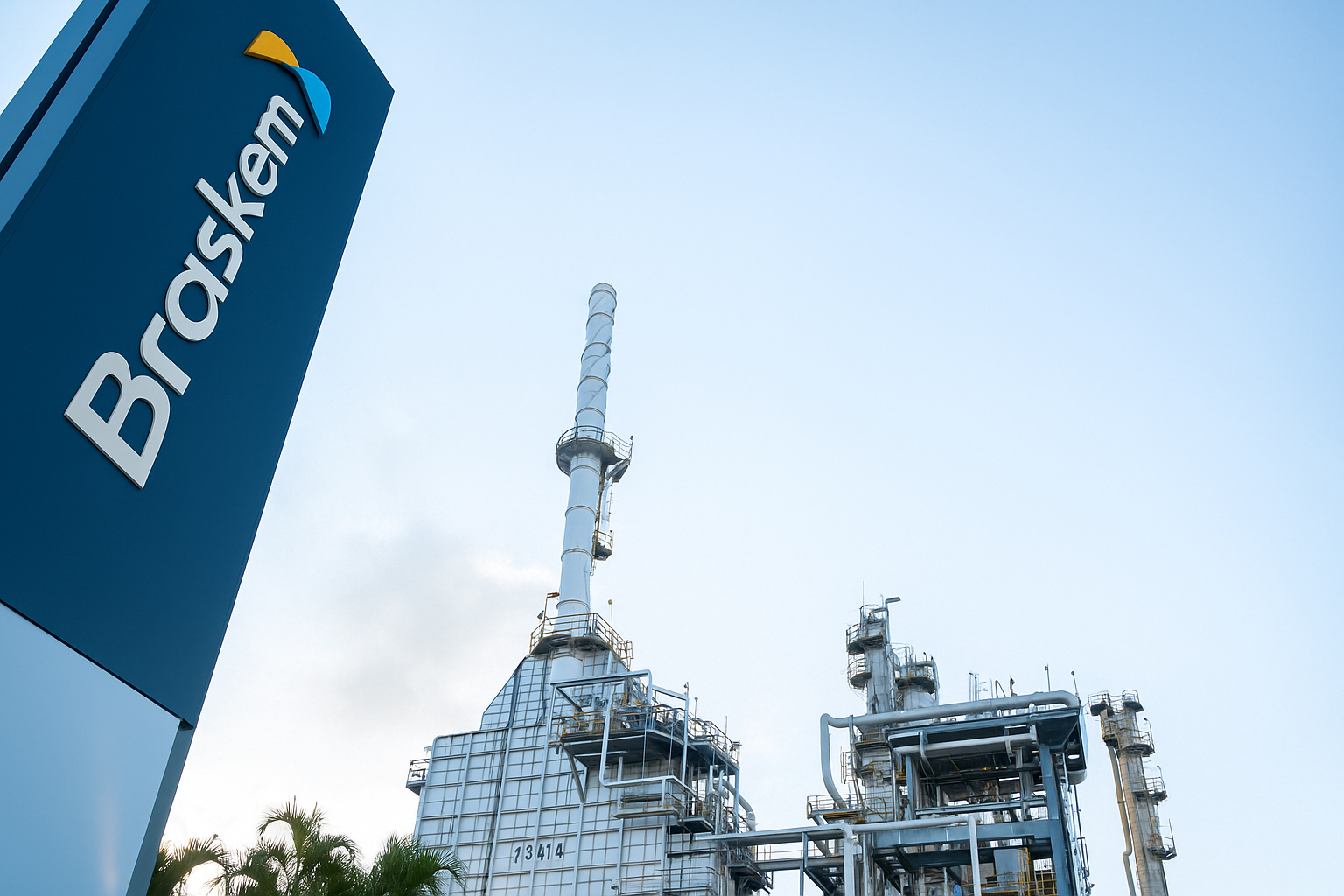
By Brazil Stock Guide – Braskem SA (B3: BRKM5; NYSE: BAK) has entered a decisive phase of its financial restructuring, launching mediation with creditors and seeking court protection in São Paulo as it races to renegotiate its capital structure before facing US$3.69 billion in debt service – about R$20.3 billion at current exchange rates – through the end of 2027.
The Latin American petrochemical producer also lifted the curtain on previously confidential restructuring materials shared with an ad hoc group of creditors. The documents reveal a proposal built around extending debt maturities while avoiding principal haircuts, debt-to-equity swaps and immediate new-money financing. Braskem said suppliers, customers and other commercial obligations remain outside the restructuring process.
The company said it “remains fully committed to continuing discussions with its financial creditors in search of a consensual, comprehensive and orderly solution for its capital structure.”
The restructuring comes only weeks after Braskem’s ownership changed hands. Investment firm IG4 Capital replaced Novonor as co-controlling shareholder alongside Petrobras (B3: PETR4; NYSE: PBR), inheriting one of the industry’s most complex balance-sheet challenges. The debt overhaul has now become the first major test of the company’s new control structure.
Debt Wall Arrives Before Industry Recovery
The restructuring is driven by timing. According to the documents, Braskem expects US$3.686 billion in debt service between July 2026 and December 2027. About US$1.646 billion relates to bilateral loans and export credit agencies, US$1.274 billion to working-capital facilities, and US$766 million to bonds, debentures and agribusiness receivables certificates (CRAs).
The pressure starts quickly. Debt service reaches US$878 million in the third quarter of 2026 alone, including US$572 million in working-capital facilities, US$188 million in bonds and debentures, and US$118 million in bilateral and export-credit debt.
The largest maturity arrives in January 2028, when approximately US$1.33 billion falls due, largely tied to Braskem’s 2028 bond.
To avoid that refinancing cliff, the company has sought precautionary court protection while conducting mediation before the Wind Mediation Chamber. The filing was made with São Paulo’s Second Bankruptcy and Corporate Restructuring Court.
No Haircuts, No Equity Conversion
Braskem’s proposal departs from the traditional restructuring playbook. Management is asking creditors to support an out-of-court restructuring under Brazilian law while preserving equal treatment among unsecured financial creditors. The company also proposes maintaining key working-capital facilities, avoiding additional collateral over fixed assets, preserving the unsecured status of existing debt, and implementing the transaction without principal haircuts, debt-for-equity swaps or immediate capital injections.
The structure matters for every stakeholder. Shareholders avoid immediate dilution. Bondholders and banks preserve the face value of their claims. In return, creditors would be asked to grant additional time while betting that the global petrochemical cycle improves.
That is the central argument behind Braskem’s proposal. Management is effectively telling creditors that the company faces a maturity mismatch rather than a structural operating problem.
Internal projections assume petrochemical spreads gradually recover through 2035, supporting higher EBITDA, stronger margins and improving cash generation. Net revenue is projected to increase from US$12.3 billion in 2025 to US$20.7 billion by 2035, while EBITDA rises from US$500 million to US$3 billion over the same period.
Braskem, however, cautions that these projections are not formal guidance. They were prepared exclusively for restructuring discussions and depend on assumptions regarding commodity spreads, feedstock prices, operating costs, utilization rates and market conditions.
The plan also includes roughly US$900 million of strategic capital expenditure between 2026 and 2030, largely associated with the Transforma Rio project, which is expected to add 220,000 metric tons (242,500 short tons) of annual ethylene capacity beginning in 2029.
Creditors Have Yet to Sign Off
The newly released documents also reveal negotiations have been difficult. Braskem and creditors signed confidentiality agreements on June 11 and subsequently exchanged restructuring proposals while holding in-person meetings. The company asked creditors to prioritize negotiations under the protection of an out-of-court restructuring process and requested a rapid response.
According to Braskem, creditors replied six business days later with terms the company considered unacceptable, prompting management to reject the proposal. That leaves negotiations at a critical stage.
Braskem wants an orderly restructuring that preserves operations and shareholder value. Creditors, meanwhile, may seek stronger protections, higher compensation or additional safeguards before agreeing to extend maturities. For now, the immediate beneficiaries are the company itself, which gains negotiating time, and suppliers and customers, whose contracts remain unaffected by the process.
The greatest uncertainty falls on financial creditors. They must decide whether extending maturities offers greater long-term value than demanding a more aggressive restructuring while the global petrochemical industry remains under pressure. The outcome will determine not only Braskem’s financial future but also the first major strategic decision under its new ownership structure led jointly by IG4 Capital and Petrobras.


Leave a Reply