
By Rodrigo Uchoa, special for Brazil Stock Guide
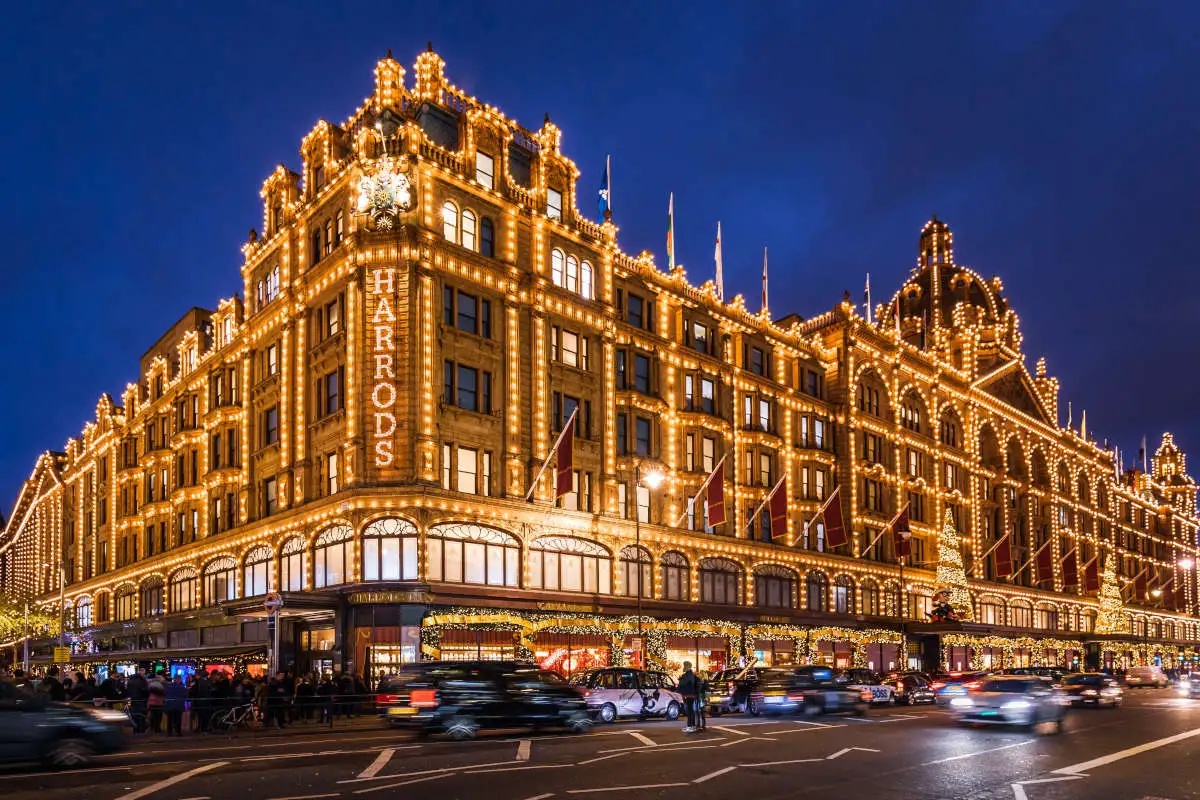
Anyone walking through the ground floor of Harrods in Knightsbridge today is greeted by what looks like a building site disguised as a boutique. Panels of black marble streaked with gold sit alongside velvet-draped scaffolding, while sales associates weave between Dior displays and elegant “coming soon” signs set in serif typefaces.
The store is in the midst of the most ambitious refurbishment in its nearly 180-year history: a Womenswear Masterplan that has already transformed the lingerie hall, expanded dedicated spaces for brands such as Schiaparelli, Fendi, Celine and Loro Piana, and is now unveiling the new International Designer Rooms by David Collins Studio. The layout is designed to guide customers from the escalators towards Dior’s frontage almost without them realising they are being guided at all. The materials tell their own story: marble, black granite, bronze, brass, and a chandelier made up of 900 pieces of hand-blown glass developed with the studio of Dale Chihuly.
For Harrods, the effort appears to be paying off. Its latest accounts showed a profit of £84.9 million on revenues of £1.08 billion, a remarkable turnaround after the previous year’s loss, which was still weighed down by costs related to the scandals surrounding former owner Mohamed Al-Fayed.
The crowd milling about the store is, in a quick and not entirely unkind sketch, a mixture of Asian tourists who arrived in London with empty suitcases and fully expect to pay excess baggage charges on the way home; Gulf executives buying birthday gifts that cost more than a family car; and middle-aged British couples who have come primarily to take tea at The Georgian and spend an afternoon pretending the Empire never quite disappeared. Occasionally, there may even be a Brazilian journalist on a work trip, paying more attention to the surroundings than the merchandise while feigning interest in a cashmere scarf.

No one is really there just to shop. Even those spending extravagantly seem to treat the products as supporting actors rather than the main attraction.
Harrods is not alone in this balancing act of survival in an era of next-day delivery and frictionless online retail. It is simply the most visible member of a small club of historic department stores that continue to thrive while the category around them steadily crumbles. Selfridges, El Corte Inglés, Isetan, Galeries Lafayette, Le Bon Marché and Liberty London have each chosen a different strategy to avoid becoming museum pieces.
Galeries Lafayette has invested heavily in culture and sustainability, launching its circular-fashion initiative Le Nouveau Cool while renovating stores outside Paris, including a major expansion in Lyon. El Corte Inglés has effectively decided to become far more than a retailer. Today it sells insurance, travel services and telecommunications, while replacing conventional hypermarkets with gourmet food halls.
The strategy pursued by Galeries Lafayette and El Corte Inglés is one of expansion and diversification. Yet there is an opposing theory. Some of the world’s most resilient department stores, including Harrods, Liberty London and Le Bon Marché, have never moved beyond their original flagship addresses. By contrast, Barneys eventually expanded to 22 stores before collapsing in 2019. It is a provocative idea: perhaps the secret of survival is not scale, but relentless reinvestment in a single location until it becomes almost synonymous with the city itself.
To understand why these stores still occupy such a powerful place in the public imagination, it helps to return to the moment they were invented. The department store was not simply a retail format. It was a nineteenth-century social technology, every bit as disruptive in its time as e-commerce has been in ours.
In 1852, Aristide and Marguerite Boucicaut transformed a modest fabric shop on Rue de Sèvres in Paris into Le Bon Marché. Almost everything we now take for granted in modern retail was pioneered there: fixed prices, returns policies, home delivery, free entry without any obligation to buy and seasonal sales.
Before that, shopping meant bargaining, negotiating and engaging directly with a salesperson. Le Bon Marché employed just twelve people in 1852. By 1877, it employed nearly 1,800 and generated more than 73 million francs in annual revenue.

Harrods began life as a grocer in 1849. Selfridges followed in 1909, founded by an American entrepreneur determined to teach Londoners to shop “for pleasure rather than necessity”. Isetan opened in Japan in 1886, Galeries Lafayette in 1894.
At heart, they were all selling the same thing: access.
For the first time, the emerging middle classes of the industrial age could enter spaces previously reserved for the aristocracy. They could touch silk, sit in reading rooms, take tea and, if they wished, leave without buying a thing.
The problem is that this model, large, generalist, organised into countless departments and dependent on foot traffic, has been overtaken by the internet, which introduced a retail system that was often cheaper, faster and more convenient.
In the United States, the number of department stores fell from 7,885 in 2015 to a projected 4,678 in 2025, a contraction of more than 40 per cent in a decade. IBISWorld estimates that the sector continues to shrink modestly, despite generating roughly US$223 billion in revenue. Coresight Research projects approximately 7,900 retail store closures across the United States this year alone. UBS estimates that more than 40,000 physical stores could disappear over the next decade.

The casualties continue to mount. Hudson’s Bay, the Canadian icon founded in 1670, before the United States even existed, liquidated its operations in 2025. Saks Global, owner of Saks Fifth Avenue, Neiman Marcus and Bergdorf Goodman, sought bankruptcy protection in early 2026. Macy’s is still in the process of closing 150 stores under a restructuring programme known, with unintentional poetry, as Bold New Chapter.
And what about Brazil?
Anyone over forty from São Paulo or Rio is likely to remember Mappin or Mesbla as symbols of Christmas shopping: brightly lit display windows, crowded lifts and attendants calling out each floor as the doors opened.
Mappin was founded in 1913, inspired by British department stores, and was famous enough to serve afternoon tea in fine Chinese porcelain. Mesbla, founded a year earlier, eventually grew to 180 stores and 28,000 employees at its peak during the 1980s, becoming a fixture in dozens of Brazilian cities.

Both collapsed in 1999 after a saga worthy of a television drama. There were billions in debt, rescue promises and, at the centre of it all, businessman Ricardo Mansur, who acquired both companies claiming he would save them, only to sink alongside them. In a twist almost too neat to be true, the Mesbla brand returned in 2022 as an e-commerce marketplace.
Today, we shop online because it is quick, inexpensive and free from judgement. Yet we fly to London and happily pay for the privilege of being judged by a sharply dressed sales assistant sizing us up from the top of a marble staircase. We spend small fortunes to experience the elegant inefficiency of travelling six floors to buy a bottle of perfume that could have been ordered from a phone in seconds.
As for me, I did eventually buy that cashmere scarf at Harrods. I returned home perfectly content, fully aware that, living in the tropics, I would have precious few occasions to wear it.


Leave a Reply