
By Rodrigo Uchoa, special for Brazil Stock Guide
The MoMA Design Store in Tokyo has something of the feel of an Apple Store. In a bright, minimalist setting, modular displays showcase around 2,000 products selected by curators from New York’s Museum of Modern Art, bringing objects that embody the institution’s design principles to a wider audience.
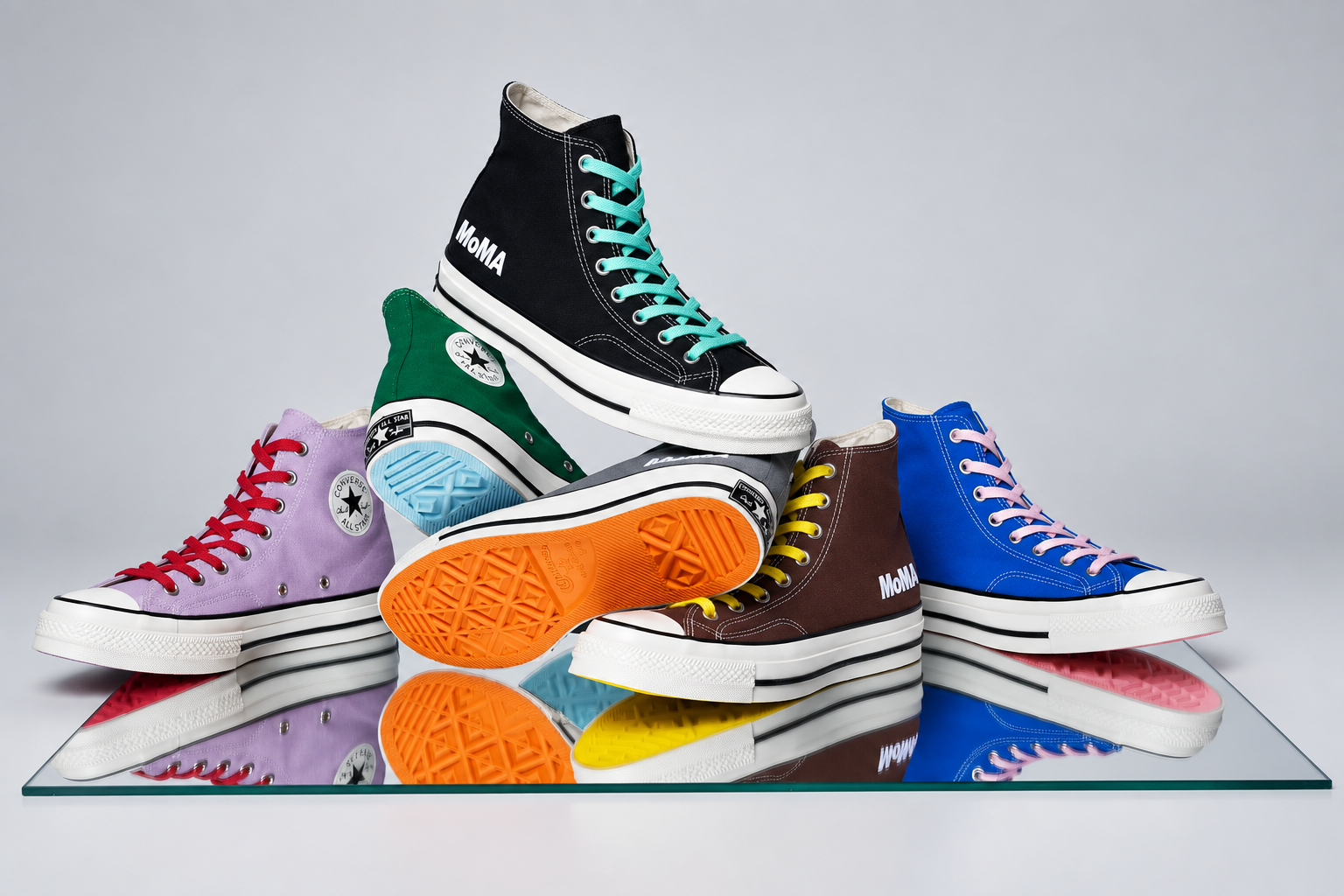
The shop occupies the third floor of GYRE, a landmark building in one of Tokyo’s most fashionable districts, where a visitor can wander from the Bulgari Café to Comme des Garçons or Maison Margiela. In March, the store began selling six versions of a high-top Converse All Star, in forest green, chocolate brown, lavender, royal blue, stone grey and black, made with recycled cotton uppers and featuring a discreet “MoMA” logo embroidered on the heel. The price: ¥15,400 (US$98).

The shoes are sold only in Japan because Converse, acquired by Nike in 2003, does not own the rights to the brand there. Those belong to Itochu, a trading house founded in 1858 by a linen merchant. Itochu acquired the Japanese rights when the American Converse filed for bankruptcy in 2001 and established Converse Japan the following year. The same Itochu also holds interests in iron-ore mines in Australia, Canada and Brazil.
Itochu is a sogo shosha, a term that roughly translates as “general trading company”. For decades these firms stood at the heart of Japanese capitalism. Over time, however, they came to be viewed as relics of a fading era. In recent years they have attracted renewed investor interest, just as hyper-specialisation appeared to have become one of capitalism’s unquestioned doctrines.
Five sogo shosha dominate the Japanese landscape: Mitsubishi, Mitsui, Itochu, Sumitomo and Marubeni. They were originally created to secure the raw materials Japan lacked and to market the goods it produced abroad. Their influence became so great that the American occupation authorities ordered the dissolution of Mitsui and Mitsubishi in 1947, although both re-emerged in the following decade.

By the 1970s, however, the cult of specialisation was taking hold. By the late 1990s, observers were openly debating when the trading houses would disappear. According to UNCTAD, their share of Japan’s foreign trade fell by around 40 percentage points over two decades. In Western markets, they became subject to the so-called conglomerate discount, with investors often valuing them at 13 to 15 per cent less than the sum of their constituent businesses. The prevailing fashion was to break up groups that insisted on doing everything. In the United States, General Electric, whose activities ranged from light bulbs to aircraft engines, completed its own dismantling only recently, in 2024.
The trading houses survived by reinventing themselves. Increasingly, they came to present themselves as business investors rather than traders. Masami Iijima, during his tenure as president of Mitsui, once compared them to private-equity funds, albeit with one decisive advantage: the constant flow of information passing through their networks.
Warren Buffett took the opposite side of the consensus that predicted the demise of conglomerates and began building stakes in all five major trading houses before the start of this decade. Berkshire Hathaway, based in Omaha, Nebraska, now owns more than 10 per cent of each. At the end of 2025, those holdings were worth US$35.4 billion. Speaking in Tokyo in September, Buffett’s designated successor, Greg Abel, said Berkshire intended to hold them “for many decades”. In August, Nikkei Asia reported a historic milestone: the trading houses had finally shaken off the valuation discount that still burdens many diversified groups.

Within Itochu, Converse is only a modest line within the textiles division. The trading house owns the brand rights in Japan, oversees its positioning and licenses Converse Japan. It is a brand royalty business judged by the same criteria as a mining operation: return on capital and dividend generation. In the most recent fiscal year, Itochu reported record profits of ¥900 billion and a return on equity approaching 16 per cent. Masahiro Okafuji, the company’s chief executive, praised Berkshire in September for not second-guessing what the trading houses do.
Japan’s interest-rate environment has also helped. For decades, rates hovered near zero, making long-term investments considerably easier to finance. Berkshire itself has funded part of its wager through yen-denominated bond issues.
By contrast, it is hard not to imagine the reaction if Vale were to announce the acquisition of a trainer brand. Bank analysts would be leaping from their chairs, demanding to know where the synergies lay and pressing management for strategic explanations. The shares would likely fall before the coffee had gone cold. This is, of course, entirely hypothetical. Vale currently follows the opposite playbook. In 2022, it sold the Corumbá mining operations to J&F, the controlling shareholder of JBS, in a US$1.2 billion transaction designed to simplify the portfolio and sharpen the company’s focus on its core business.
Brazil once attempted to foster tropical versions of the sogo shosha. A 1972 decree regulated trading companies, and under President Ernesto Geisel, Petrobras created Interbras, which exchanged manufactured goods, frozen chicken and sugar for Iraqi oil. The company was abolished by President Fernando Collor in March 1990.
To be sure, Brazil is hardly lacking in diversified groups today. The closest equivalent to a trading house may be J&F, whose interests span meatpacking, pulp production, digital banking, energy, cosmetics and the mining assets acquired from Vale. Yet the logic is different: this is the model of an operating owner, often highly leveraged, who buys, develops and ultimately sells assets when circumstances require.

Alpargatas, owner of the Havaianas brand, was acquired from Camargo Corrêa in 2015 for R$2.7 billion and sold two years later to Itaúsa and the Moreira Salles family for R$3.5 billion, helping fund debt repayments and a R$10.3 billion leniency settlement.
The company that comes closest to the idea of a permanent capital allocator is Votorantim, which describes itself as a “permanently capitalised” holding company. It ended 2025 with nearly R$8 billion in cash and no debt, sold interests in CBA to Chinalco and Rio Tinto, and increased its stake in Hypera to 11 per cent. Yet cement, zinc and orange juice remain a long way from appearing in the window of a fashionable Tokyo concept store.
The simplest explanation for the absence of a Brazilian sogo shosha may lie in interest rates. With Brazil’s benchmark Selic rate hovering around 14 per cent, fixed-income investments offer returns that make patience a scarce commodity. Investors demand focus, not sprawling portfolios.
There is also a deeper structural explanation. Japan’s trading houses emerged because the country needed institutions capable of coordinating global supply chains, importing raw materials and exporting manufactured products. Brazil faces the opposite reality. The country is rich in commodities and consequently home to specialised champions such as Vale, Suzano and JBS, all of which can access global markets directly without relying on intermediaries.

For those who believe corporate focus is sometimes overrated, or who simply have a weakness for Converse trainers, there is always the option of visiting Tokyo to buy a MoMA All Star, knowing that a tiny fraction of the money spent will eventually find its way into a dividend cheque heading for Omaha.


Leave a Reply