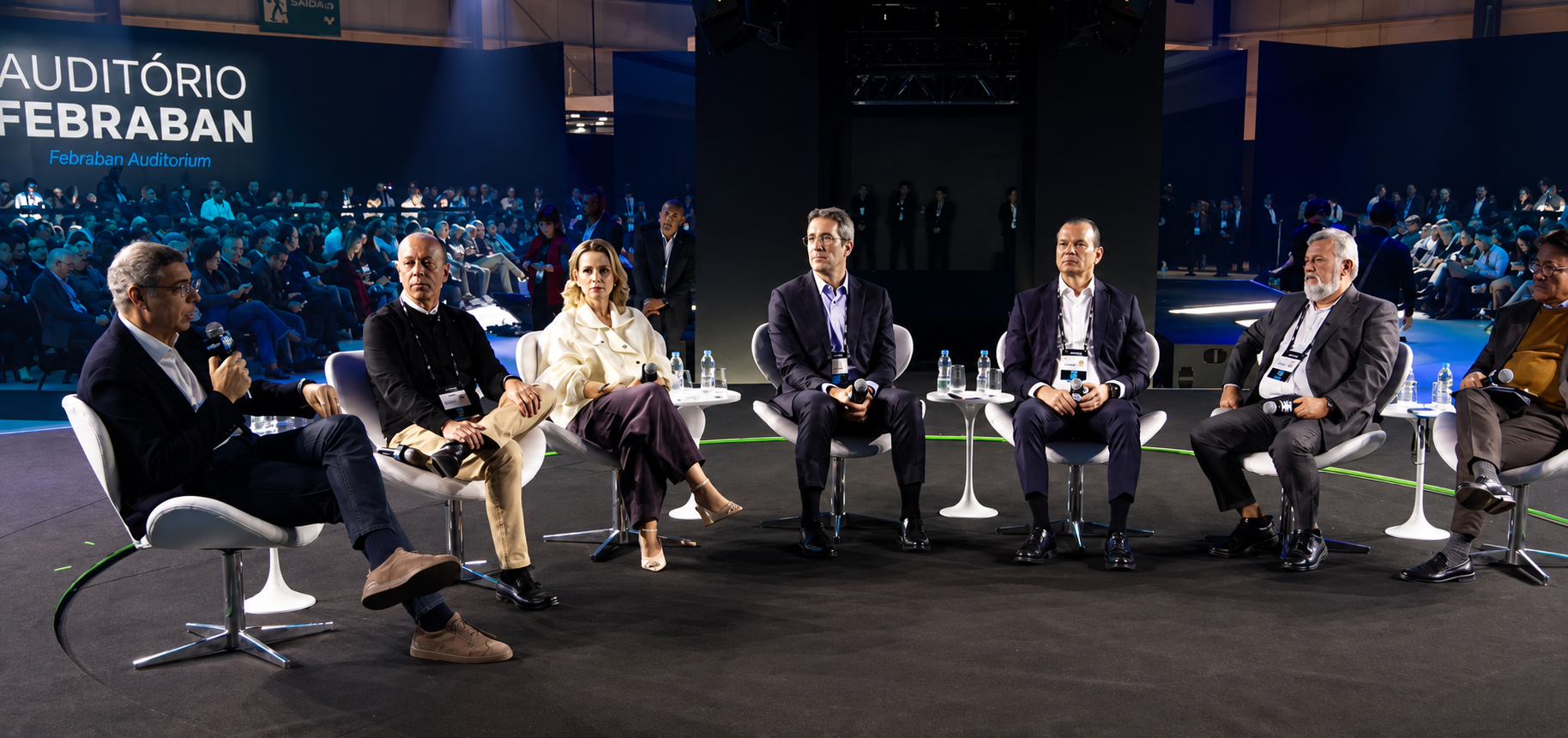
By Brazil Stock Guide — A panel that was supposed to focus mainly on artificial intelligence and the future of banking ended up offering something more revealing: a snapshot of how the leaders of Brazil’s financial system see the country that will emerge from the 2026 elections.
Gathered at Febraban Tech, the heads of Itaú Unibanco, Bradesco, BTG Pactual, Santander Brasil, Nubank and state-owned Caixa Econômica Federal offered different views of the road ahead. But once the discussion shifted from technology to the economy, an unusual degree of consensus emerged.
To varying degrees, nearly all of them pointed to public debt, the cost of capital, productivity and the need for a longer-term economic strategy. They also shared a concern about a more challenging global environment: structurally higher interest rates, geopolitical tensions, intensifying competition for capital and a technological revolution that could widen the gap between countries able to invest and those constrained by domestic imbalances.
Milton Maluhy Filho — CEO of Itaú Unibanco
Maluhy delivered one of the panel’s toughest assessments of Brazil’s fiscal outlook. In his view, the debate too often focuses on the level of interest rates rather than on the forces keeping those rates high.
“Interest rates are the symptom, not the cause,” he said.
The Itaú CEO said Brazil’s debt burden is likely to rise by about 12 percentage points over four years and described the current trajectory as unsustainable. He also argued that the fiscal debate should move beyond the primary balance and pay greater attention to the overall, or nominal, deficit — particularly with public debt at roughly R$10 trillion and borrowing costs still exceptionally high.
Maluhy also rejected the common assumption that high interest rates are necessarily good for banks. Credit remains banks’ core product, he said, and an excessively restrictive environment pushes up defaults, reduces lending and ultimately weakens the broader economy.
Looking toward the next political cycle, he called for a change in the quality of the electoral debate. Instead of polarization, Brazil should be discussing an economic plan, education, healthcare, productivity and international competitiveness.
“That should be the agenda for the next cycle,” he said.
Marcelo Noronha — CEO of Bradesco
Noronha broadly echoed Maluhy’s diagnosis, but added numbers to the discussion.
The Bradesco CEO said public debt is approaching 82% of GDP and that the bank’s economics team had identified a series of measures capable of producing a meaningful fiscal adjustment.
According to Noronha, nine potential measures could add up to roughly R$250 billion. Adding other initiatives could bring the total to around R$580 billion, or close to 5% of GDP.
He did not spell out the measures during the panel, and said the government would not necessarily need to implement all of them. Brazil could choose a subset. The real obstacle, in his view, is political.
“There has to be political will to do it,” Noronha said.
He also issued a direct challenge to presidential candidates, saying he wants to hear from the candidates themselves — “not their advisers” — about what they intend to do with fiscal policy and the debt trajectory from 2027 through 2030.
For Noronha, Brazil has viable options. What is missing is a credible plan to turn the fiscal diagnosis into government policy.
Roberto Sallouti — CEO of BTG Pactual
Sallouti widened the lens. In his view, Brazil’s challenge is not simply to fix its own fiscal problems, but to recognize that the global environment in which the country competes has fundamentally changed.
“The geopolitical world we have known since the early 1990s no longer exists,” he said.
The era of exceptionally low interest rates that followed the 2008 financial crisis is also over, he argued. At the same time, the artificial-intelligence investment boom is creating a new global race for capital, infrastructure and technology.
Against that backdrop, Sallouti sees three priorities for Brazil: lowering the cost of capital, improving security — public, legal and tax-related — and raising productivity.
The BTG CEO said Brazil should aim for long-term borrowing costs roughly 150 to 200 basis points above U.S. rates. Today, he said, the spread is closer to 500 to 550 basis points.
He also criticized Brazil’s tax uncertainty and pointed to neighboring countries that offer investors long-term guarantees on tax treatment.
The third challenge may be the hardest. With demographics no longer providing a reliable engine for potential GDP growth, Brazil will have to expand through productivity gains — driven by education, technology, infrastructure and investment.
Sallouti laid out three different timelines: fiscal problems could be addressed in roughly one year; security-related issues in four or five years; and productivity would require a 10- to 15-year effort.
“As a nation, we need to have that project,” he said.
Gilson Finkelsztain — CEO of Santander Brasil
Finkelsztain began with the global picture and arrived at a similar conclusion.
The Santander Brasil CEO sees little chance that geopolitical tensions will ease significantly over the next few years. Competition over technology, data, pharmaceuticals, innovation and economic influence is likely to continue generating friction among countries.
At the same time, fiscal expansion around the world is pushing up the cost of money even in economies that spent years with interest rates near zero.
The result, he said, will be more intense competition for capital.
That makes Brazil’s domestic challenges even more urgent. In a benign international environment, the country might have some room to postpone reforms. In a world of higher rates, geopolitical tension and tougher competition for investment, that room is disappearing.
“We have to do twice the homework,” Finkelsztain said.
Brazil’s domestic agenda, he added, will require “twice the effort to put the house in order, because the world is more complex.”
Lívia Chanes — CEO, Nubank Latin America
Chanes offered a somewhat different perspective.
While the executives from the more traditional banks focused heavily on fiscal policy and the cost of capital, the Nubank executive put volatility at the center of the discussion.
With nearly 140 million customers across Latin America and preparations under way for an entry into the U.S. market, Nubank increasingly views Brazil through a broader global lens.
For Chanes, the world has entered a phase in which economic, political and technological instability will be a permanent feature of the business environment.
“Nothing is very stable,” she said.
The answer, in her view, cannot depend solely on waiting for the macroeconomic environment to become more predictable. Companies will also need to build more resilient business models that can adapt quickly to shocks.
She agreed that economic fundamentals need to improve, but added a corporate dimension to the debate: in a structurally volatile world, adaptability itself will become a competitive advantage.
Carlos Vieira — President of Caixa Econômica Federal
Vieira presented the view closest to the government and placed greater emphasis on investment and Brazil’s development potential.
The head of state-owned Caixa said both the Finance Ministry and the presidency are concerned with fiscal balance, but also with productivity and job creation.
Vieira highlighted the assets Brazil already has at its disposal: vast mineral resources, a favorable energy mix and human capital. The challenge, he said, is to turn those advantages into investment and productivity.
He cited the construction sector as an example of how financing, private-sector capabilities and public policy can work together to create scale.
Vieira also pointed to the federal government’s real-estate portfolio as a potential source of monetization and investment, citing roughly 790,000 properties and a potential value of as much as R$2 trillion. The figures were mentioned during the panel without further detail.
His message was less focused on fiscal correction itself and more on Brazil’s ability to mobilize assets, credit and investment to generate growth.
An Unusual Consensus
There are important differences among the six executives. Caixa emphasizes investment. Nubank focuses on resilience. Santander looks at the global backdrop. BTG combines fiscal discipline, institutional security and productivity. Bradesco wants concrete proposals from presidential candidates. Itaú puts the debt trajectory at the center of the problem.
Yet taken together, their remarks point to something unusual ahead of a presidential election: the upper ranks of Brazil’s banking industry appear to agree on much of the diagnosis, even if they differ on where the emphasis should fall.
Brazil is entering its next political cycle with less room to rely on a benign global backdrop. Capital is more expensive. Competition for investment has intensified. Artificial intelligence is unleashing a new wave of spending and productivity gains. And countries with persistent fiscal imbalances tend to pay a higher price to finance both their governments and their companies.
Sallouti perhaps offered the clearest summary of the choice ahead:
“Thinking that the same playbook of recent years will work in the years ahead — it won’t.”


Leave a Reply