
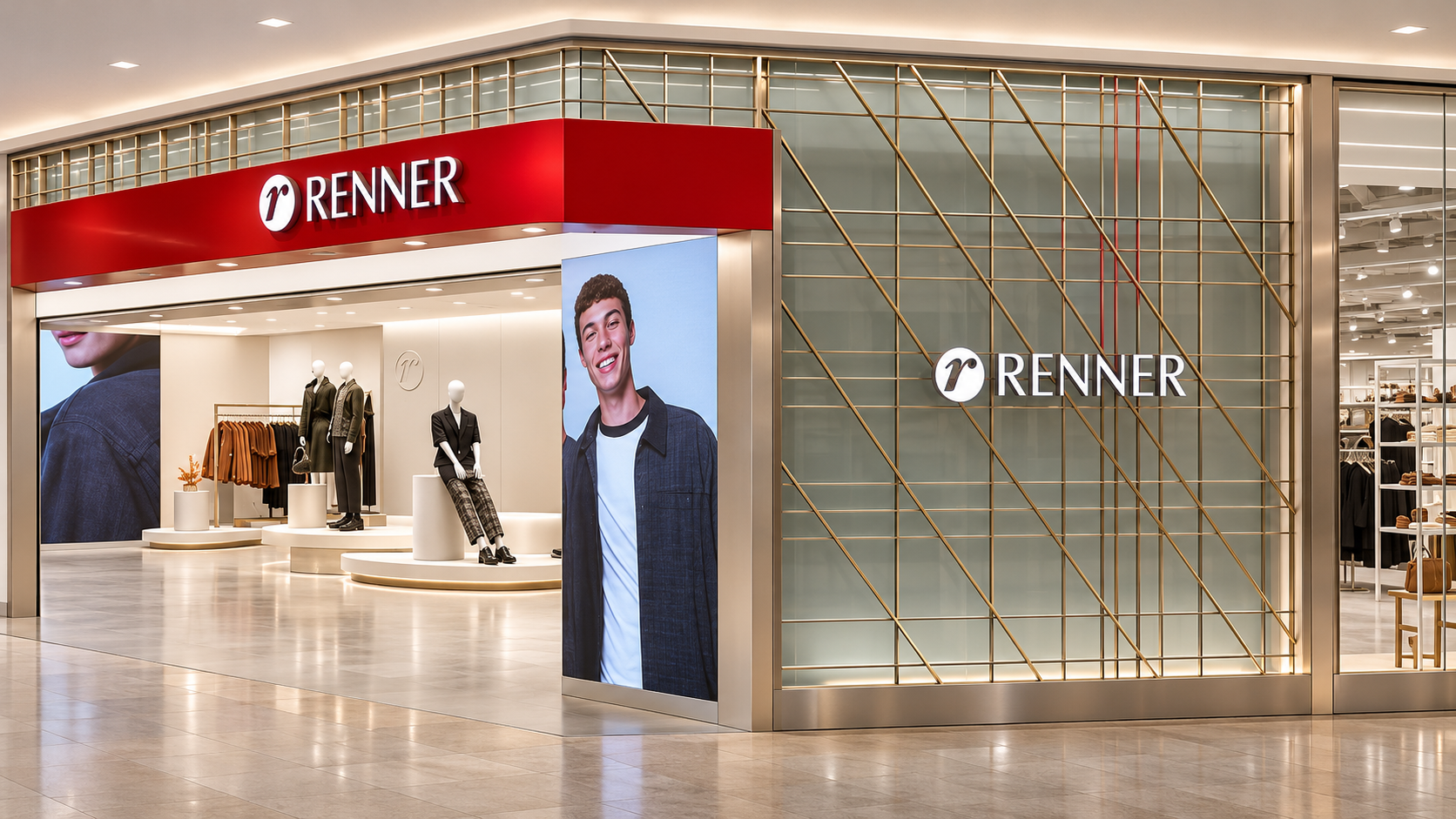
By Brazil Stock Guide — Lojas Renner (B3: LREN3), one of Brazil’s largest fashion retailers, said on Thursday (November 5) it was withdrawing its revenue growth forecasts for 2026 and the 2027–2030 period, citing weaker consumer demand and intensifying competition from international e-commerce platforms. The announcement came as the company reported comparable net income of R$187.1 million in the third quarter of 2026, down 24.5% from a year earlier.
Reported net income fell 11.8% to R$246.4 million, while net retail revenue declined 1.6% to R$3.03 billion. Same-store sales dropped 2.5%, reversing the 3.1% growth recorded a year earlier. Total adjusted EBITDA decreased 3.9% to R$570.9 million, with the margin narrowing to 18.8% from 19.3% in the third quarter of 2025.
In a regulatory filing released alongside its quarterly results, Renner said its decision to withdraw the forecasts reflected growing macroeconomic uncertainty and regulatory changes affecting the retail sector. The revenue growth targets were originally announced in December 2025 and revised for 2026 in August.
The company partly attributed its difficulties to competition from international e-commerce platforms, whose expansion, according to Renner’s earnings report, has benefited from federal tax incentives granted to cross-border online retailers since May 2026. Renner also pointed to heightened consumer price sensitivity amid high interest rates and elevated household debt.
In his message to investors, Chief Executive Fabio Faccio said demand had gradually recovered during the quarter, but at a slower pace than anticipated. The company observed stronger demand for basic, versatile and more affordable products, prompting adjustments to its merchandise assortment and pricing strategy.
Despite declining sales, Renner’s retail gross margin reached 55.5%, a record for a third quarter and an increase of 0.4 percentage points year over year. Operational efficiency gains and favorable currency movements more than offset the impact of heavier promotions. Retail EBITDA rose 3.2% to R$530.3 million.
Earnings at Realize, the company’s financial services division, fell 49% to R$40.7 million. Net credit losses increased 13% to R$297.5 million, reflecting a more challenging environment for consumers. Renner said, however, that delinquency indicators remained under control.
Online sales outperformed physical stores, with digital gross merchandise value (GMV) rising 3.7% to R$705.1 million. Digital channels accounted for 17.5% of total retail sales, up from 16.7% a year earlier. The company also expanded its use of artificial intelligence in product recommendations, visual searches and virtual fitting rooms, while pursuing social commerce initiatives through TikTok Shop.
Profitability and Expansion Targets Remain Unchanged
Although Renner withdrew its revenue growth forecasts, it maintained its profitability and expansion targets through 2030. The company continues to target a retail EBITDA margin of 18% to 20%, before the accounting effects of IFRS 16 lease rules, and a return on invested capital (ROIC) of approximately 20% by the end of the decade.
Renner also reaffirmed its goal of operating between 570 and 600 Renner stores in Brazil and 260 to 290 Youcom stores by 2030. For 2026, it maintained its R$1.05 billion capital expenditure plan and its target of opening 50 to 60 stores across its brands.
The company ended September with approximately R$2 billion in cash and a net cash position of R$1.2 billion. Quarterly free cash flow totaled R$423.4 million, down 10.6% year over year. ROIC over the trailing 12 months reached 14.8%, an improvement of 0.4 percentage points.
The decision to withdraw revenue growth guidance through 2030 marks a significant shift in the company’s outlook. While Renner remains confident in its ability to improve profitability and expand its store network, management acknowledges that the pace of sales growth has become increasingly difficult to predict. For investors, the central question is whether efficiency gains can offset weak consumer demand and mounting competition in Brazil’s fashion retail market.


Leave a Reply