

By Rodrigo Uchoa, special to Brazil Stock Guide
Walking the shops of Pinheiros is one of those quintessential São Paulo pastimes that appeals to locals and tourists alike. And while this winter of our discontent has yet to be made glorious summer by a tropical sun of York, several shoes displayed along Cônego Eugênio Leite and Mateus Grou streets stand out for the historical and cultural arcs they carry.
Consider the Wallabee and Desert Trek, both featuring rows of tiny stitches tracing the outline of Brazil across their suede uppers. Could those beige pairs still be found? They came from a collaboration between Clarks Originals and Rio de Janeiro-based Carnan — the British brand’s first Latin American partnership — unveiled in a campaign featuring rapper Marcelo D2 and model Luiza Machado.
The answer is no. They are sold out.

A few blocks away, another gleaming white shop window displays the second piece of this theatrical plot. It is unmistakably Dr. Martens, but surrounded by relatives no one in 1960 could have imagined: a laceless, backless mule resembling an uncertain cross between Birkenstocks and Crocs, yet bearing the traditional yellow welt stitching as its birth certificate.
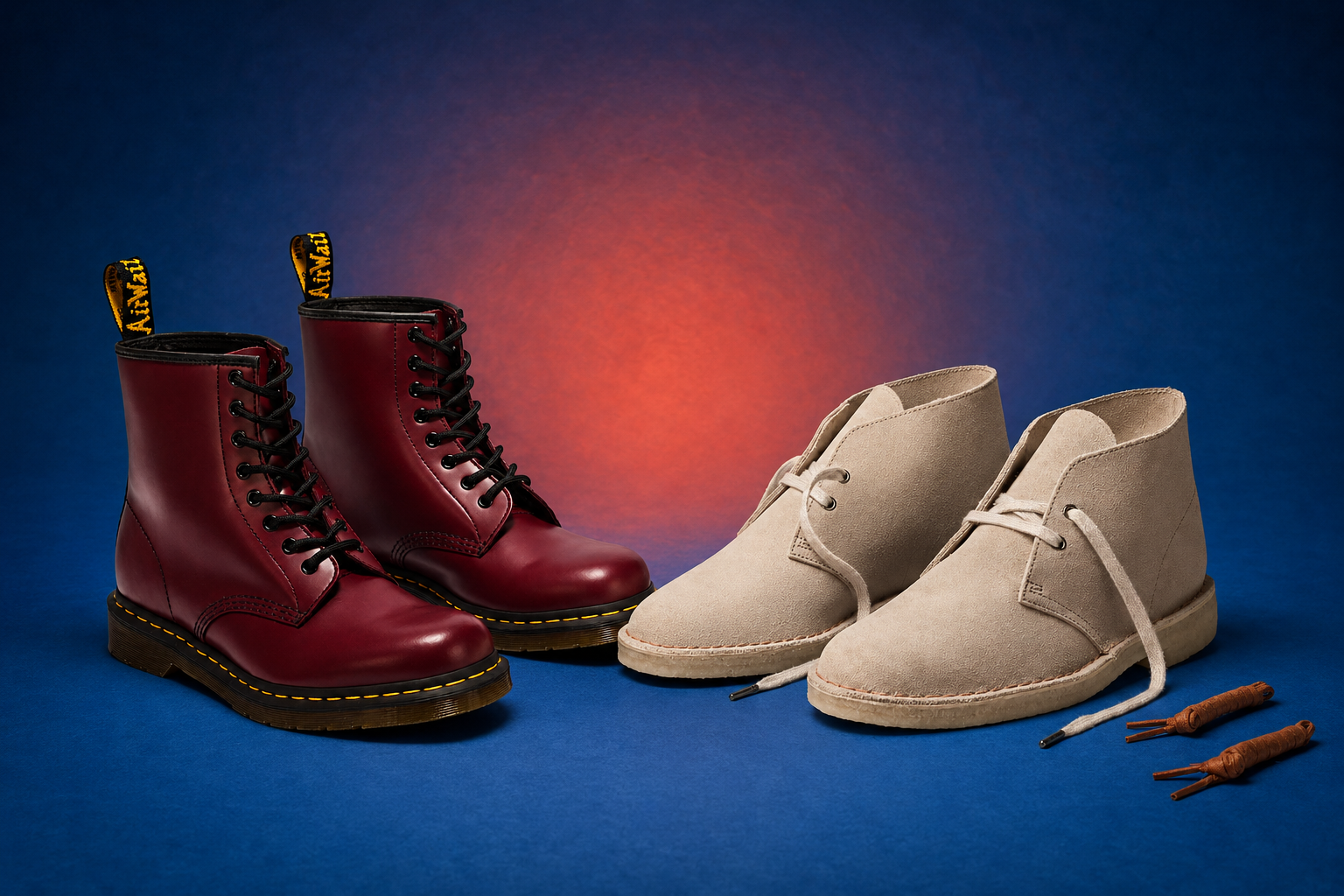
The two displays encapsulate a phenomenon that connects Clarks and Dr. Martens. Both emerged from practical needs — one inspired by the shoes British officers wore during their downtime, the other designed to provide comfort and durability to postwar workers.
Today, they compete for shelf space with streetwear brands and luxury sportswear labels, decades after each underwent a second incarnation as the uniform of a subculture.
To understand how Clarks arrived there, however, one must return to the model that began its transformation into a cultural icon.
The Desert Boot was born out of an officer’s boredom. Nathan Clark, an heir to the Somerset shoemaking family, was serving with the British Army in Burma when he noticed fellow officers wearing rough suede boots during their time off. The shoes were inspired by footwear sold in Cairo’s bazaars.
Clark brought the idea home, and in 1950 it became a product: crepe sole, two eyelets, no pretensions.
The boot became fashionable almost by accident. It was first embraced by beatniks and jazz musicians in the 1950s and later by London’s mod scene, paired with sharply tailored suits and a soundtrack of American soul and R&B.
But it was in Jamaica during the 1960s and 1970s that the Desert Boot acquired its most enduring meaning. Rude boys adopted it, along with other Clarks models, as a symbol of urban sophistication. As reggae and dancehall carried that aesthetic abroad, they took the brand with them. Bob Marley was among its most celebrated wearers, helping turn Clarks’ suede shoes into part of the visual vocabulary of Jamaican music.

The origins of Dr. Martens were even more accidental. Klaus Märtens, a doctor in the German Army, injured his foot while skiing in 1945. Frustrated by the rigidity of military boots, he developed an air-cushioned sole for his own use.
The invention became a patent and then a business. It later crossed the English Channel after the Griggs family acquired the British manufacturing rights.
The 1460 was born on April 1, 1960 — its name is simply the date of its debut. Initially adopted by postal workers, police officers and factory workers who needed comfort and durability, the boot was claimed by skinheads in the late 1960s and by punks in the following decade.
Sid Vicious helped turn it into something close to a logo. Goths followed, and later the grunge and riot grrrl scenes. Each subculture rewrote the meaning of the same yellow stitching — quite an achievement for footwear born from an orthopedic need.

Both models, of course, went through purgatory. From the late 2000s through the middle of the following decade, the Desert Boot and the 1460 were pushed into the “dad shoe” drawer: comfortable, respectable and hopelessly dull.
Their resurrection came through the same door that has returned so many aging products to contemporary desire: streetwear and collaborations.
Who Owns Them Now
This is where the story loses some of its romance.
Clarks entered a severe crisis in 2020, when the pandemic compounded problems that had accumulated over several years, including inventory-management failures and difficulty adapting the business to digital retail.
The Clark family ultimately accepted a £ 100 million investment from LionRock Capital. Completed in 2021, the transaction funded the company’s restructuring and helped avert the collapse of a brand founded almost two centuries earlier.
LionRock took control, and Hong Kong-based Viva China Holdings — now known as Viva Goods — subsequently acquired LionRock’s investment vehicle, giving it an effective 51% interest in Clarks. The Clark family remained a minority shareholder but relinquished control of the company bearing its name.
Dr. Martens followed the opposite and more conspicuous path. It went public on the London Stock Exchange in January 2021 at a valuation of £ 3.7 billion.
The celebration did not last. Its shares lost roughly 80% of their value over the following years, punished by operational failures, excess inventory, distribution problems in the United States and slowing demand.

The brand nevertheless continues to sell at enormous scale. In the financial year ended March 2026, volumes declined 2.5% to 10.2 million pairs. Revenue fell 2.9% to £ 764.9 million, while adjusted profit before tax rose 61% to £ 55 million.
The company became a paradox for investors: a culturally ubiquitous brand that, for years, proved unable to translate its relevance into shareholder value.
Meanwhile, both brands continue collecting collaborations as if they were postage stamps.
In 2026 alone, Dr. Martens partnered with Supreme on the Postal Supreme, as well as with Metallica and Verdy’s Japanese label Wasted Youth. Clarks joined forces with Danish brand NN.07 to revisit the Wallabee and Desert Boot in premium leather, while Japan’s MASU presented a hand-painted Desert Boot at a pop-up in Sendai.
And then, of course, there was the collaboration with Brazil’s Carnan.
The Price of Nostalgia
In Brazil, where every imported shoe carries taxes as surely as it carries a sole, a pair of original Dr. Martens 1460 boots typically costs between R$ 1,200 and R$ 2,500.
That is an enormous range, but it says more about exchange rates, taxes and logistics than it does about the product itself.
The now sold-out Carnan x Clarks pairs were released as a limited edition starting at R$ 2,399 — equivalent to approximately US$ 440 at the time.
In the end, the shop windows of Pinheiros reveal an irony neither brand could have planned. Shoes inspired by military, orthopedic and industrial needs now survive by selling, above all, anemoia — nostalgia for a time one never lived through.
As for me, I slipped on my Wallabees and continued walking around Pinheiros as though I were wandering through Camden, the spiritual home of Dr. Martens.
More Weekend Reads
Looking for more stories beyond earnings, markets and breaking news? Explore our latest essays on history, design, culture and economics.
The Price — and the Value — of Inefficiency
For a century, Germans and Japanese taught the world how to make things faster, better, and more efficiently. Now they charge a premium to make them slowly, sparingly, and imperfectly.
Read the story →
https://brazilstockguide.com/insights/the-price-and-value-of-inefficiency/
The Priests of Amun Go to the Opera
As opera companies struggle with financial pressure, aging institutions, and the search for new audiences, the art form keeps reinventing itself—only to discover that its greatest obstacle to change may be its own public.
Read the story →
https://brazilstockguide.com/insights/the-priests-of-amun-go-to-the-opera/
The Other Shore of the Mediterranean
From the Atlas Mountains to the Bekaa Valley, winegrowing endures amid wars, hostile governments, and an increasingly unforgiving climate—and struggles to redraw the wine map.
Read the story →
https://brazilstockguide.com/insights/the-other-shore-of-the-mediterranean/
The Octagonal Watch Case
How Gérald Genta’s Royal Oak and Kikuo Ibe’s G-Shock turned the octagonal case into two very different symbols of design, status and resilience.
Read the story →
https://brazilstockguide.com/insights/octagonal-watch-design-genta-ibe-royal-oak-gshock/


Leave a Reply