By Rodrigo Uchoa, special for Brazil Stock Guide
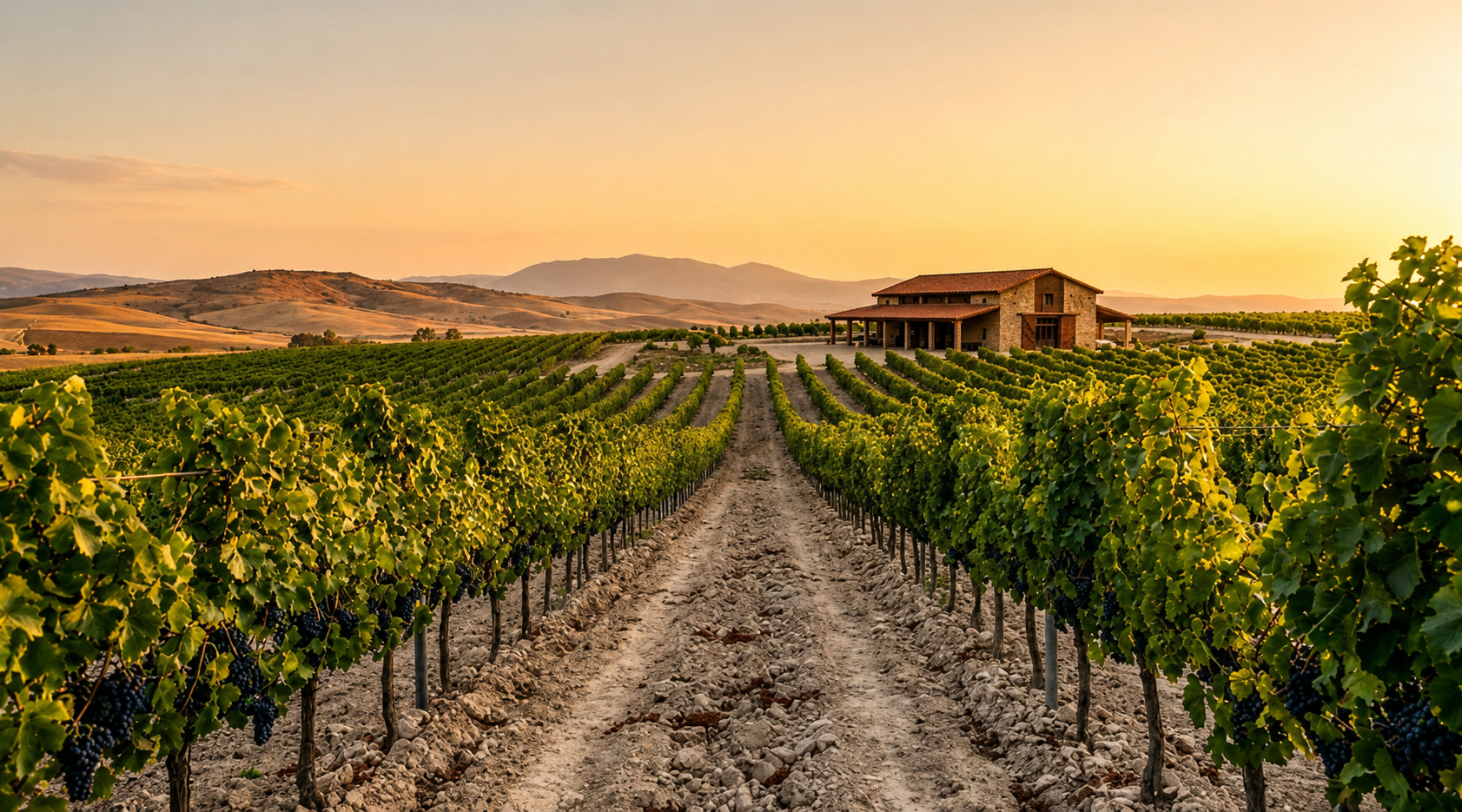
Seen from the north, the Mediterranean’s vineyards seem to end where Europe ends: in Provence, on the slopes of Sicily, across Spain, and throughout the Greek islands. Yet on the southern shore of the same sea, along the arc stretching from Morocco’s Atlas Mountains to Syria’s coastal ranges, vines have been cultivated for longer than in any French appellation. It was the Phoenicians, sailing from what is now Lebanon, who carried the vine to Carthage—present-day Tunisia—and onward to the Iberian Peninsula.
Today, this other side of the Mediterranean produces wine under conditions that few European winemakers would recognize as normal: punitive fiscal and social policies, recurring wars, and domestic markets where most of the population does not drink alcohol. Yet it continues to produce wine. In some cases, it strives to produce it better than ever.
Back in 2013, Valor Econômico reported some of the first surprises emerging from wines made in Islamic countries (in an article I wrote following a trip to the region). The curiosity sparked by seeing two national football teams face off at the World Cup—France, the Mediterranean’s traditional wine frontier, and Morocco, its emerging frontier on the opposite shore of the Mare Nostrum—prompted me, thirteen years later, to revisit the region and take stock of what has happened around the Mediterranean basin. In the end, this may read as a study of how geography and geopolitics shape an industry.
The Atlas as a Climatic Frontier

Morocco is the region’s clearest success story. The country produces between 30 and 40 million bottles annually and has overtaken Algeria as Africa’s second-largest wine producer, behind only South Africa.
Geography helps explain why. Roughly 60% of production is concentrated around the Meknès plateau and the Saïss Plain, between 500 and 800 meters above sea level, sheltered by the Zerhoun massif and cooled by Atlantic influences from the west. It was here that French settlers during the protectorate period (1912–1956) planted Rhône Valley varieties such as Carignan, Cinsault, Syrah, and Grenache. It is also here that a single group, Celliers de Meknès—founded by Brahim Zniber—controls about 85% of the market, with Château Roslane serving as its flagship estate.
Morocco’s monarchy maintains a pragmatic arrangement: although the law prohibits the sale of alcohol to Muslims, the state collects billions of dirhams in taxes from alcoholic beverages and tourism. The principal threat to Moroccan winegrowing comes not from politics but from the sky. Consecutive years of drought have pushed producers such as Villa Volubilia to plant vineyards at ever higher elevations.
The region’s embrace of gris wines—pale rosés made largely from Cinsault—has aligned perfectly with global consumer tastes over the past decade and become a valuable export asset. A Brazilian wine enthusiast once dismissed the wine as “not even fit for punch,” but American consumers have proven far more receptive, helping sustain demand.
The contrast with Algeria is striking. In the 1930s, the departments of Oran, Mascara, and Tlemcen made French Algeria the world’s largest wine exporter. Independence in 1962 drove away both settlers and customers; nationalization completed the decline. A country that once boasted 350,000 hectares of vineyards barely registers in OIV statistics today.
Tunisia, with its Muscats from Cap Bon, survives modestly on the back of coastal tourism, while Egypt’s irrigated vineyards in the Nile Delta mainly satisfy the curiosity of tourists visiting Red Sea resorts.

Anatolia: Geological Potential, Political Ceiling
No country in the region has more to gain—or lose—than Turkey.
Anatolia is one of the cradles of vine domestication and preserves hundreds of native grape varieties, from Öküzgözü in Elazığ in the east to Kalecik Karası near Ankara, as well as vineyards planted at 1,700 meters above sea level along the shores of Lake Van.
The country’s diversity of terroirs is remarkable, spanning Thrace, the central Anatolian plateau, and the volcanic slopes of Cappadocia. This variety supports between 140 and 200 licensed wineries, which together have accumulated more than a thousand international awards.
The ceiling, however, is political.

Since coming to power in 2002, the AKP government has turned wine into a prime target of its moralizing agenda. Advertising has been banned since 2013, online sales are prohibited, special taxes have risen faster than inflation, and since 2023 producers have faced financial guarantee requirements that disproportionately burden small wineries—the very segment driving Turkey’s quality renaissance.
Per-capita consumption remains below one liter per year. Even displaying a bottle on social media can constitute an offense in Turkey.
The result is an industry mature enough to compete internationally, yet constrained by a state that effectively acts as a non-tariff barrier to its own producers.
One winery I visited in 2013, Gali, on the Gallipoli Peninsula, had pinned its hopes on Bordeaux-style blends. At the time, its wines were promising rather than impressive. Unfortunately, recent reports in the specialized wine press suggest that the overall quality of Turkish wines has not progressed as much as many observers once expected.
The Levant: Viticulture in a War Zone
If the Maghreb illustrates the weight of climate and Anatolia the weight of the state, the Levant shows wine reduced to its most elemental challenge: survival.
The Bekaa Valley, nestled at roughly 1,000 meters between mountain ranges, managed to continue harvesting grapes throughout Lebanon’s civil war from 1975 to 1990. That achievement helped make Château Musar a global icon, now managed by the third generation of the Hochar family.
Between 2023 and 2024, history echoed once again. Israeli strikes targeting Hezbollah positions hit the plain, damaging wineries and vineyards. Even so, the industry bottled around 15 million bottles in 2024, and exports are already recovering.
Further north lies perhaps the region’s ultimate case study: Syria.
Domaine de Bargylus, owned by the Saadé brothers, occupies the slopes of Jabal al-Ansariyah, the coastal mountain range near Latakia that the ancient Greeks called Mount Bargylus. During fourteen years of war, the estate was managed remotely from Beirut. Grape samples traveled by taxi to determine harvest dates, and the winery’s annual production of 45,000 bottles left the country through improbable logistical routes.
The fall of Bashar al-Assad in December 2024 opened, for the first time, the possibility of normal logistics for a wine that critics such as Jancis Robinson have ranked among the finest in the eastern Mediterranean.
In a future column, it will be worth focusing on the wines of the Golan Heights, territory annexed by Israel. It is a region with a well-established, world-class wine industry, particularly renowned for its white wines.
The Mediterranean’s Third Shore
For Brazilian consumers, these wines need not remain abstract curiosities.

Château Musar is imported by Mistral, with its flagship red retailing at around R$860—more than four times its 2013 price, reflecting both scarcity and prestige. Morocco is represented by World Wine through Tandem, an Atlas-grown Syrah produced in partnership with Alain Graillot, the celebrated winemaker from Crozes-Hermitage.
Turkey, lacking a significant importer, still relies largely on travelers’ suitcases. As noted earlier, however, the extra baggage may not be worth it.
In the modern imagination, the story of Mediterranean wine has always been told from the northern shore. Yet viticulture on the southern shore—arguably the older of the two—never disappeared. Now, beyond demonstrating geopolitical resilience, it must also prove its ability to adapt to new climates, changing tastes, and shifting patterns of consumption.
Leave a Reply