

By Brazil Stock Guide — As Brazil rolls out its new national critical minerals policy, the country faces a familiar challenge: turning its abundant natural resources into lasting industrial development.
In the southeastern state of Minas Gerais, the niobium industry offers a compelling example of how private capital, technological innovation and public participation in profits can work together. But the experience also provides lessons on transparency, long-term contracts and the protection of public assets.
Brazil’s National Policy on Critical and Strategic Minerals, introduced in September 2026 and followed by implementing regulations, aims to encourage domestic processing and industrial development of resources essential to batteries, semiconductors, defense equipment and energy-transition technologies.
On November 5, the federal government classified 27 mineral commodities into three priority groups, placing rare earth elements, lithium and graphite among those requiring the greatest attention.
Niobium, somewhat surprisingly, was assigned to the lowest-priority category. That does not diminish its strategic importance. Rather, the classification reflects factors such as supply risks, import dependence and the maturity of existing industrial supply chains.
In that respect, niobium represents much of what Brazil’s new policy hopes to achieve: an established industry with technological capabilities, a global customer base and the ability to transform raw materials into higher-value products.
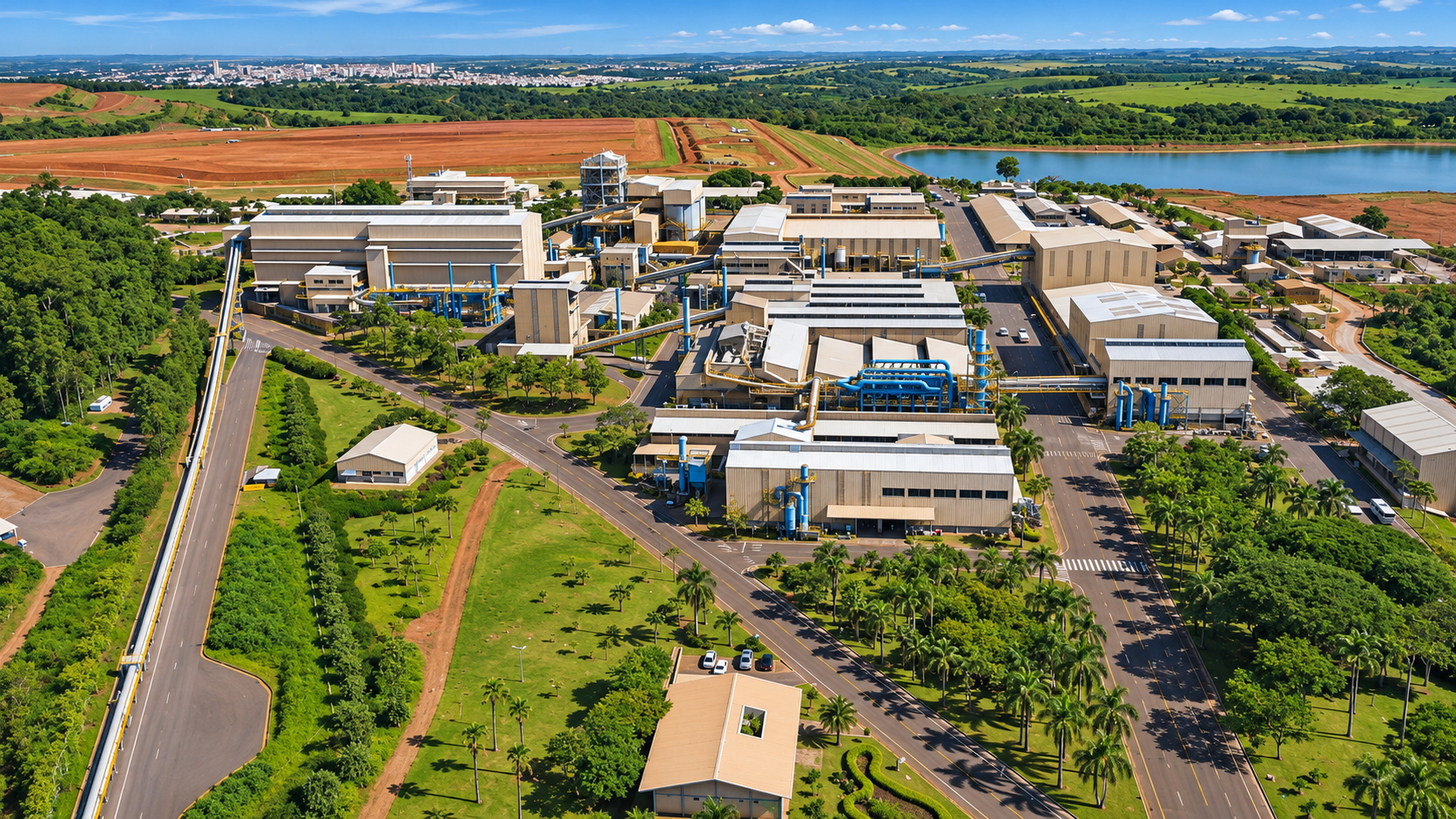
According to the U.S. Geological Survey (USGS), Brazil accounts for approximately 93% of global niobium production. Much of that leadership is associated with Companhia Brasileira de Metalurgia e Mineração (CBMM), based in Araxá, Minas Gerais. The company ended 2025 with net revenue of R$14.5 billion and net profit of R$6.4 billion.
Built over more than five decades, the Minas Gerais experience offers at least five lessons for Brazil’s federal critical minerals strategy, according to an analysis by Brazil Stock Guide.
Lesson one: Processing minerals matters more than simply extracting them
In Araxá, niobium does not necessarily leave the mine as an unprocessed commodity. CBMM converts the ore into ferroniobium, niobium oxides and metallic niobium, products used across a range of industries. The company serves more than 500 customers in over 50 countries and has helped develop a global market for niobium applications.
This is one of the defining features of the Minas Gerais model.
The economic value of niobium lies not only in mining the resource, but also in the technological expertise required to process it and expand its industrial uses. Although some downstream processing and finished-product manufacturing still take place abroad, Brazil has retained important stages of mineral transformation and technological development.
The new federal legislation recognizes that distinction. Law No. 15,506 establishes that tax incentives for mineral processing and manufacturing should be linked to the value added within Brazil.
Under the legislation, tax credits may reach 20% of eligible expenditures, subject to implementing regulations and an overall annual ceiling of R$1 billion from 2030 through 2034.
The challenge will be ensuring that these incentives translate into meaningful domestic industrial capacity, rather than simply increasing the volume of minerals extracted for export.
Lesson two: The state can share in profits without running the business
The partnership between Codemig, a Minas Gerais state-owned company, and CBMM dates back to 1972, when the two companies established Companhia Mineradora do Pirocloro de Araxá (Comipa) to extract ore from their respective mineral deposits.
CBMM handles mineral processing, industrial transformation and commercialization, while Codemig receives 25% of the net profit generated through the contractual profit-sharing arrangement underpinning the partnership.
In 2024, the arrangement generated R$1.73 billion for the state-owned company, according to figures released by the Minas Gerais government.
The model demonstrates that public participation in mineral wealth can extend beyond collecting taxes and royalties, without necessarily requiring the government to manage industrial or commercial operations.
That does not mean the 25% profit-sharing arrangement can be replicated indiscriminately.
The structure depends on mineral rights, the assets contributed by each partner and the risks each is prepared to assume. Its broader significance lies in demonstrating that governments can structure partnerships that allow the public sector to participate directly in the long-term economic returns generated by strategic mineral resources.
Lesson three: Technology must be part of the business from the outset
Brazil’s niobium industry did not become a global leader simply because the country possesses abundant reserves.
Over several decades, CBMM invested in applied research, workforce development, university partnerships and the creation of new industrial applications.
Today, its technology program encompasses more than 200 projects, supported by annual investments of between R$250 million and R$300 million. Research includes new applications for niobium in batteries, steelmaking and other advanced materials.
This experience is particularly relevant to rare earth elements.
Although Brazil has substantial rare earth reserves, it still needs to develop industrial capabilities in areas such as element separation, refining and the production of higher-value components, including permanent magnets.
The challenge is already visible in projects entering commercial production.
In October 2026, Serra Verde, a rare earth mining company operating in the central Brazilian state of Goiás, began commercial shipments of mixed rare earth carbonate to the United States.
The material still requires additional processing to separate individual elements before they can be used in advanced industrial applications.
The lesson from Araxá is that attracting investment to open new mines is not enough. Countries also need to develop technological expertise, processing infrastructure, specialized suppliers and customers capable of supporting an industrial supply chain over the long term.
Lesson four: Long-term contracts must balance stability with oversight
In October 2025, Codemig and CBMM agreed to an early renewal of their niobium mining partnership.
The new agreement provides for another 30 years of cooperation, with the possibility of a further 15-year extension, potentially keeping the arrangement in place until 2070.
The renewal also expanded the state-owned company’s rights to future profits from rare earth elements and other minerals associated with the Araxá deposits.
Under the revised terms, Codemig is entitled to 25% of the profits from those activities without being required to make proportional investments in the new projects.
The provision is significant because it allows Minas Gerais to participate in future commercial opportunities that were not yet developed when the original partnership was established.
It does not, however, mean that rare earth production is already generating revenue. Commercial development of those resources remains subject to technical, economic and environmental feasibility.
The arrangement illustrates the importance of contracts that provide sufficient stability to support capital-intensive investments while retaining the flexibility to accommodate technological advances and emerging markets.
At the same time, agreements extending over several decades require effective oversight.
The renewal introduced a committee responsible for audit, governance, compliance and sustainability, alongside more detailed periodic reporting requirements.
For the federal government, the challenge will be to provide investors with legal certainty without compromising transparency or the public sector’s ability to oversee the development of strategic mineral assets.
Lesson five: Mineral wealth also depends on strong institutions
The recent history of Codemge and Codemig shows that even an economically successful mineral partnership is not immune to political and institutional decisions affecting public assets.
In November 2025, Minas Gerais carried out a corporate restructuring that transferred direct ownership of 95% of Codemig to the state government, leaving Codemge, its former controlling shareholder, with a minority stake of just 5%.
The restructuring took place as Minas Gerais negotiated participation in the federal government’s Programa de Pleno Pagamento de Dívidas dos Estados (Propag), a debt-restructuring framework that allows Brazilian states to transfer certain assets to the federal government to reduce outstanding obligations.
The transaction did not remove the assets from state ownership. It did, however, change the allocation of economic rights and dividends between the two companies, while raising questions about Codemge’s future and its ability to finance economic development initiatives.
The renewal of the CBMM partnership also attracted scrutiny in the Minas Gerais state legislature, particularly over access to economic studies and documents related to the negotiations.
State lawmakers sought a review of a 15-year confidentiality restriction imposed on a document associated with the agreement.
The episode highlights a broader lesson: building a successful minerals policy does not end with signing contracts or establishing mechanisms for sharing profits.
It also requires transparent asset valuations, institutional continuity and clear rules governing how public revenues are allocated and used.
A model to adapt, not simply replicate
Araxá benefits from conditions that are difficult to reproduce elsewhere: world-class deposits, an established industrial base, decades of accumulated technological knowledge and an international customer network built over generations.
The rare earth supply chain presents different challenges.
Individual rare earth elements have distinct characteristics and markets, and their processing involves complex industrial stages. Moreover, the international concentration of separation technologies and component manufacturing capabilities — particularly in China and the United States — creates barriers that cannot be overcome simply by possessing mineral reserves.
For that reason, Minas Gerais’ most valuable contribution is not a contractual formula that can be copied elsewhere. It is the demonstration that mining, industrial development, technology and public participation in economic returns need to be pursued as parts of an integrated strategy.
Brazil’s new federal policy already incorporates some of those principles. What remains to be seen is whether the government can translate them into investment, industrial production and lasting economic benefits.


Leave a Reply