
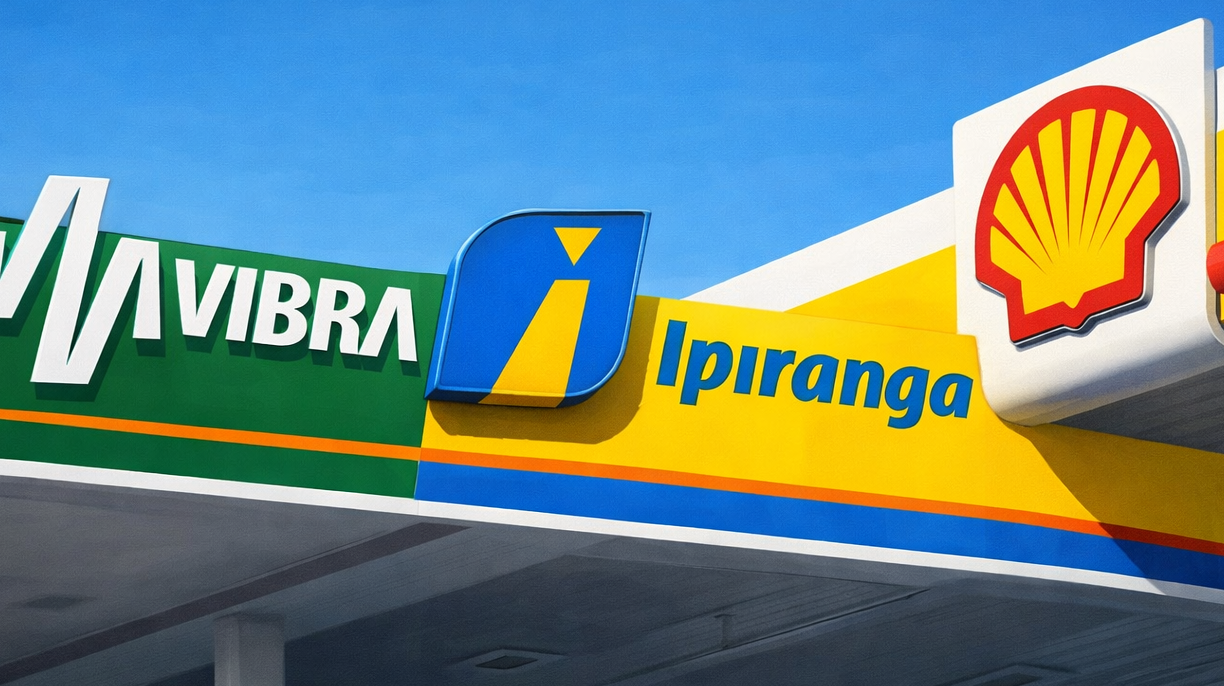
By Brazil Stock Guide – Brazil’s three largest fuel distributors increased their combined market share to 59.4% in July from 57.3% a year earlier, while regional companies fell to 40.6% from 42.7%.
The leaders are Vibra Energia SA (VBBR3), Ultrapar Participações SA’s (UGPA3) Ipiranga and Raízen SA (RAIZ4). All three expanded volumes faster than the broader market, according to a Banco BTG Pactual SA (BPAC11) report based on data from Brazil’s oil regulator ANP.
Brazilian fuel sales rose 1.8% from a year earlier to 11.699 million cubic meters in July. Ipiranga volumes jumped 10.8% to 2.122 million cubic meters, Vibra gained 3.9% to 2.609 million and Raízen advanced 3.1% to 2.219 million. Regional distributors’ sales declined 3.2% to 4.749 million cubic meters.
The divergence was also evident in the first seven months of 2026. Overall market volumes grew 2.5% to 76.419 million cubic meters, while regional distributors posted a 3.5% contraction to 31.569 million.
Ipiranga’s year-to-date volumes rose 8.9%, followed by a 7.4% increase at Raízen and 5.7% growth at Vibra. Regional companies’ diesel sales dropped 5.7% over the same period.
Fewer Irregularities, Better Petrobras Access
BTG attributed the market-share gains by larger distributors to a reduction in irregular activity and their sourcing advantage through stronger supply allocations from Petróleo Brasileiro SA (PETR4).
Greater access to Petrobras fuel allows the companies to secure products at competitive prices and reduce their exposure to fluctuations in the import market, according to the bank.
The report said this advantage has helped the major distributors recover customers previously served by regional rivals. Their combined market share has remained near or above 59% since April, indicating that the shift extends beyond a single month.
Ipiranga Leads the Advance
Ipiranga increased its market share to 18.1% from 16.7% a year earlier, a gain of 1.4 percentage points. The gap with Raízen narrowed to 0.9 percentage point from two points over the period.
Vibra remained the market leader with a 22.3% share, followed by Raízen at 19%.
Ipiranga’s growth was spread across its two main segments. Diesel volumes increased 10.4% to 1.214 million cubic meters, while adjusted Otto-cycle sales rose 11.2% to 908,000 cubic meters.
BTG linked Ipiranga’s outperformance to its ability to source fuel at attractive prices and capture spot customers that do not rely on regular supply contracts.
Russian Diesel Remains in the Mix
Imports accounted for 16% of Ipiranga’s diesel sales in July. The company imported 190,000 cubic meters, with Russia supplying 31% of that volume.
The Russian share declined sharply from 78% in June, while imported diesel’s contribution to Ipiranga’s sales fell from 21%. Russia nevertheless remained part of the company’s sourcing mix.
Higher Oil Prices Raise Sourcing Stakes
The consolidation comes as international oil prices remain elevated. Brent crude climbed above $92 a barrel on Tuesday, driven by renewed tensions in the Middle East and concerns over supply disruptions.
BTG estimated that Brazil’s diesel import-parity price rose to R$5.91 a liter in August from R$5.20 in July. The gasoline benchmark increased to R$3.87 from R$3.80.
The bank did not identify the oil rally as a direct cause of the market-share shift. Its analysis instead highlighted reduced irregularities and the supply advantage enjoyed by distributors with stronger Petrobras allocations.
BTG said diesel and gasoline distribution margins had retreated from their April peak but remained strong. The bank estimated sector EBITDA margins of about R$320 per cubic meter in the third quarter.


Leave a Reply