
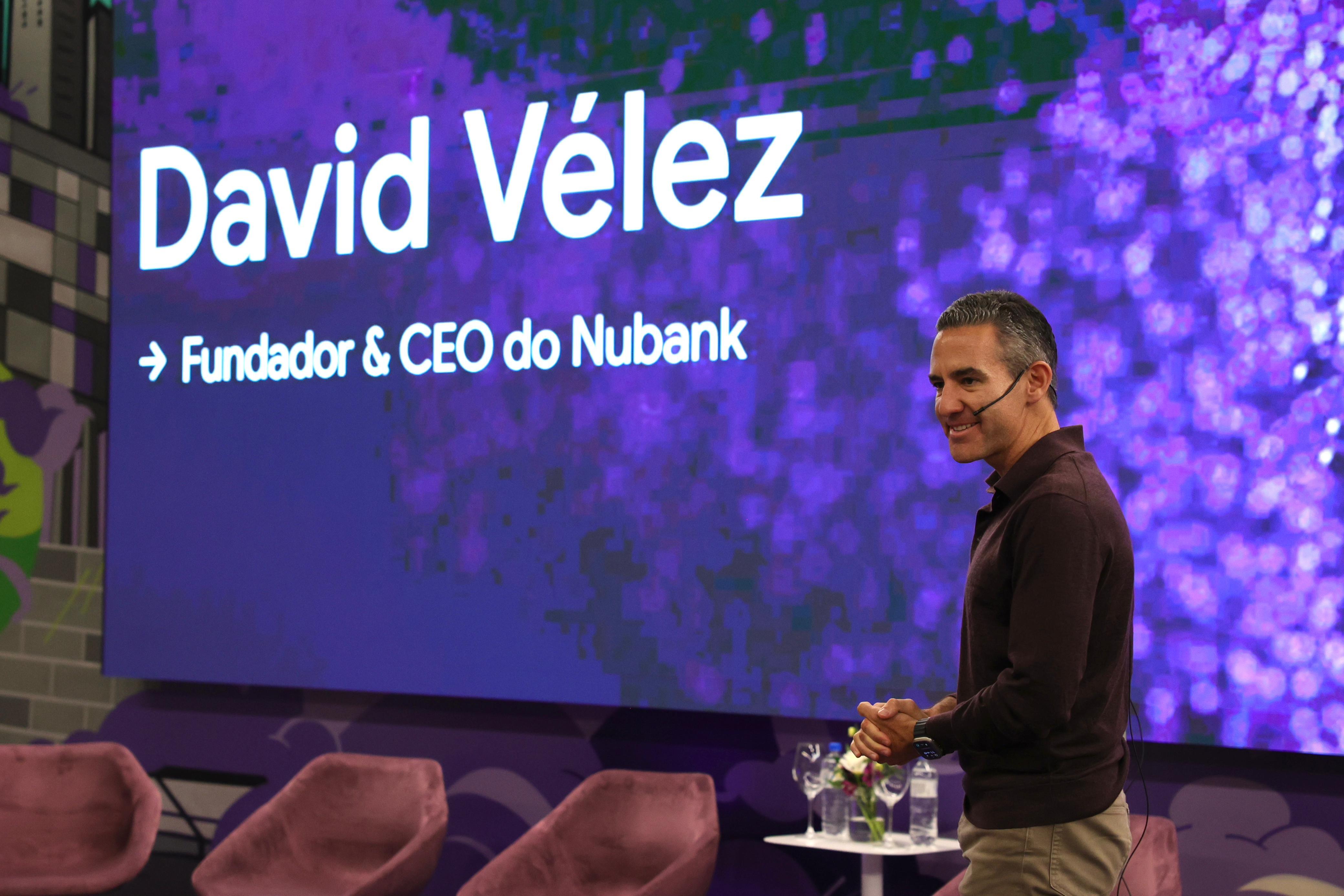
By Brazil Stock Guide — Nubank founder and CEO David Vélez outlined an ambitious vision to transform the Brazilian digital lender into a global financial institution serving as many as 1 billion customers across 100 countries, while suggesting that artificial intelligence could eventually allow banks of that scale to operate with just 5,000 employees.
In an interview released on October 13 on the Invest Like the Best podcast, hosted by Patrick O’Shaughnessy, Vélez said advances in artificial intelligence and Nubank’s low-cost operating model could enable a dramatic expansion beyond Latin America.
The company currently serves approximately 140 million customers with 10,000 employees, a scale Vélez contrasted with traditional banks that may employ 100,000 people and operate thousands of branches to serve smaller customer bases.
“You could imagine banks that have 500 million, a billion customers with 5,000 employees,” Vélez said, describing what he considers technologically achievable as AI transforms banking operations.
The figures represent a long-term vision rather than formal corporate targets. Vélez did not announce a timetable for reaching 1 billion customers or 100 countries, nor did he outline plans to reduce Nubank’s workforce to 5,000 employees.
From Latin America to the world
Vélez said the ambition to build a global banking platform dates back to Nubank’s founding in 2013, when its original presentation to investors already envisioned a worldwide shift from traditional banks to digital financial institutions.
After 13 years of expansion in Brazil, Mexico and Colombia, he believes the company has demonstrated that its model can compete with established lenders.
Nubank has approximately 120 million customers in Brazil, representing more than 65% of the country’s adult population, according to Vélez. About 60% of its customers use Nubank as their primary banking institution.
The executive said he had spent one or two years considering whether to pursue opportunities outside Nubank before concluding that expanding the company tenfold could have a greater impact than any other project.
That ambition would take Nubank from operations in three countries to a presence in 100 markets, potentially reaching 1 billion customers.
Vélez said traditional banks still dominate roughly 90% of a global consumer financial services industry he estimates at $10 trillion, leaving substantial room for digital competitors to gain market share.
The company is pursuing expansion into the United States and has also announced plans for stablecoin-backed accounts across more than 35 countries.
Vélez acknowledged that entering the U.S. market will be particularly challenging because of intense competition and the importance American consumers place on established banking brands.
Building customer trust and recognition without spending excessively on marketing will be among Nubank’s biggest challenges, he said.
Artificial intelligence as a growth engine
Vélez believes artificial intelligence could further widen Nubank’s operating-cost advantage.
According to the executive, Nubank’s cost of serving a customer is approximately 3% of that of a traditional incumbent bank, even before accounting for potential productivity gains from AI.
The company has already redesigned approximately 120 internal workflows around artificial intelligence, including software development, product design, compliance, internal auditing and regulatory capital management.
Nubank has also reduced its organizational structure from roughly ten management layers to five, while Vélez increased the number of executives reporting directly to him from one to approximately 20.
The executive sees these changes as part of a broader transformation that could allow financial institutions to serve vastly larger customer bases without proportionately increasing their workforces.
He also said Nubank is developing services for autonomous AI agents, which the company increasingly regards as a distinct customer segment capable of interacting with financial products on behalf of consumers.
The risks of global expansion
Despite his optimism, Vélez acknowledged that Nubank’s international ambitions face significant execution risks.
He described a negative scenario in which the company saturates its existing Latin American markets, fails to expand successfully overseas and cannot fully capitalize on the opportunities created by artificial intelligence.
With Nubank already serving a substantial majority of Brazil’s adult population, continued customer growth will increasingly depend on new markets.
The more optimistic scenario, Vélez said, would see Nubank capitalize on the migration from traditional banks to digital platforms over the next two or three decades, eventually establishing a presence in more than 100 countries.
For Vélez, the opportunity is no longer simply to challenge Brazil’s largest banks, as Nubank set out to do more than a decade ago, but to compete for a significant share of the global financial services market.


Leave a Reply