

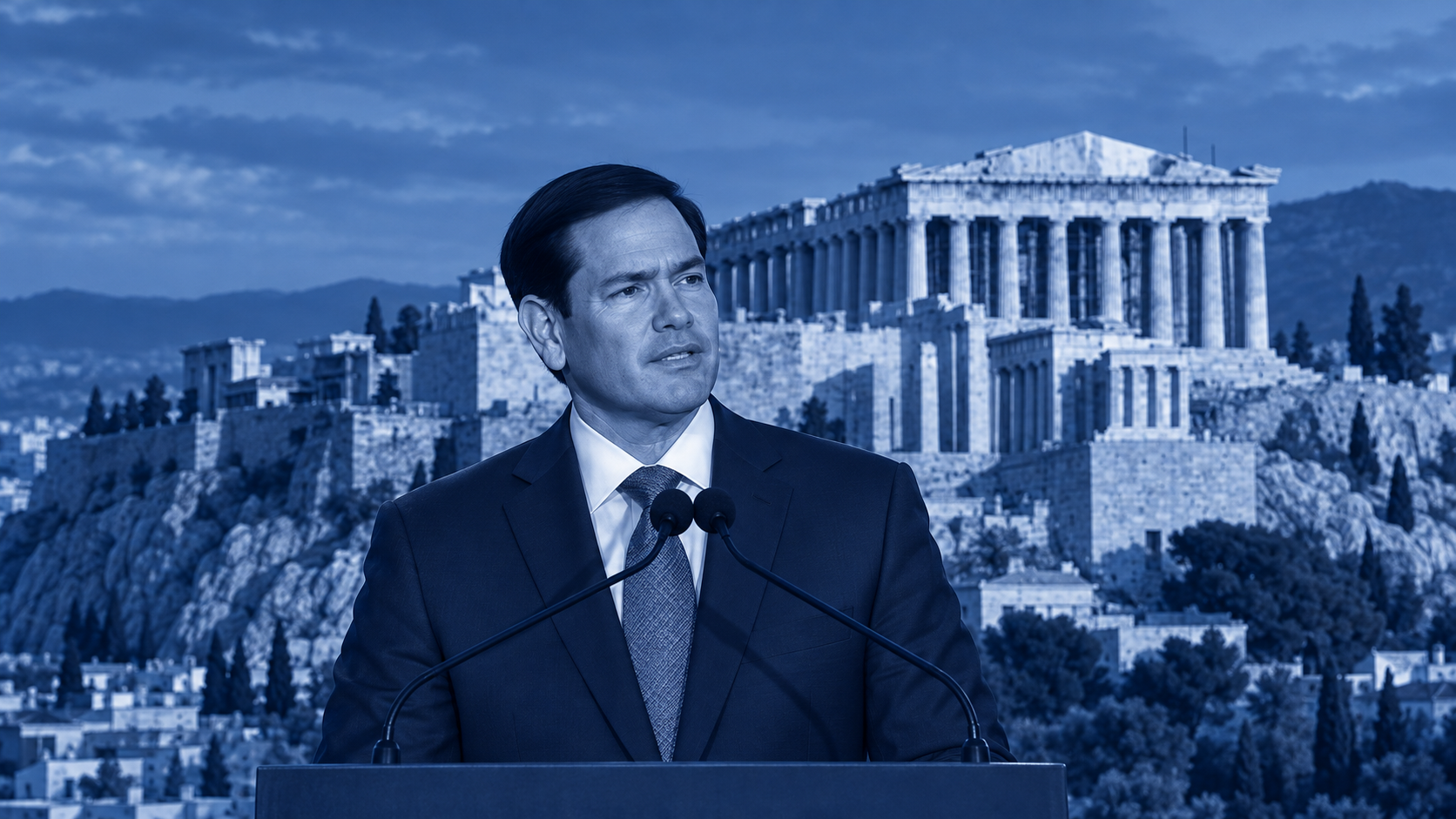
While Brazil remains consumed by the presidential runoff between Lula and Flávio Bolsonaro, a speech delivered in Athens may offer important clues about the international order that whoever occupies Brazil’s presidential palace will have to navigate.
On Wednesday, October 7, Marco Rubio reached back 2,500 years to portray Donald Trump’s nationalism not as a break with the past, but as the revival of virtues that, in his telling, helped build Western civilization. The editorial board of The Wall Street Journal called it the speech of the year.
The WSJ’s praise deserves attention. Not only because of the newspaper’s influence in American conservative and financial circles, but because Rubio sought to do more than defend the administration he serves. He attempted to construct a historical narrative capable of sustaining a political vision beyond Trump himself.
The setting in Athens was carefully chosen. Rubio spoke at the Pnyx, the hill where the assembly of ancient Athenian democracy once gathered, with the Acropolis and Parthenon as his backdrop. He began by recalling the destruction of Athens by the Persians — whose empire was centered in what is now Iran — in 480 BC, and the subsequent rebuilding of its monuments under Pericles, invoking a story of renewal and greatness.
Rubio acknowledged the Greeks’ contributions to philosophy, political institutions and rational thought before arguing that those achievements sprang from something more fundamental: individualism, ambition, curiosity, competition, courage and a determination to push beyond established limits. Those qualities, in his view, also helped shape the United States.
The pivotal word was thymos, a concept in ancient Greek thought associated with spirit, courage, pride and the drive for recognition. For Rubio, without that inner force, civilizations lose their ability to compete, fight and survive. Western decline, in this telling, is above all a crisis of will.
It is a politically potent argument, delivered by a man widely discussed as a potential successor to Trump and frequently mentioned alongside Vice President JD Vance in debates over the Republican Party’s future.
In Rubio’s account, the West began to decline when it became ashamed of its history, turned against nationalism, surrendered decision-making to international bureaucracies and shifted industrial production to other countries, including China. Restoring national pride, he argues, is a prerequisite for restoring prosperity and power.
The narrative leads directly to American policy. Rubio said that under Trump, the United States had chosen to reclaim national power. He outlined priorities including greater control over supply chains, reindustrialization, military strength and leadership in semiconductors, critical minerals, artificial intelligence, energy and defense technologies.
History as an argument
The historical construction behind what the WSJ called the speech of the year deserves closer examination. Rubio traces a continuous thread from ancient Greece through Rome and European Christendom, the Renaissance and the Age of Exploration, culminating in America’s territorial expansion and technological rise.
Along the way, he invokes Alexander the Great, Julius Caesar, Charlemagne and Hernán Cortés as successive expressions of a shared civilizational impulse to conquer, explore and push beyond frontiers. Copernicus, Galileo, Kepler and Newton form part of an intellectual lineage leading to the great scientific achievements of the modern era.
There is, however, something strained about this construction: it places vastly different figures and traditions along an almost uninterrupted path of progress, emphasizing the achievements that support the argument while relegating their contradictions to the background.
Athenian democracy, after all, coexisted with slavery and imperialism. European expansion brought knowledge and exchange, but also colonial conquest and violence. And Greek philosophy itself wrestled with the dangers of unchecked ambition and the abuse of power.
For a modern audience, the speech was also designed to circulate as imagery, spectacle and narrative across digital platforms. According to The Washington Post, the Athens event involved four State Department cameras, including one mounted on a crane to capture cinematic images of Rubio against the ancient ruins.
The battle for Trump’s legacy
It is through this combination of history, ideology and political communication that Rubio seeks to give intellectual coherence to America First. Rather than simply defending Trump’s decisions, he offers a longer-term vision of American power, one in which nationalism, industrial capacity, technological superiority and international alliances serve the restoration of Western greatness.
Rubio concludes by urging Western nations to rediscover their identity without abandoning their own national interests. But the speech leaves a fundamental question unanswered.
If American greatness requires putting the United States first — America First — how will Washington respond when other countries invoke the same tradition to defend priorities that do not align with its own?
For Brazil, this is not a question of Greek philosophy. It is an economic and diplomatic choice the next administration will have to confront.
In the next edition of Behind the Lines, we will examine how this new vision of American power could affect Brazil, its relationship with China and the limits of any potential political alignment with Washington.


Leave a Reply