
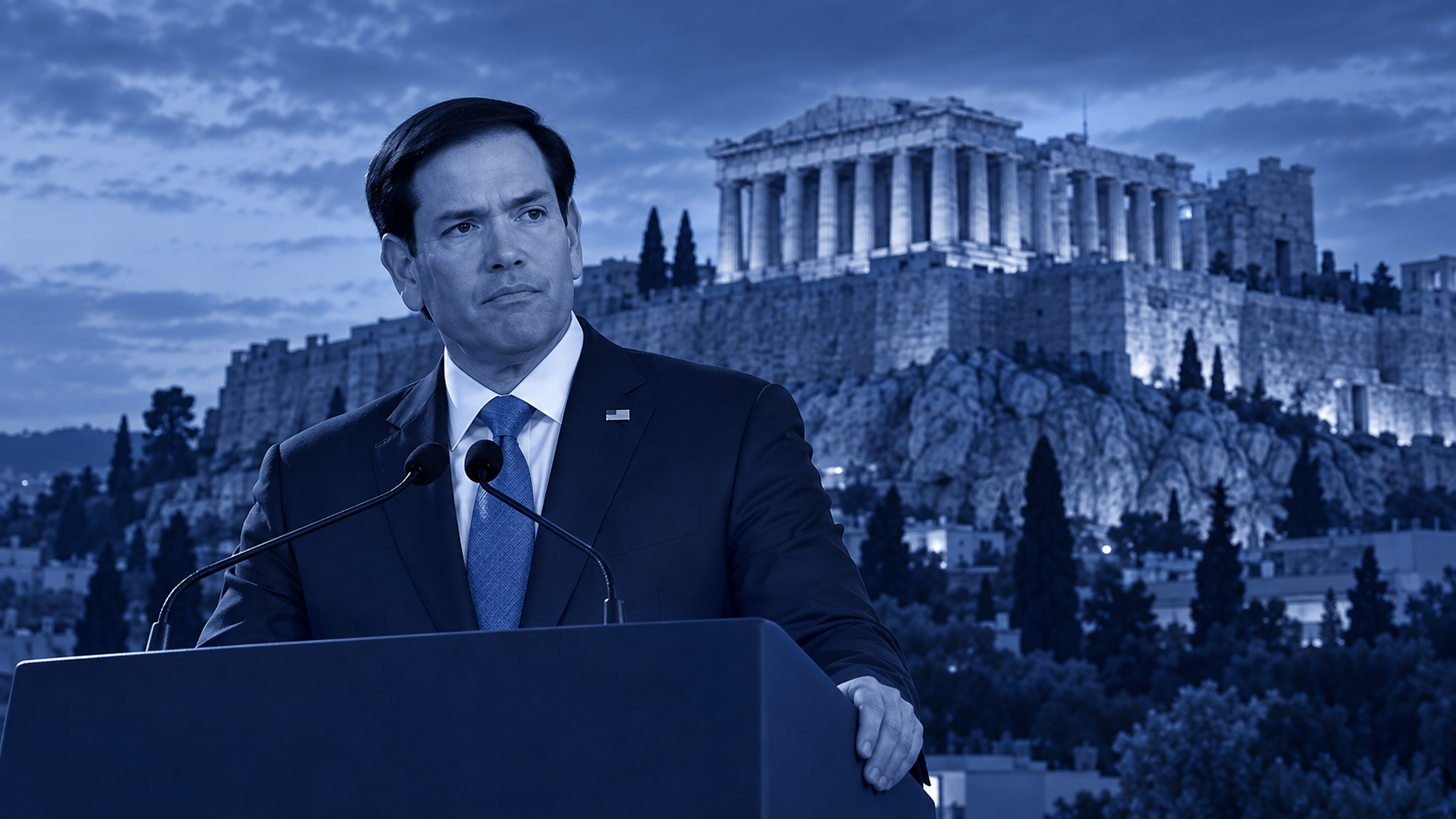
Marco Rubio defended the right of nations to put their own interests first in his speech in Athens. But the U.S. secretary of state left one question unanswered: Would Washington accept Brazil doing the same, even when Brazilian interests run counter to those of the United States?
In the first article of this series, we examined how Rubio drew on Western history to give Donald Trump’s America First agenda an intellectual foundation. The question now is how that vision applies to countries such as Brazil, whose economy is deeply tied to China even as they maintain strategic relations with the United States.
From January through September 2026, China accounted for 29.7% of Brazilian exports, worth $84.7 billion. The United States took 9.6%, or $27.5 billion, according to Brazil’s Ministry of Development, Industry, Trade and Services.
Political affinity cannot change those numbers. China is the leading buyer of Brazilian soybeans, iron ore and crude oil. The United States remains an important market for manufactured goods and a major source of investment and technology. Brazil needs to do business with both.
A New Monroe Doctrine
The contradiction in Rubio’s argument becomes clearer when set against the U.S. National Security Strategy, published in December 2025.
The document states that Washington intends to reassert its preeminence in the Western Hemisphere and prevent powers from outside the region from controlling strategically important assets. The policy was labeled the Trump Corollary to the Monroe Doctrine, invoking the 1823 doctrine that became a cornerstone of American influence across the Americas.
In practice, Chinese investments in Latin American ports, energy, telecommunications and mining could increasingly be treated by Washington as national security concerns.
Here lies the tension: Rubio presents sovereignty as a virtue, while the administration he represents claims a privileged role in shaping strategic decisions across the hemisphere.
For Brazil, exercising sovereignty has become more costly.
The Flávio Bolsonaro Test
That is the backdrop against which a potential Flávio Bolsonaro administration would confront its first major foreign-policy dilemma.
The presidential candidate is politically close to Trump and favors stronger cooperation with Washington. At the same time, he has said he would maintain pragmatic relations with China and that Brazil need not choose between the two powers.
Those positions are not necessarily incompatible. But reconciling them would not be frictionless.
A Brazilian government politically aligned with the United States would remain dependent on Chinese demand for commodities, Asian investment and industrial supply chains increasingly integrated with China’s economy.
It would also have to negotiate trade disputes with Washington that personal ties between presidents cannot simply erase. In July, the United States imposed additional tariffs on Brazilian products covering 23.1% of Brazil’s exports to the American market, based on 2024 trade figures.
The same underlying challenge would confront Lula if he wins re-election. His return to office would not eliminate Washington’s economic and strategic interests in maintaining relations with Brazil.
The challenge, therefore, goes beyond politics. Any Brazilian administration will have to manage relations with both the United States and China without sacrificing national economic interests.
Critical Minerals Show What Is at Stake
The competition for critical minerals already provides a concrete example.
In April, U.S.-based USA Rare Earth announced a $2.8 billion agreement to acquire Serra Verde, a rare-earth producer operating in the Brazilian state of Goiás. The transaction includes a 15-year supply arrangement backed by a financing structure involving American public and private capital.
For Washington, securing access to these minerals is part of a broader effort to reduce dependence on China in military technology, electric vehicles and industrial equipment.
But how much of that mineral wealth will translate into manufacturing, technology and jobs in Brazil?
Attracting foreign capital is not the same as building a domestic industrial supply chain. For Brazil, what matters is the terms of investment, local processing capacity and the ability to capture more value from its mineral resources.
This clash of interests extends beyond the United States. The European Union is investigating the proposed acquisition of Anglo American’s Brazilian nickel operations by MMG, a Hong Kong-listed company controlled by a Chinese group, amid concerns that supplies could be diverted from Europe to China.
Brazilian mining has thus become part of a strategic contest in which investment decisions can increasingly be shaped by governments thousands of miles away.
The Price of Sovereignty
America’s new foreign-policy direction confronts Brazil with a reality: competition between Washington and Beijing can attract investment, but it can also increase pressure on Brazil’s commercial and diplomatic choices.
In this environment, sovereignty means more than declaring independence. It requires alternative markets, industrial capacity, access to technology and genuine bargaining power.
Flávio Bolsonaro’s proximity to Trump could change the political atmosphere surrounding bilateral negotiations. It would not, by itself, alter the economic ties binding Brazil to China.
In Athens, Rubio defended America’s right to put its interests first.
But does America First leave room for Brazil First?


Leave a Reply