
By Brazil Stock Guide — LATAM Airlines Group (NYSE: LTM) reported net income attributable to shareholders of $441 million in the third quarter of 2026, up 16.3% from a year earlier.
Operating revenue rose 18.4% to $4.57 billion, driven by higher airfares, capacity expansion and strong demand for premium services. Soaring jet fuel prices, however, drove up costs and weighed on the airline group’s operating profitability.
“Our business model is resilient. It can withstand a very significant shock,” Jerome Cadier, CEO of LATAM Airlines Brazil, told reporters during the company’s earnings presentation on Tuesday (November 3). Cadier said the airline has been navigating a jet fuel price crisis for seven months, with elevated costs likely to remain a challenge for the industry in 2027.
Adjusted EBITDA fell 4.7% to $1.095 billion, while the EBITDA margin narrowed to 24% from 29.8% a year earlier. Adjusted operating income declined 17.9% to $573 million, with the operating margin falling to 12.5% from 18.1%. Fuel expenses surged 60.9% to $1.57 billion, reflecting a 52.1% increase in average jet fuel prices, including hedging costs.
During the earnings call, group Chief Financial Officer Ricardo Bottas said higher fuel prices alone added $520 million to quarterly expenses, excluding the impact of increased fuel consumption from capacity growth. LATAM was able to offset approximately 80% of that increase through $410 million in additional revenue generated by higher unit revenues and pricing. The strategy helped preserve a double-digit operating margin, although profitability remained substantially below year-earlier levels.
The increase in net income, despite weaker operating profitability, was supported by lower financing costs and income taxes. Interest expenses declined 29% to $183 million, while income tax expenses fell to $31 million from $70 million. Adjusted net income attributable to shareholders, which excludes certain nonrecurring items, rose by a much more modest 0.9% to $413 million.
Passenger revenue increased 17.8% to $4 billion, while cargo revenue climbed 19.5% to $483 million. LATAM carried 23.5 million passengers during the quarter, up 2.7%, and expanded capacity by 7.7%. Its load factor, a measure of how much available seating capacity is filled, declined to 83.7% from 85.4%. Premium-related revenue grew 23%, outpacing overall passenger revenue growth.
Full-Year Outlook Cut
Persistently high jet fuel prices prompted LATAM to revise its 2026 financial guidance. The company lowered its adjusted EBITDA forecast to $3.9 billion–$4.05 billion from a previous range of $4.1 billion–$4.4 billion. Its expected adjusted operating margin was reduced to 10.5%–11.5% from 12%–13%. At the same time, the airline raised its full-year revenue forecast to $17.6 billion–$17.8 billion.
The revised guidance assumes a benchmark jet fuel price of $180 per barrel in the fourth quarter, compared with the previous assumption of $130. Bottas said higher fuel prices are expected to add approximately $2 billion to the group’s costs over the course of 2026. Even so, LATAM expects to generate at least $1.2 billion in adjusted levered free cash flow for the year.
Cadier said LATAM remains committed to expanding its operations but is taking a cautious approach to 2027. Alongside elevated fuel prices, currency volatility, Brazil’s tax reform and potential changes to working-hour regulations present additional uncertainties. He noted that more than 60% of Brazilian airlines’ operating costs are denominated in U.S. dollars and warned that tax changes could push ticket prices higher, potentially weighing on passenger demand.
LATAM has also made limited adjustments to its domestic expansion plans in Brazil. Its projected capacity growth for 2026 was revised to 7.5%–8.5% from 8%–9%. Cadier said the airline had not eliminated any destinations or routes, instead reducing frequencies on heavily served routes with multiple daily flights. Looking ahead to 2027, he expects further targeted adjustments but no sweeping reductions to the network.
Fleet Expansion and Investment
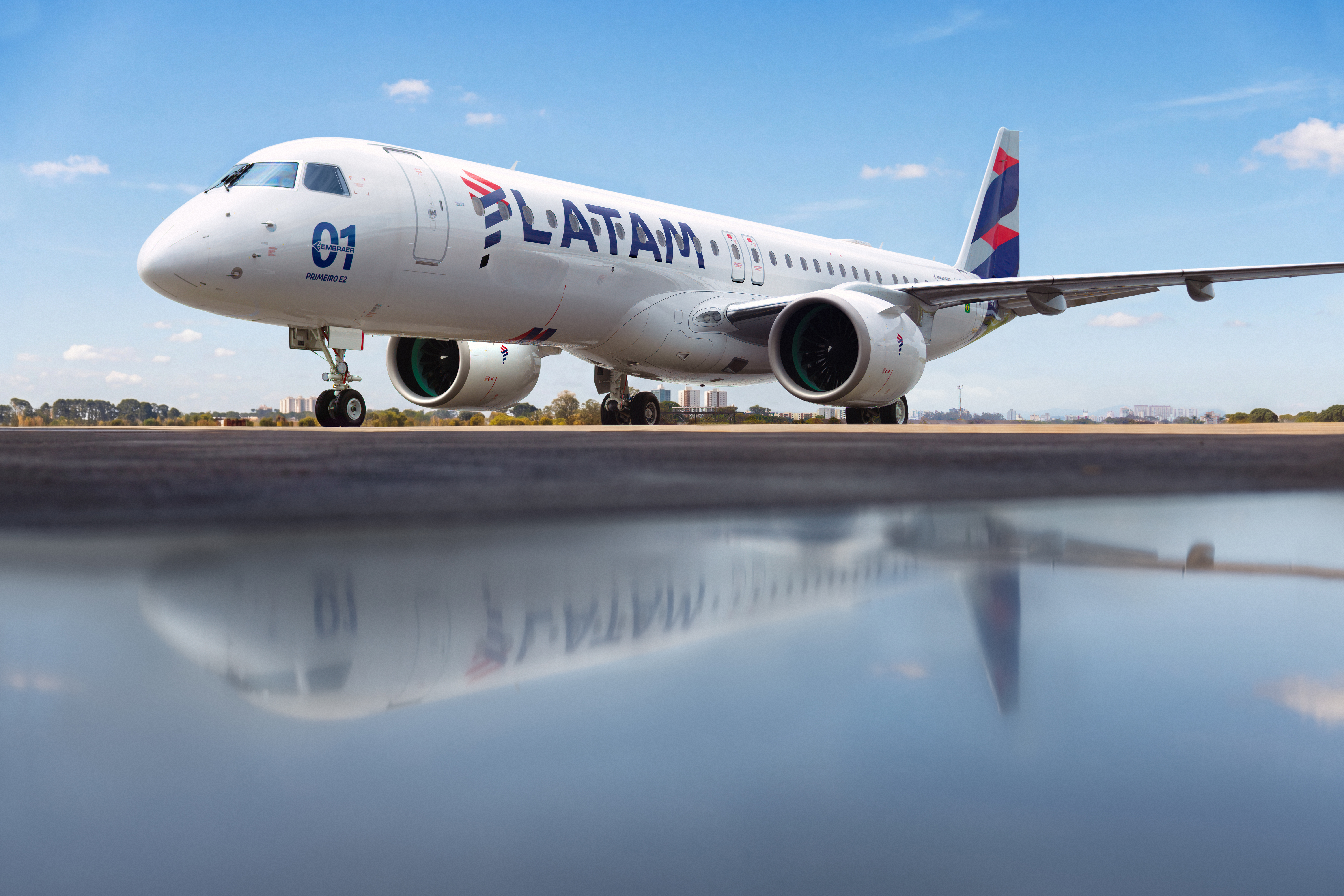
LATAM is maintaining its fleet renewal and expansion plans. In October, the airline took delivery of its first two Embraer E195-E2 jets, with commercial operations scheduled to begin on November 30 in Brazil’s domestic market. The initial deployment covers 14 aircraft and 42 routes. According to Cadier, the aircraft’s greater fuel efficiency and suitability for lower-density markets make it particularly valuable in an environment of persistently high operating costs.
The group ended the quarter with a fleet of 390 aircraft and expects to reach 409 by December, 426 by the end of 2027 and 452 in 2028.
Reflecting improvements in its financial position, S&P Global Ratings and Fitch Ratings upgraded LATAM’s corporate credit rating to BB+ from BB, both with stable outlooks. The airline group’s secured bonds also received investment-grade ratings from both agencies, marking another step in its financial recovery and balance-sheet strengthening.


Leave a Reply