
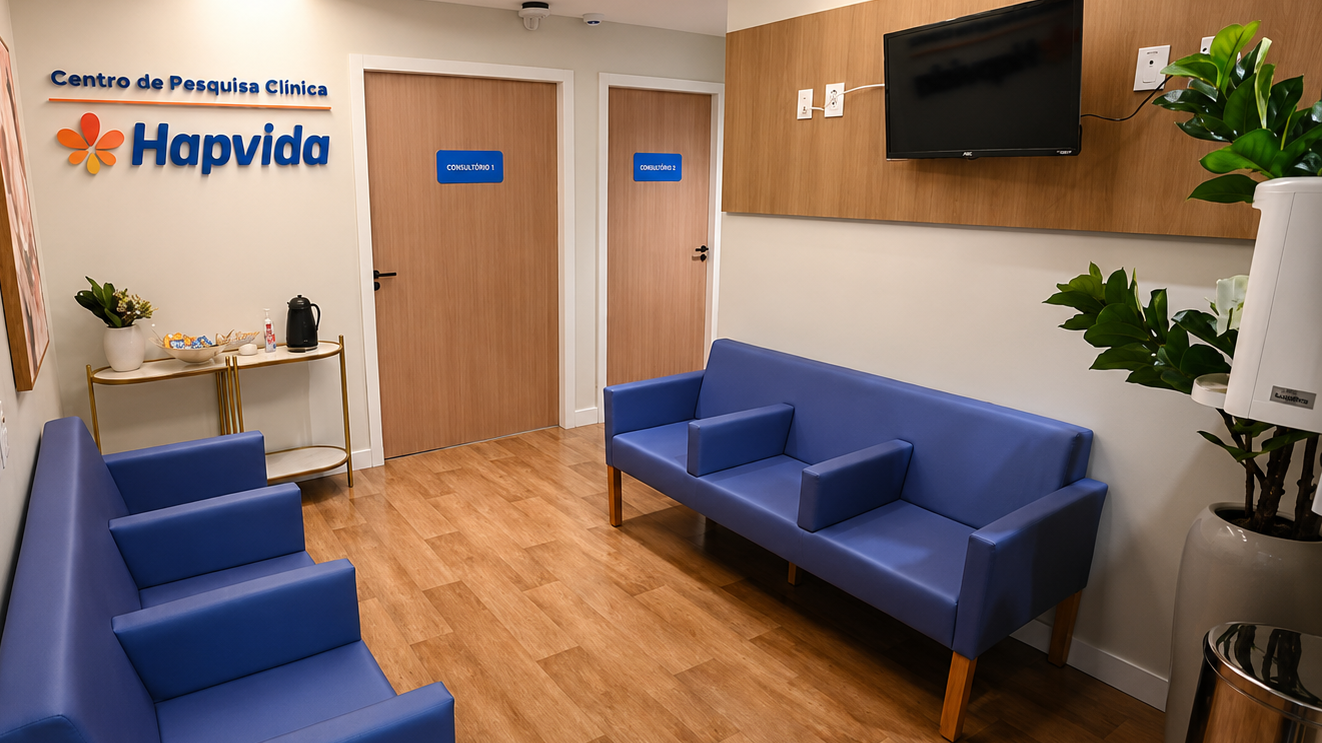
By Brazil Stock Guide — Hapvida (HAPV3) has opened a new clinical research center in São Paulo, in a move aimed at turning one of its biggest competitive advantages — its patient scale and integrated care network — into a platform for clinical trials and high-complexity therapies.
The new Clinical Research Center, located at the Qualivida Higienópolis building in central São Paulo, spans 444 square meters and is eight times larger than the previous facility. The unit has a team of 25 professionals, including doctors, nurses, pharmacists, research coordinators and medical investigators.
Hapvida said it currently has 13 studies under way at the center. The company plans to enroll 1,400 patients in new studies in 2026. So far, more than 1,000 have already been selected, with a retention rate of 95.8%.
That figure gives the strategy more substance. For clinical-trial sponsors, the ability to recruit patients quickly — and keep them enrolled throughout the protocol — is one of the main bottlenecks in medical research. Hapvida is trying to position itself at the intersection of care scale, clinical data and access to a broad base of health-plan members.
The portfolio’s focus also points to a push into more complex therapeutic areas. In institutional material, the company says oncology accounts for 50% of the study pipeline, followed by cardiometabolic conditions and biologics, with 20% each. Diabetes represents 7%, and other areas account for 3%.
The company also cites research fronts in neuromuscular diseases, metabolic disorders, hematology and oncology, including conditions such as Huntington’s disease, spinal muscular atrophy, ALS, Gaucher disease, Hunter syndrome, hemophilia, neuroblastoma and solid tumors. These are areas where the pharmaceutical industry often faces challenges in identifying patients, recruiting participants and generating clinical and real-world evidence.
To speed up recruitment, Hapvida says it uses a proprietary artificial intelligence platform that has reduced by 80% the time required to identify eligible patients. The center also relies on a three-layer recruitment structure, according to the company.

Hapvida’s new Clinical Research Center: the expanded unit seeks to accelerate clinical studies . Credit: Ivan Ismael da Silva/Disclosure
The initiative reinforces an area still relatively underexplored by large healthcare operators in Brazil: using their care networks to conduct active clinical studies, real-world evidence projects, scientific validation and patient recruitment for the pharmaceutical industry.
In material presented by the company, Hapvida positions the center as part of an ecosystem that includes drugmakers such as AstraZeneca, Roche, Johnson & Johnson, Sanofi, Lilly, Bayer, EMS, Aché and Eurofarma; technology, data and contract-research companies such as IQVIA, PSI, Precision Data, Siemens Healthineers, Promptly, Azidus, ODC Life Sciences, Traverse Health and Intrials; and leading clinical institutions such as Einstein and HCor hospitals.

The list gives weight to the strategic case behind the project. For the pharmaceutical industry, an integrated healthcare operator can offer something difficult to replicate: a large patient base, care-network reach and the ability to follow patients throughout their care journey.
“This growth positions us uniquely before the pharmaceutical industry and reinforces our commitment to international standards of scientific excellence,” Rodrigo Sardenberg, Hapvida’s clinical research director and a thoracic surgeon, said in a statement. “We want to use research and its results to democratize innovation, with a direct impact on the lives of thousands of Brazilians.”
The company is also seeking to increase its scientific output. Its target for 2026 is to publish 20 articles in journals indexed on PubMed. By the end of May, 13 articles had already been published. In 2025, Hapvida published 21 articles, above its initial target of 15.
The expansion comes as healthcare operators in Brazil, including Hapvida, try to rebalance margins, control medical costs and improve perceptions of care quality after years of pressure on the sector. Clinical research offers Hapvida a narrative that complements scale and vertical integration: that of a platform capable of generating data, attracting industry partners and bringing patients closer to innovative therapies.
With nearly 16 million health and dental-plan members, 84 hospitals, 75 urgent-care units, 367 clinics and 313 diagnostic centers, Hapvida has a base that is difficult to replicate. If it can turn that patient scale into high-quality research, reliable data and relevant commercial relationships with the industry, the expanded center may help Hapvida capture value beyond the traditional health-plan model.


Leave a Reply