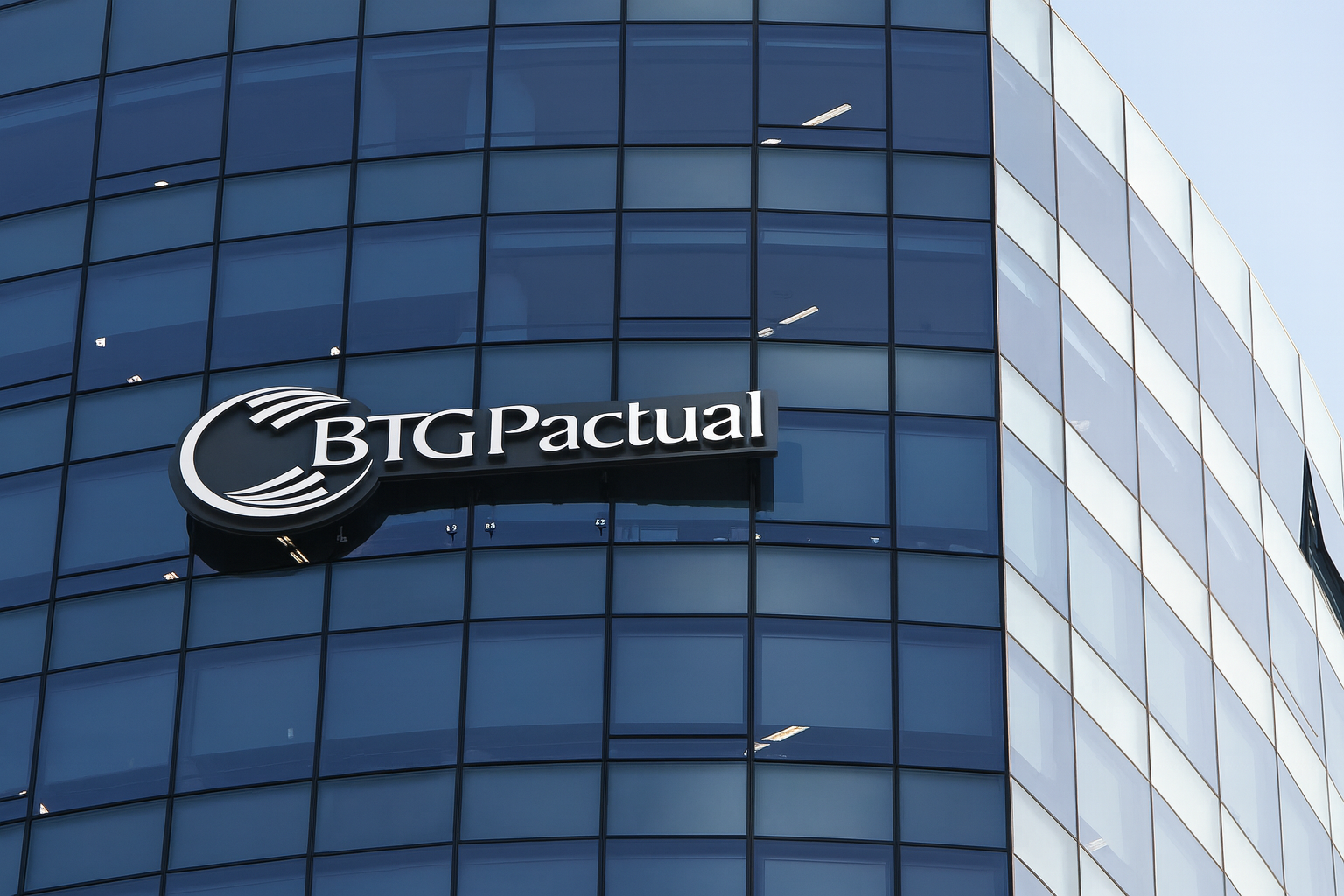
By Brazil Stock Guide — BTG Pactual (B3: BPAC11), Brazil’s largest independent investment bank, reported record adjusted net income of R$5.33 billion ($1 billion) in the third quarter of 2026, up 17% from a year earlier, driven by growth in corporate lending, consumer finance and wealth management. However, its adjusted annualized return on average equity (ROAE) fell to 26.4%, from 28.2% a year earlier.
Total revenue reached R$10.81 billion, an increase of 13.8% year-on-year and 4.3% from the previous quarter. Reported net income rose 17.4% to R$5.09 billion. The difference between reported and adjusted earnings was largely attributable to goodwill amortization associated with acquisitions, including Banco Pan, Órama and Julius Baer Brasil.
Despite the record profit, adjusted ROAE declined for a second consecutive quarter, from 28.2% in the third quarter of 2025 to 26.7% in the second quarter of 2026 and 26.4% in the July-September period. For the first nine months of the year, BTG reported adjusted net income of R$15.28 billion, up 26%, while revenue increased 20.4% to R$31.15 billion. Adjusted ROAE averaged 26.9% over the nine-month period.
Corporate Lending & Business Banking was the main driver of growth, with revenue rising 28.4% year-on-year and 10.7% quarter-on-quarter to R$2.77 billion. The performance reflected an expanding loan portfolio and contributions from the bank’s Special Situations business, which focuses on tailored financing, complex transactions and investment opportunities involving companies with specific capital needs.
The corporate and small-business loan portfolio reached R$301.9 billion, up 22.3% from a year earlier. Lending to small and medium-sized enterprises jumped 25.9% during the quarter alone, reaching R$33.5 billion. The acquisition of HSBC Uruguay further expanded BTG’s regional footprint, bringing the share of its corporate loan portfolio held outside Brazil to approximately 25%. The bank also received regulatory approval to operate as a bank in Peru.
Consumer Finance & Banking, which includes Banco Pan, posted a 63.5% annual increase in revenue to R$1.60 billion. Its loan portfolio reached R$84 billion, up 36.7% over 12 months, supported mainly by growth in private-sector payroll-deductible lending and the contribution from MeuTudo, a consumer credit platform acquired by the group. Revenue from Too Seguros remained broadly stable at R$150.8 million.
Wealth Management & Personal Banking also delivered record results, with revenue rising 15% year-on-year to R$1.57 billion. Client assets under management reached R$1.38 trillion, an increase of 21.5% from the third quarter of 2025. Net inflows totaled R$30.2 billion between July and September and R$94.2 billion in the first nine months of the year, reflecting the bank’s growing presence among affluent investors and private banking clients.
Asset Management revenue increased 8.1% from a year earlier to R$808.3 million. Assets under management and administration surpassed R$1.42 trillion, supported by net inflows of R$27.9 billion in the quarter and R$105.2 billion year-to-date. Growth was driven primarily by asset servicing activities and Brazilian fixed-income strategies, although contributions from minority stakes in independent asset managers were lower.
Investment banking, however, painted a different picture. Revenue from the division fell 35.9% year-on-year to R$412.2 million, reflecting weaker capital markets activity amid heightened caution ahead of Brazil’s elections. Debt capital markets remained the division’s largest revenue contributor, while mergers and acquisitions advisory activity improved compared with the previous quarter.
Transaction volumes highlighted the slowdown. BTG participated in 20 debt underwriting transactions during the quarter, down from 52 a year earlier, while equity capital markets transactions fell from 11 to three. The number of announced M&A transactions increased from seven to 13, with a combined value of $4.27 billion. Despite weaker activity in some areas, BTG maintained its leading position by number of M&A transactions in Brazil and Latin America, according to rankings included in its earnings release.
Sales & Trading also lost momentum, with revenue declining 10.6% year-on-year and 6.6% quarter-on-quarter to R$1.74 billion. The bank said it maintained a more selective approach to risk exposure amid market uncertainty. Average daily value at risk (VaR) stood at 0.23% of average shareholders’ equity, remaining below the bank’s historical levels.
Conversely, Brazil’s high interest-rate environment continued to support BTG’s Interest & Others business, which generated R$1.92 billion in revenue, up 14.6% from a year earlier. According to the bank, the result largely reflected returns earned on its tangible equity at prevailing benchmark interest rates. A larger capital base, combined with elevated borrowing costs across the economy, helped sustain this revenue stream and partly offset weaker capital markets activity.
Business expansion also pushed operating costs higher. Total operating expenses reached R$4.52 billion, an increase of 16.3% from the third quarter of 2025. Administrative and other expenses rose 33.6% to R$1.36 billion, mainly reflecting the consolidation of HSBC Uruguay and non-recurring costs. BTG’s adjusted cost-to-income ratio increased to 37.8%, from 36.8% a year earlier, indicating that expenses absorbed a larger share of revenue despite higher absolute profitability.
The bank’s balance sheet continued to expand. Total assets reached R$944.8 billion at the end of September, up 2.1% from June. Unsecured funding rose 31.7% year-on-year to R$436.1 billion, supported by growth in time deposits and debt issuance in domestic and international markets. Equity attributable to controlling shareholders reached R$81.7 billion, even after the bank distributed R$3 billion in interest on equity during the quarter, a common form of shareholder remuneration in Brazil.
Capital and liquidity indicators also strengthened. BTG’s Basel capital adequacy ratio rose to 16.3%, from 15.5% a year earlier, while its liquidity coverage ratio stood at 179.4%. The combined corporate and consumer loan portfolio reached R$386 billion, highlighting the importance of monitoring asset quality as lending expands rapidly in an environment of persistently high interest rates.
Alongside its earnings release, BTG’s board approved a share buyback program of up to R$2 billion, to be executed over a period of up to 18 months. The program covers BPAC11 units, which will be held in treasury, with management determining the timing of purchases.
In a regulatory filing with Brazil’s Securities and Exchange Commission (CVM), BTG said the buyback was intended to improve the deployment of available cash and optimize capital allocation. The decision comes as the bank combines record earnings with international expansion and continued growth in its lending, asset management and wealth management businesses.


Leave a Reply