
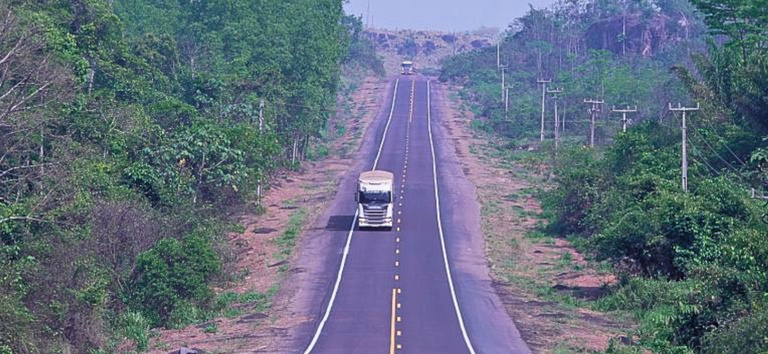
By Brazil Stock Guide – Brazil’s National Land Transport Agency (ANTT) has scheduled a Nov. 12 auction to select the new controlling shareholder of the concession operating the BR-163 highway between Mato Grosso and Pará, one of the country’s most important logistics corridors for moving soybeans, corn and other agricultural commodities to Amazon export terminals.
The restructured concession calls for R$ 10.8 billion in investments to expand capacity, improve safety and modernize 1,009 kilometers (627 miles) of highways spanning BR-163 and BR-230. The auction will be held at São Paulo’s B3 stock exchange.
Unlike a traditional greenfield concession, bidders will not compete for a brand-new contract. Instead, they will bid to acquire control of the existing concessionaire, Via Brasil BR-163, assuming its contractual rights, obligations and financial commitments under a revised concession framework.
The winning bidder will be the one offering the largest discount to the reference toll tariff. If the leading bids are separated by only a narrow margin, the process provides for a live outcry round to determine the winner. Binding bids are due by Nov. 9.
Fixing an outdated model
The restructuring reflects how traffic forecasts underpinning the original concession proved overly optimistic about the timing of Brazil’s rail expansion.
When the concession was awarded in 2022, the financial model assumed that the long-planned Ferrogrão railway would begin diverting a substantial share of grain traffic away from BR-163 during this decade. With the railway still delayed, truck volumes have remained significantly above the assumptions used to design the concession.
The result has been heavier wear on the highway, growing demand for additional capacity and maintenance, and investment needs that exceeded the revenue profile of the original contract.
According to ANTT documents, the concessionaire had accumulated tax losses of roughly R$ 164.9 million and financial debt of just over R$ 1 billion by mid-2025, highlighting the structural imbalance of the original concession model.
To restore financial viability, regulators extended the concession term by 15 years, allowing investments to be amortized over a longer period while reflecting the corridor’s actual traffic profile. The restructuring was negotiated through a consensual process overseen by Brazil’s Federal Court of Accounts (TCU).
Test case for Brazil’s concession policy
The auction is also expected to become an important test of the federal government’s strategy for rescuing distressed infrastructure concessions without restarting the procurement process from scratch.
Under the new framework, concession contracts can be renegotiated to restore their economic balance before being exposed to a competitive auction. If another investor presents a superior offer, control of the concession is transferred to the new operator.
The model seeks to preserve competition while avoiding lengthy legal disputes and minimizing disruptions to critical infrastructure assets.
For prospective bidders, the key challenge will be determining how much toll discount the project can absorb while still generating adequate returns on the planned investment program. Higher discounts reduce future toll revenues, forcing operators to balance pricing with construction commitments, maintenance costs and debt service.
Although BR-163 benefits from robust freight volumes driven by Brazil’s expanding agricultural exports, investors must also consider exposure to crop cycles, commodity prices, weather conditions and future competition from railways and inland waterways.
Strategic corridor
BR-163 has become one of Brazil’s most strategic logistics arteries as agricultural production has steadily expanded across northern Mato Grosso. The highway connects the country’s largest grain-producing region with river terminals in Miritituba and other Amazon export facilities, reducing dependence on the traditional southern ports of Santos and Paranaguá.
Its importance has only increased as exporters seek shorter and more cost-efficient routes to international markets through the so-called Northern Arc port system. The current concessionaire will continue operating the highway until the transfer of control is completed.
Access to the project’s virtual data room will begin on Aug. 1, while requests for clarification on the auction documents may be submitted through Sept. 8.
Beyond selecting a new operator, the auction will signal whether Brazil’s emerging concession restructuring framework can successfully transform financially distressed infrastructure assets into investable projects without placing the full cost of past modeling errors on road users through higher tolls.


Leave a Reply