
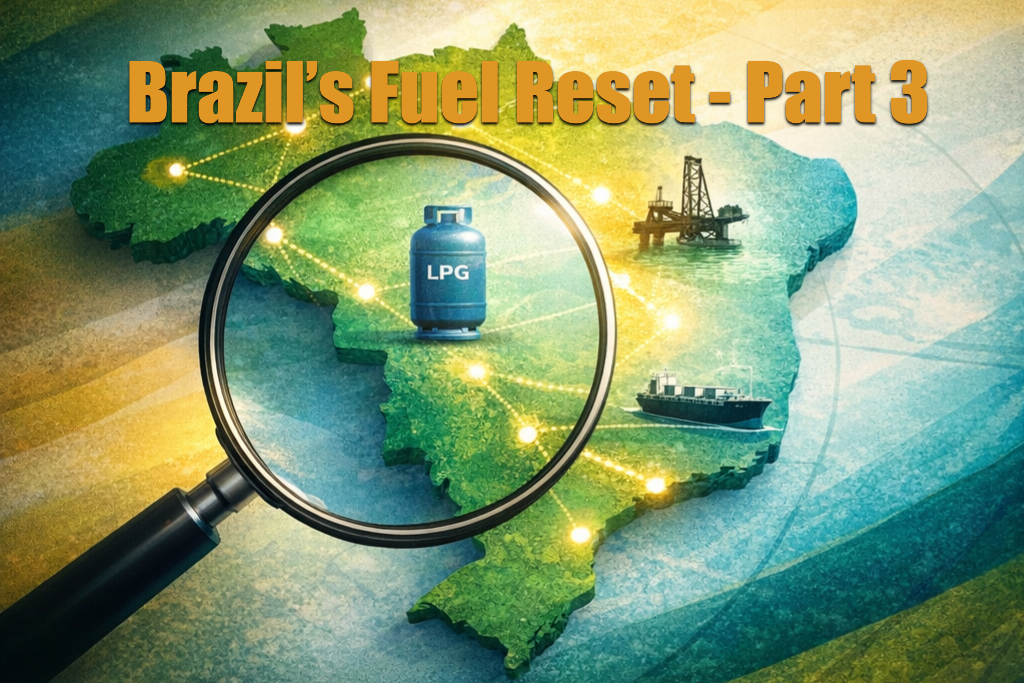
By Brazil Stock Guide – If LPG exposes Brazil’s social and pricing vulnerabilities, aviation fuel reveals a different structural issue: cost. The country’s jet fuel market remains one of the most concentrated segments in the energy chain, directly impacting airline profitability and ticket prices — and now sits at the center of the government’s reform agenda.
Jet fuel (QAV) is one of the largest cost components for airlines operating in Brazil, often accounting for around 30% to 40% of operating expenses. In a market where margins are structurally thin, this cost dynamic plays a decisive role in route viability, ticket pricing and network expansion.
At the supply level, Petrobras (PETR3; PETR4) remains the dominant producer and supplier of aviation fuel, with refining capacity concentrated in a limited number of assets. Distribution is similarly concentrated, with Vibra Energia (VBBR3), Raízen (RAIZ4) and Air bp (BP) controlling access to airport infrastructure and fueling operations across most major hubs.
On the demand side, airlines such as LATAM Airlines, Gol (GOLL4) and Azul (AZUL4) are highly exposed to domestic fuel pricing dynamics, with limited ability to hedge costs compared to peers in more competitive markets.
Structural constraints
The CNPE reports highlight a series of bottlenecks that define the aviation fuel market in Brazil:
- limited competition in supply and distribution
- restricted access to airport fueling infrastructure
- logistical constraints in transporting fuel to inland airports
- concentration of storage and refueling assets
- limited number of qualified operators at key airports
These factors create a market where prices are shaped less by pure competition and more by structural constraints, reinforcing cost pressures across the aviation sector.
A concentrated chain
Unlike more liberalized markets, Brazil’s aviation fuel chain operates with high entry barriers.
Fuel must be supplied through certified infrastructure within airports, often controlled by a small number of distributors. This creates a vertically constrained system where access to infrastructure becomes as critical as access to supply itself.
In practice, this means that even if new suppliers emerge, their ability to compete is limited by logistical and regulatory hurdles.
Reform proposals
The CNPE studies propose a series of measures aimed at opening the market:
- expanding third-party access to airport fueling infrastructure
- encouraging new entrants in distribution and supply
- improving transparency in pricing mechanisms
- reducing regulatory barriers to entry
- strengthening logistics to underserved regions
One of the key ideas is to decouple infrastructure access from incumbent distributors, allowing more players to operate within airport environments — a move that could increase competition over time.
Market implications
For distributors such as Vibra (VBBR3) and Raízen (RAIZ4), increased competition could pressure margins, particularly in high-traffic airports where scale currently provides a competitive advantage.
At the same time, improved infrastructure access and higher traffic volumes could partially offset these effects, depending on how reforms are implemented.
For airlines, the potential upside is more direct. Greater competition and efficiency in fuel supply could reduce operating costs — a critical factor in a market where profitability remains volatile.
For Petrobras (PETR3; PETR4), the reform could gradually reshape its role as the dominant supplier, particularly if import dynamics and alternative supply channels gain traction.
Regional imbalance
Another issue highlighted in the reports is regional disparity.
Airports outside major hubs often face higher fuel costs due to logistical challenges, limited competition and lower volumes. This creates distortions in route economics, discouraging connectivity in less developed regions.
Addressing these imbalances is part of the broader reform effort, particularly through investments in logistics and storage infrastructure.
Political and economic trade-offs
While aviation fuel does not carry the same direct social sensitivity as LPG, it remains politically relevant.
Airfare prices are highly visible to consumers, and fuel costs are a key driver. Any reform that affects pricing dynamics — even indirectly — can quickly become a public issue.
At the same time, maintaining the current structure means preserving inefficiencies that weigh on airlines and, ultimately, passengers.
What comes next
The aviation fuel market illustrates a different dimension of Brazil’s fuel challenge: not access, but cost and efficiency.
If reforms succeed, they could increase competition, reduce structural costs and improve connectivity across the country. If not, the current model — concentrated, infrastructure-constrained and cost-intensive — is likely to persist.
This is Part 3 of the series “Brazil’s Fuel Reset.”
Next: SAF — where Brazil’s decarbonization ambitions collide with cost realities.



Leave a Reply