
By Rodrigo Uchoa, special for Brazil Stock Guide
Before 1969, the wristwatch was an instrument of daily navigation. It was by the wrist that the factory worker knew when his shift ended, the executive timed the start of a meeting, the mother calculated when to collect the children from school. Knowing the time was a personal responsibility, and the instrument that told it was taken seriously.
Precision, in that context, was everything. A good mechanical watch certified by the COSC — the Contrôle Officiel Suisse des Chronomètres — would gain or lose between four and six seconds a day. An ordinary mechanical watch, by contrast, could drift by thirty seconds a day. Over a month, that meant a deviation of nearly fifteen minutes — enough to miss the 8:14 train.

That world was destroyed in a single night. On 25 December 1969, Seiko launched in Japan the Astron, the first commercial quartz watch in history. It cost the equivalent of an average Japanese car, but the proposition was unsettling: while the finest mechanical watch erred by thirty seconds a day, the quartz erred by fifteen seconds a month. Joseph Schumpeter, who theorised “creative destruction” as the engine of capitalism, would have recognised the Astron as a textbook example of his theory — a product that does not improve on what exists, but renders it irrelevant.
Through the 1970s, Seiko, Citizen and Casio industrialised quartz and drove prices down with an efficiency that Swiss craftsmen had no means to match. What cost a car in 1969 cost a dinner in 1979. Of the 90,000 workers in the Swiss watchmaking industry, fewer than 30,000 remained. The country’s share of the global market fell from 50 to 15 per cent. Brands with decades of history disappeared without a word.
Survival required a conceptual turn that, in retrospect, looks obvious.
The so-called Holy Trinity — Patek Philippe, Audemars Piguet and Vacheron Constantin — bet on a combination of extreme craftsmanship and exclusivity that created a market of collectors prepared to pay not for utility, but for narrative. Patek went so far as to build an entire philosophy around the idea that its watches do not belong to the buyer — they are kept for the next generation. It is an argument that depends on the buyer accepting they are acquiring something that will outlast them. It works well.
Rolex took a different path, equally sure-footed: it built an aspirational image tied to performance and status. The Submariner appears on the wrists of professional divers and investment bankers with equal conviction. It is not by accident — it is the product of decades of marketing that turned a watch into a badge of arrival. It does not matter that the owner does not dive. He could. That is the message.

An essential name from this period is that of Genevan designer Gérald Genta, who in the 1970s imagined an entirely new aesthetic language, introducing steel and geometric forms where only gold and sobriety had existed before. The result was the Royal Oak for Audemars Piguet, in 1972, and the Nautilus for Patek Philippe, in 1976. Genta deserves a column of his own.
The industry arrived at the present in a paradoxical position: never more financially healthy, never more functionally unnecessary.
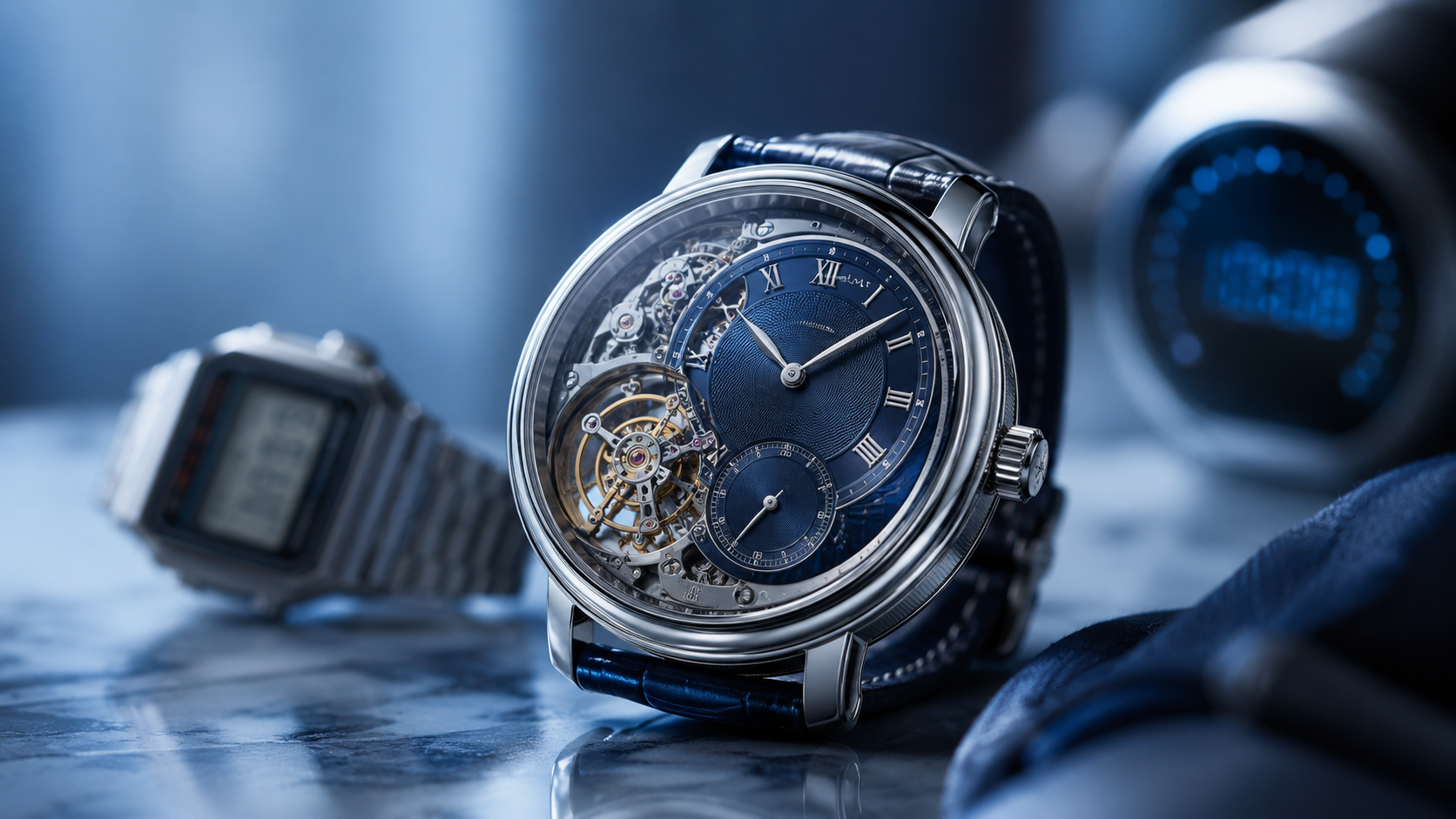
Nobody looks at their wrist to check the time — especially nobody under 35. The phone, the car dashboard, any surface with embedded electronics will do it with satellite precision. The mechanical watch has become the most expensive and least efficient object on the market for performing its original function. And for precisely that reason, it thrives.
So where does haute horlogerie stand today? Dress watches have returned with force after a decade dominated by sporting giants of 44 to 46 millimetres, which aged badly on wrists and in display cases alike. Cartier and Piaget have regained prominence with refined geometric forms. The Jaeger-LeCoultre Reverso, created in 1931 with a reversible case to protect the dial during polo matches, never quite left — and it now ranks among the most coveted dress watches on the market.
And this is an age of collaborations.
What Omega did with Swatch in 2022 — launching the MoonSwatch and creating queues lasting days outside stores — appears also to have opened a Pandora’s box, selling membership in a universe previously closed to anyone unable to spend five or six figures. Audemars Piguet went further still with the Royal Pop in 2026, turning the Royal Oak into something within reach (at least in the bioceramic pop version).


The most compelling collaborations, however, are those that go beyond hype. BVLGARI worked with Korean artist Lee Ufan, treating the watch as an object of philosophical reflection. G-Dragon, the K-pop star, produced with Jacob & Co something that can only be described as a horological manifesto. And Hiroshi Fujiwara, the godfather of Japanese streetwear, collaborated with TAG Heuer on a Carrera with an in-house movement and an 80-hour power reserve.
Schumpeter described creative destruction as the process by which capitalism renews itself, dismantling the old to make way for the new. What watchmaking has done over the past few decades is something more subtle: faced with destruction, it invented a new reason to exist. Not a better product. A product with a different meaning.
The market today is more mature, more selective and, paradoxically, more creative. Less volume, more meaning in each piece. Brands no longer compete on precision — they compete on narrative, craft and culture. The watch that once existed to tell the time now tells a story about the person wearing it, what they value, where they place themselves in the world.
Whether that is creative destruction or simply creation, Schumpeter would probably know.


Leave a Reply