
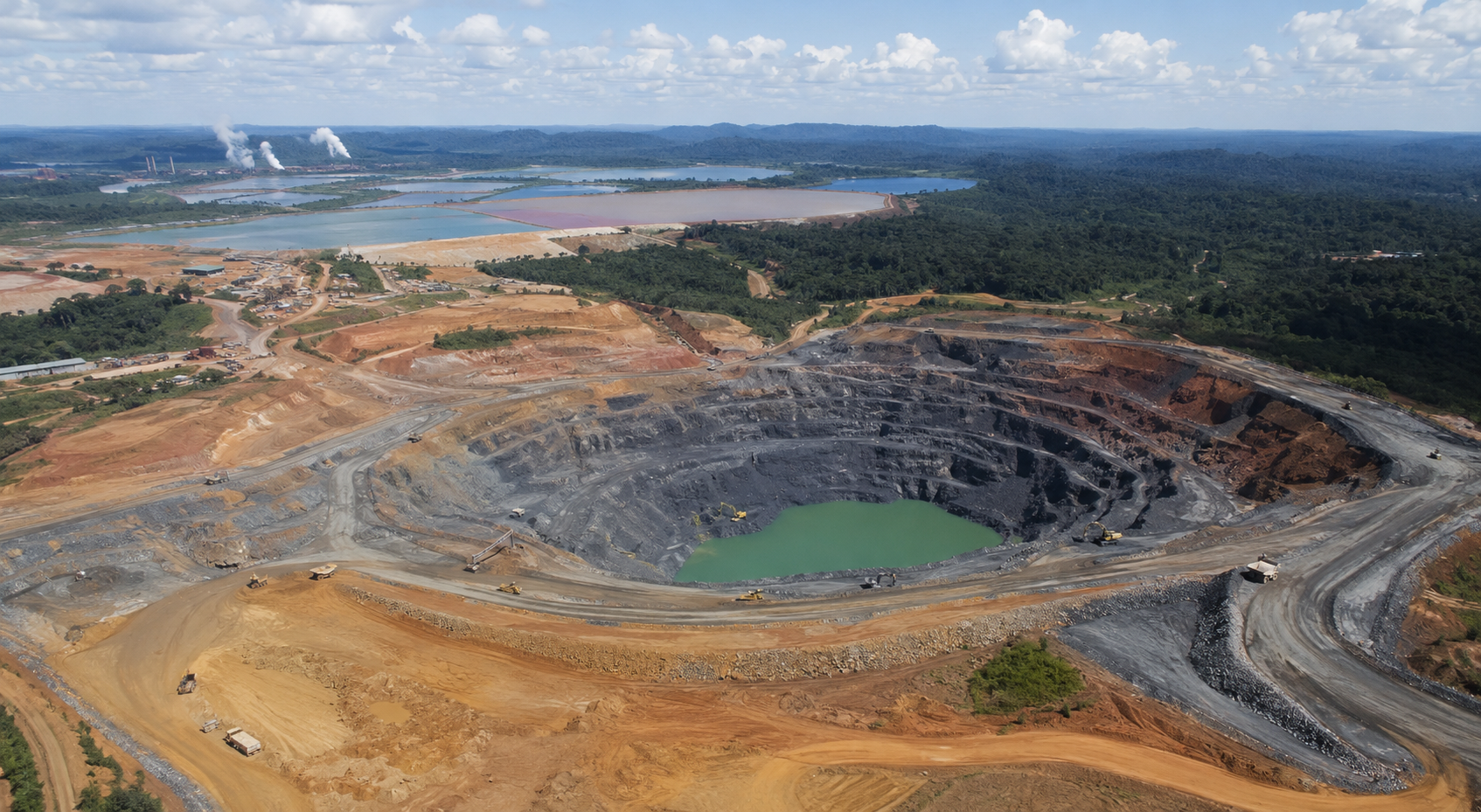
By Brazil Stock Guide – Brazil’s Legal Amazon contains almost half of the country’s mining claims involving critical and strategic minerals, but production and investment remain heavily concentrated in established commodities such as iron ore, copper, gold and bauxite, according to a broad sector study released by the National Mining Agency, or ANM.
The region accounted for 38,732 of Brazil’s 80,427 mining proceedings involving minerals classified as critical or strategic as of October 2025, representing a 48.2% share. More than half of the Amazon region’s proceedings were located in Pará state, followed by Mato Grosso and Rondônia.
The headline number, however, overstates how much of that activity is close to becoming commercially viable. Almost 80% of the proceedings were still in early stages, including applications for small-scale mining permits, exploration authorizations and exploration requests.
More advanced stages, such as mining concessions, represented only a small portion of the total. The data suggest that much of the region’s geological promise remains far from becoming operating mines.
Gold dominates the map of mining rights, accounting for 67% of the proceedings. Tin represents 10% and copper 7.3%. Minerals more directly associated with batteries, fertilizers, advanced electronics and low-carbon technologies – including potash, nickel, rare earths, lithium and cobalt – remain a relatively small part of the portfolio.
The study was prepared to support the development of a national policy for critical and strategic minerals. It brings together information on mining rights, reserves, production, royalties, investment, projects under development and foreign trade, largely based on company filings and official data through 2024 and October 2025.
Production remains concentrated
Iron ore, copper, gold and bauxite accounted for more than 90% of the value generated by critical and strategic minerals in the Legal Amazon in 2024.
Iron ore led with R$ 72.5 billion in mineral production value, followed by copper at R$ 17.4 billion, gold at R$ 7.7 billion and bauxite at R$ 5.3 billion.
The region accounted for 94% of Brazil’s bauxite production value, 93.9% of tin and 76.2% of copper. Those figures reflect the importance of Pará, home to the Carajás mineral province and some of the country’s largest iron ore and copper operations.
Pará produced about 70% of Brazil’s copper concentrate in 2024 and 92.6% of its bauxite. The Legal Amazon also accounted for 98.9% of national tin output and 31% of gold production.
The numbers confirm the Amazon’s importance to Brazil’s existing mining industry. They also highlight the gap between the region’s established mineral economy and its potential role in new supply chains.
Despite its geological resources, the region still has no meaningful production of rare earths, cobalt or potash, according to the ANM.
Exploration spending still favors traditional minerals
The sharpest contrast appears in mineral exploration spending.
Companies invested R$ 4.9 billion in exploration for critical and strategic minerals in the Legal Amazon between 2003 and 2024. In 2024, however, gold absorbed 65.8% of the total and copper another 19.1%.
Together, the two minerals accounted for 85% of exploration investment.
Rare-earth exploration received only R$ 1.2 million in 2024. Lithium attracted R$ 811,000, nickel R$ 801,000, cobalt R$ 48,000 and graphite R$ 25,000.
The distribution indicates that companies are still directing most exploration capital toward commodities with established infrastructure, known deposits and existing markets rather than toward many of the minerals at the center of the global competition for batteries, electric vehicles, renewable energy systems, electronics and defense technologies.
The ANM identified some diversification since 2021, including greater spending on tin, tantalum, rare earths and lithium. The amounts, however, remain modest compared with investment in gold and copper.
The figures reveal one of the report’s central contradictions: Brazil frequently describes critical minerals as a strategic priority, but exploration capital has yet to follow that policy narrative at scale.
R$ 40 billion invested in mines and processing plants
Investment in existing mines and processing facilities has been significantly larger.
A total of R$ 40.4 billion was invested in mines and beneficiation plants for strategic minerals in the Legal Amazon between 2006 and 2024, excluding iron ore.
Investment reached R$ 6.75 billion in 2024 alone. Copper received 31.3% of the total, followed by nickel at 19.8%, bauxite at 18.7%, gold at 17.2% and manganese at 11.3%.
Those five minerals accounted for 98.3% of investment in mines and plants during the year.
The difference between spending on current production and investment in exploration helps explain why the region remains a major mineral producer without yet developing a more diversified critical-minerals industry.
Capital continues to flow primarily toward commodities that already have operating assets, infrastructure and established export channels.
Projects could reshape the mineral mix
The report identifies several projects that could increase the region’s exposure to potash, nickel, copper and platinum-group metals.
The Potássio Autazes project in Amazonas is among the most strategically relevant for Brazil. The project is expected to produce approximately 2.2 million to 2.4 million metric tons of potassium chloride a year, with an estimated mine life of between 23 and 31 years.
Its significance goes beyond mining. Brazil imports roughly 97% of the potash it consumes, making fertilizer supply a major source of vulnerability for one of the world’s largest agricultural producers.
If developed at the projected scale, Autazes could replace a meaningful portion of Brazilian potash imports. The project, however, also illustrates the environmental, legal and social complexities involved in developing large mineral assets in the Amazon.
Other projects highlighted by the ANM include the Tucumã copper mine, Vale’s Novo Carajás investment program, the Araguaia and Vermelho nickel projects, bauxite developments in Pará and the Luanga deposit, which contains platinum-group metals.
The report also includes the Volta Grande gold project. These assets differ widely in development stage, permitting status and access to financing. Their inclusion in the ANM’s portfolio does not mean that all of them will enter production.
Geological resources alone are not sufficient. Projects also require environmental licenses, infrastructure, funding, community consultation, regulatory predictability and, in many cases, stronger commodity prices.
Royalties remain concentrated in Pará and iron ore
The Legal Amazon generated R$ 3.17 billion in mining royalties from critical and strategic minerals in 2024, equivalent to 47.3% of the Brazilian total.
Iron ore alone accounted for 79.5% of regional royalty revenue. Pará collected 96% of all mining royalties generated by critical and strategic minerals in the Legal Amazon.
The concentration exposes regional governments to the performance of a limited number of large operations and to volatility in global commodity prices.
It also means that the economic benefits of mining are unevenly distributed. A small group of municipalities receives substantial royalty flows, while much of the broader region remains only indirectly connected to the mineral economy.
The ANM argues that a future critical-minerals policy should consider directing a larger portion of royalty revenue toward sustainable-development funds, economic diversification and transition plans for mining-dependent municipalities.
Such measures could help reduce the risk of sharp declines in employment and public revenue when mineral deposits are depleted, operations are suspended or commodity prices fall.
A US$17.6 billion trade surplus
Strategic minerals are also an important source of foreign currency for the region.
The Legal Amazon exported US$22.36 billion in strategic minerals and related goods in 2024, while imports totaled US$4.75 billion. The resulting trade surplus was US$17.61 billion.
The result highlights the region’s importance to Brazil’s external accounts, but it also reflects an export structure still dominated by mineral extraction and relatively early stages of industrial processing.
Brazil remains much less prominent in the higher-value segments of critical-mineral supply chains, including refining, advanced materials, battery components, permanent magnets and other manufactured products.
The ANM says a national strategy should combine mining with regional industrial hubs, research and development, energy and transportation infrastructure, and partnerships between the government and the private sector.
Without those links, Brazil risks remaining primarily a supplier of raw or lightly processed materials while other countries capture the most technologically sophisticated and profitable stages of the value chain.
The environmental and Indigenous challenge
Expanding mining in the Amazon involves additional complications because part of the region’s geological potential overlaps with, or lies close to, Indigenous territories and protected areas.
The report acknowledges that responsible mineral development will require integrated territorial planning, environmental protection and prior consultation with affected communities under International Labour Organization Convention 169.
The ANM recommends clearer environmental rules, defined licensing timelines, greater coordination among federal, state and local authorities, more transparent management of royalty revenues and wider adoption of lower-impact technologies.
It also suggests sustainable mining zones, mandatory environmental restoration, regional industrial clusters and economic-transition mechanisms for mining municipalities.
The proposals are broad and, in principle, compatible with both investment and environmental protection. The harder question is how they would be implemented in practice.
Mining projects in the Amazon are frequently affected by overlapping regulations, legal disputes, infrastructure constraints, political pressure and conflict over Indigenous and local community rights.
A credible policy would therefore need to provide predictability without weakening environmental standards or treating consultation as a procedural formality.


Leave a Reply