
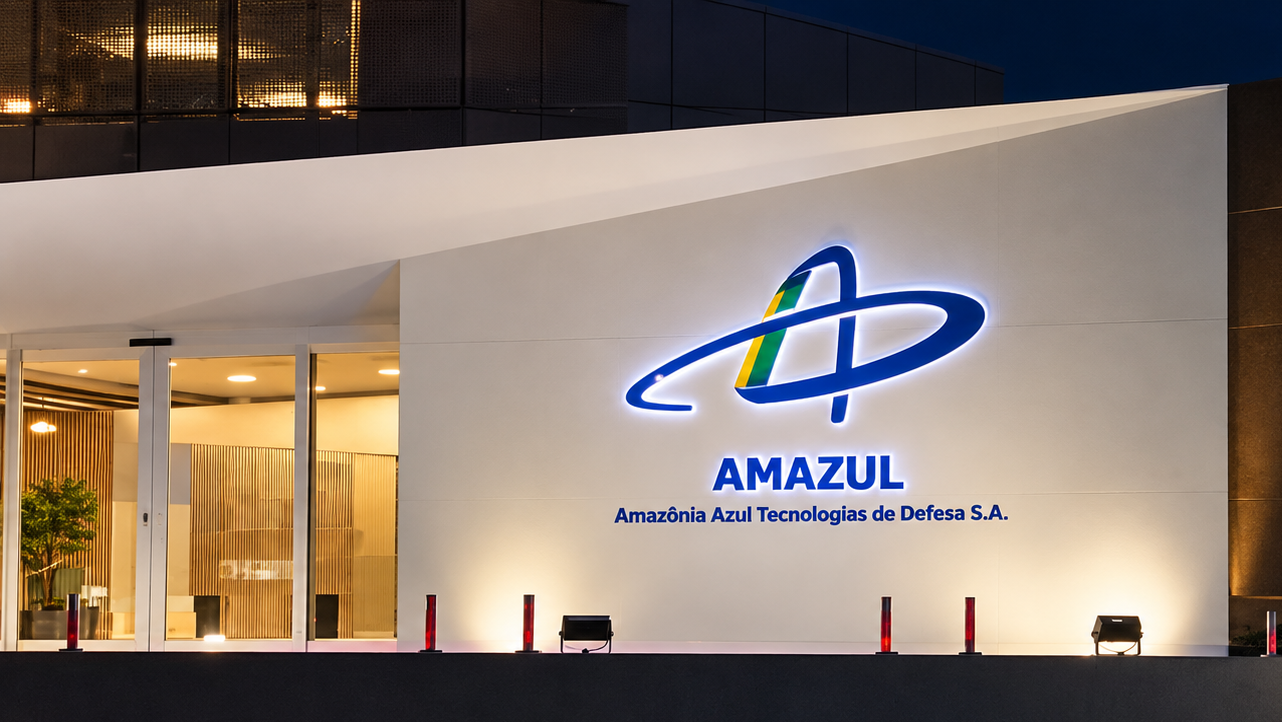
By Brazil Stock Guide – Brazil’s state-owned nuclear technology company Amazul has begun a new phase in the country’s uranium-enrichment program, taking part in the management of efforts to industrialize the manufacturing of ultracentrifuges developed by the Brazilian Navy.
The move does not mark the beginning of ultracentrifuge production in Brazil. The country has manufactured the equipment for years and already operates domestically developed centrifuges at the nuclear fuel facility run by Indústrias Nucleares do Brasil, or INB, in Resende, Rio de Janeiro.
What is new is the institutional step disclosed by Amazul: the company said it has started participating in the management of the industrialization process for ultracentrifuge manufacturing, an activity currently conducted by the Brazilian Navy’s Technology Center in São Paulo, known as CTMSP.
A dedicated unit, called the Núcleo de Implantação da Industrialização das Ultracentrífugas, or NIUCT, is being created to manage the transition and help structure the industrial capacity required for manufacturing, according to minutes of an Amazul board meeting published Tuesday in Brazil’s Official Gazette.
Amazul described the initiative as a “new stage” in its operations and said it would expand the company’s strategic role in Brazil’s nuclear program.
Amazônia Azul Tecnologias de Defesa, or Amazul, is a state-owned technology company linked to the Brazilian Navy. It provides engineering, technological and project-management capabilities for the country’s nuclear programs, including work related to nuclear fuel, naval nuclear propulsion and other strategic technologies.
The company was created in part to preserve and develop technical knowledge accumulated by Brazil’s Navy nuclear program and has become increasingly involved in projects across the civilian nuclear industry.
Brazil’s ultracentrifuge technology was developed domestically by the Navy’s CTMSP in partnership with nuclear research institute IPEN. The centrifuges are used to increase the concentration of uranium-235, a critical step in producing fuel for nuclear power reactors.
Amazul itself is not new to their manufacture. Between 2018 and 2022, its technicians and specialists, working under Navy supervision, participated in the planning, design, manufacturing and assembly of ultracentrifuges used in four enrichment cascades, according to a company report.
The latest disclosure therefore signals a shift in scale and organization rather than the introduction of the technology itself.
Brazil completed the first phase of INB’s uranium enrichment plant with 10 centrifuge cascades. The second phase, known as the Commercial Uranium Enrichment Plant, or UCEU, is planned to add another 30 cascades. Amazul has already been contracted by INB to develop the basic engineering project for that expansion.
According to previously announced plans, the additional capacity is intended to allow Brazil eventually to meet domestically the enriched-uranium requirements of its nuclear power plants, reducing its reliance on enrichment services abroad.
The industrialization initiative disclosed this week addresses another part of that equation: building the manufacturing capacity needed to produce the centrifuges themselves on a more structured industrial basis.
The board minutes also show progress elsewhere in Brazil’s nuclear fuel infrastructure. Amazul said an upgrade of the boiler system at the USEXA uranium hexafluoride production unit had been completed and that equipment had been contracted for a special compressed-air system at the facility.
Both projects are part of the broader effort to strengthen Brazil’s domestic nuclear fuel cycle.
For Amazul, the creation of the NIUCT suggests a broader evolution in its role: from providing engineering and specialist support to taking part in the organization of the industrial infrastructure behind one of Brazil’s most strategically sensitive nuclear technologies.
The expansion of Amazul’s role is not limited to the nuclear fuel cycle. The company also said it has held talks with Petrobras over potential cooperation involving small modular reactors, or SMRs, as part of the oil producer’s decarbonization program. According to the board minutes, discussions have begun over possible cooperation instruments involving Petrobras, the Brazilian Navy and Amazul.


Leave a Reply