
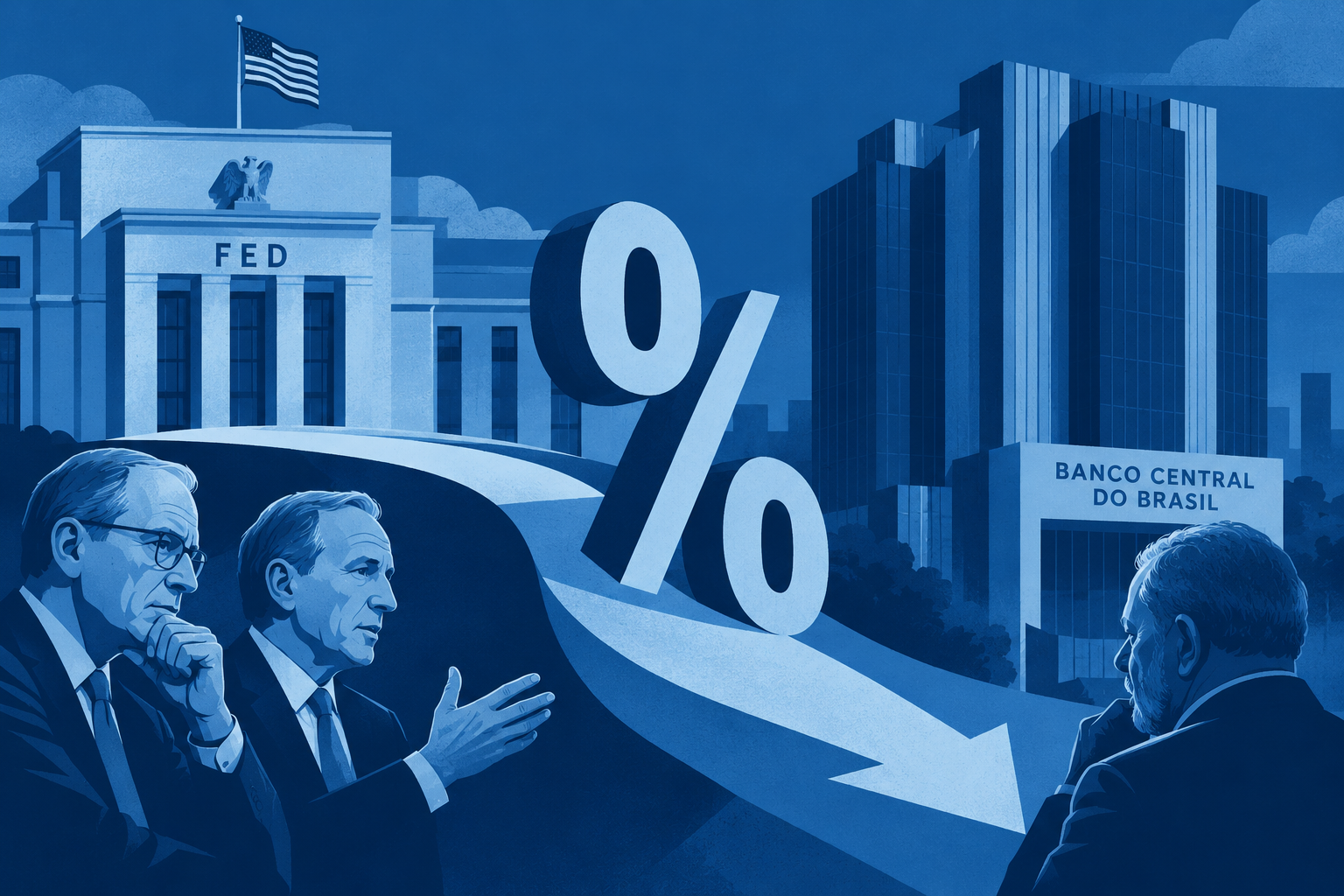
The Federal Reserve left U.S. interest rates unchanged at 3.75%–4%, in a 10–2 vote. The decision comes amid an increasingly intense debate over the limits of monetary policy and the effectiveness of the models used by central banks. For Brazil, where Luiz Inácio Lula da Silva has just been re-elected to an unprecedented fourth presidential term and the benchmark Selic rate stands at 13.75%, the discussion is particularly relevant. Why does the country continue to rely on such high interest rates to control inflation? And what needs to change for borrowing costs to decline sustainably? These should be central questions for Brazilian economic policy.
Two recent articles in The Wall Street Journal help frame the debate. Alan Blinder, a former Federal Reserve vice chairman, emphasized the importance of central bank communication in shaping expectations and economic decisions. David Malpass, a former World Bank president, challenged conventional inflation-fighting models, arguing that high interest rates do little to resolve supply-side shocks, such as rising energy prices and production bottlenecks. Their approaches differ, and some of their claims are open to debate. Yet both raise a fundamental question: how can monetary policy become more effective without imposing unnecessary costs on economic growth and investment?
This is more than an academic debate. Under Chairman Kevin Warsh, the Fed has established five working groups to reassess its communication strategy, inflation models and other analytical tools. One of the groups includes Arminio Fraga, a former governor of Brazil’s central bank. In the United States, examining the limits and effectiveness of monetary policy has therefore become an institutional undertaking, bringing together economists from different schools of thought. The objective is not to weaken the commitment to price stability, but to assess whether the tools currently available remain the most appropriate for achieving it.
In Brazil, the central bank’s operational independence, established by law in 2021, protects monetary policy decisions from undue political interference. But that does not mean its methods and outcomes should be exempt from public scrutiny. The Central Bank of Brazil has itself been regularly updating its economic models, incorporating new variables and experimenting with artificial intelligence tools to improve its forecasts. The question, then, is not whether technical revisions are taking place, but whether the existing combination of instruments and economic policies is sufficient to put Brazil on a path toward structurally lower interest rates. Debating the effectiveness of monetary policy is not the same as challenging central bank independence. It means recognizing that its tools, like those of any economic institution, should be subject to rigorous and transparent evaluation.
There are compelling reasons to broaden this discussion. Although the Selic has declined from its previous level of 15%, Brazilian interest rates remain exceptionally high, making credit more expensive, discouraging investment and increasing the cost of servicing public debt. Fiscal adjustment is essential to reducing risk and improving expectations, but it cannot be the only answer. The debate must also address price formation, supply shocks, productivity, competition in the financial system and the mechanisms through which monetary policy affects the broader economy. High interest rates can restrain demand, but they cannot, on their own, fix the structural weaknesses that constrain Brazil’s growth potential. There is also a contradiction worth confronting: expensive capital can undermine precisely the investments needed to expand productive capacity and ease future inflationary pressures.
Brazil needs to create the conditions to break this cycle. The Federal Reserve’s experience demonstrates that questioning economic models, improving analytical tools and debating the costs of monetary policy are entirely consistent with central bank independence. In Brazil, where technical revisions are already taking place, the next step should be a broader examination of their results and of the structural obstacles that keep borrowing costs so high. The fundamental question is what Brazil must do to avoid having to push the Selic back to such elevated levels, time and again.


Leave a Reply