
By Rodrigo Uchoa, special for Brazil Stock Guide
In September 2025, the French magnate Bernard Arnault landed in Shanghai to inspect the stores of his luxury empire, LVMH. After all, Louis Vuitton, Dior, Moët & Chandon, Bulgari and the group’s seventy-odd other brands have grown ever more dependent on the Chinese consumer. And yet what really caught the eye was his stop at the Taikoo Li Qiantan mall. There he walked into Songmont, a Chinese leather-goods label, and bought two bags. Then, a few doors down from Cartier and Van Cleef & Arpels, he spent half an hour inside Laopu Gold, a homegrown gold jeweller, peering at pieces and pendants and murmuring words like “exquisite” and “interesting.” He must have flown home with a nagging doubt: is China paving its way to dominate luxury as well?
Today a number of brands already stand out for the quality of what they make in this sizeable niche we lazily call “luxury.” Songmont, for one, was born in 2013, when designer Fu Song, fresh off maternity leave, couldn’t find a bag that was at once practical, roomy and beautiful (doesn’t it faintly echo the way the Birkin came about, after Jane Birkin complained to Hermès that no such bag existed?). She enlisted her grandmother, a traditional seamstress, and other artisans from Shanxi to bring a sketch to life.

In 2024, the brand showed at Paris Fashion Week — the first Chinese bag label ever to do so. In its pavilion it built an installation inspired by a Song-dynasty landscape painting and displayed one of its bags taken apart: 78 pieces in all, requiring 72 hours of work for each finished example. They use German thread, Italian edge oils and tanned leather, and cost roughly a third the price of a comparable European piece. The impact was resounding: online sales have grown nearly 90% over the past two years.
Laopu Gold is another spectacular phenomenon. Rather than charge for gold by weight, like a neighbourhood jeweller, it fixed its prices and put design front and centre. “The Hermès of gold,” people say. It worked: in 2025 revenue leapt 221%, to 27.3 billion yuan (about $3.95 billion), and net profit rose 230%. In February 2026 it raised prices by an average of 27% — its largest hike yet — and demand accelerated anyway. Cartier has gone so far as to warn investors about the rival. (The share price, admittedly, has proved that gravity exists: after soaring since its 2024 IPO, it slid from around HK$1,100 to near HK$470 by mid-2026. Enthusiasm, like gold, fluctuates.)
The tip of an iceberg
Songmont and Laopu are only what shows above the waterline. Below it, there’s a whole shoal.

Begin with high fashion. Shang Xia, founded in partnership with Hermès itself, elevates Chinese craft into furniture, silk and jewellery. Icicle joined Paris’s official calendar in 2025, having bought the French house Carven and opened a five-floor store on Avenue George V. Uma Wang, founded in Shanghai in 2009, manufactures in Italy and sells in more than a hundred luxury addresses, from London to New York, in an almost poetic minimalism of faded drapery, deconstructed tailoring and fabrics that seem to have aged on purpose. And then the keepers of memory: Ne·Tiger, one of the country’s oldest couture houses, specialising in silks embroidered with imperially inspired techniques; and Exception de Mixmind, a conceptual label founded in 1996 that made its name dressing Chinese public figures at affairs of state.
From fashion, leap to cashmere: 1436, of the Erdos group, spins the hair of Inner Mongolian goats into pieces described as “white as snow, light as cloud,” and is treated as a Chinese Loro Piana. From jewellery, note the irony: Qeelin, a high-end jeweller with shops from Paris to Tokyo, belongs to the Kering group — meaning part of China’s answer to European luxury is already, technically, European.
In beauty we may find the unlikeliest case of all. Mao Geping bears the name of a makeup artist who began in the opera and built a premium brand around what he calls “Oriental aesthetics,” heavy on facial contouring and the play of light and shadow. When it went public in Hong Kong in late 2024, the shares jumped nearly 80% on the first day and the makeup artist became a billionaire. In 2025 revenue grew 30%, to 5.05 billion yuan (US$ 750 million), with counters in more than 300 department stores and prices that flirt with those of Lancôme and Estée Lauder.
The thread running through all these brands is a mix of originality, identity and disdain for the prejudice that still lingers. The world learned to associate “made in China” with fakes — some bad, some exceptionally good, the kind you can’t tell from the originals. These new brands propose the opposite: millennia-old craftsmanship, not a discount, is the competitive edge. This is no cheap copy of Paris; it is a “grammar of its own” (as the trend forecasters love to say, ad nauseam), with iconography and materials that Western houses struggle to imitate without sounding opportunistically touristy.
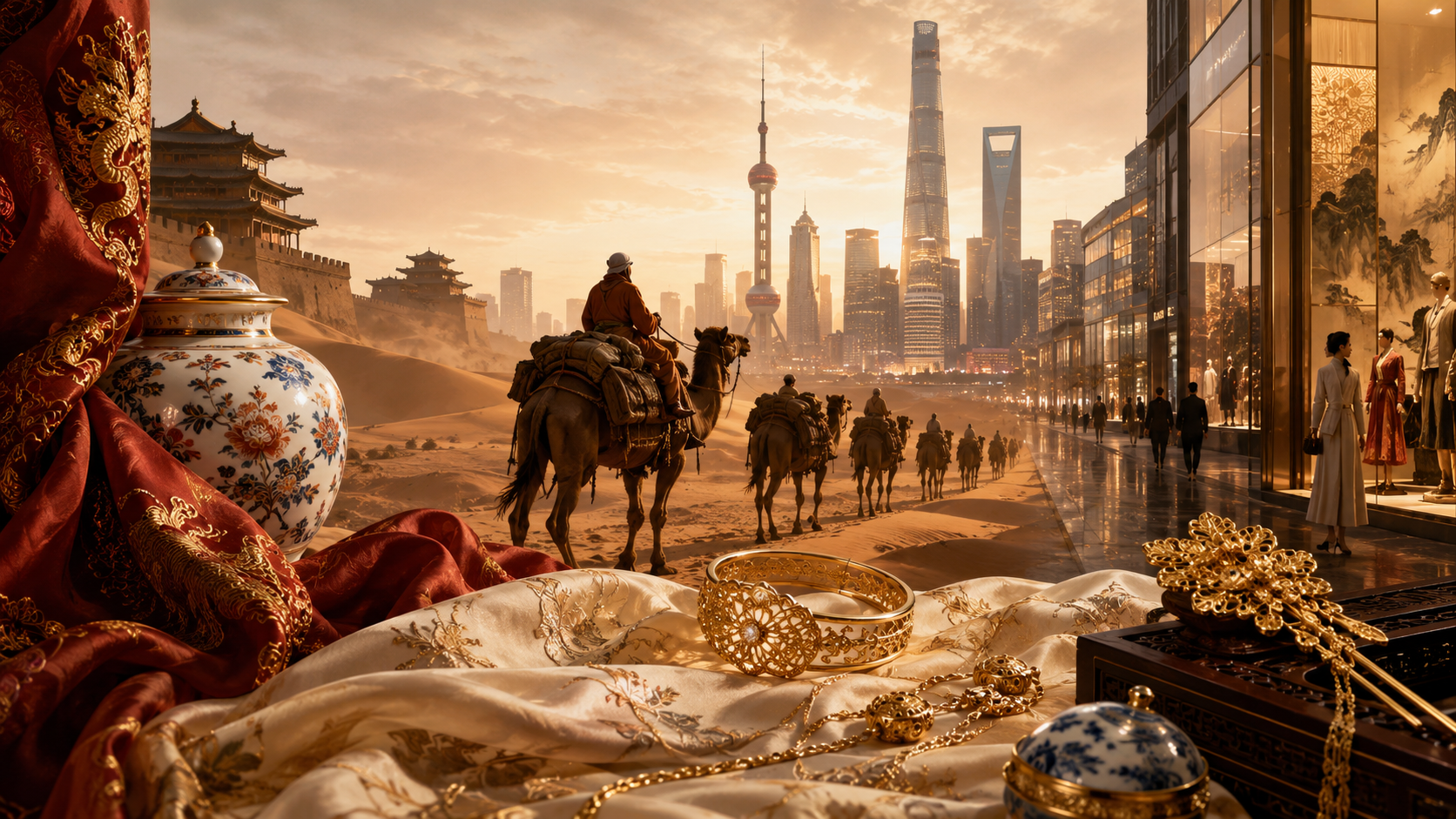
A historical footnote here, one the West mislaid in its rush to invent luxury. Chinese silk has been an object of desire for more than two thousand years: the Romans called China Seres, “the silk people,” and spent fortunes on fabrics that travelled the route that became known, fittingly, as the Silk Road. And then there is porcelain — which in English is simply called china, for the unglamorous reason that, for centuries, the fine, translucent ware Europe craved came from one place and one place only. European craftsmen could not reproduce it until 1708, in Meissen, Germany, and only after a great deal of industrial espionage. In other words: China was exporting luxury to Europe while much of the so-called Western world still ate from pewter bowls. The current chapter may be less a novelty than a reunion.


It is also worth remembering who paid for luxury’s party over the past two decades. In 2000, Chinese consumers accounted for about 1% of global personal-luxury spending; today, counting purchases at home and abroad, they top 30% of the total. That appetite is what swelled the windows and the tills of Chanel, Dior and Prada. The trouble is that the tide is going out: worldwide, the personal-luxury market slipped from €369 billion in 2023 to €358 billion in 2025, and shed some 60 million customers in three years. LVMH’s fashion-and-leather sales in Asia-Pacific fell 8% in the first half of 2025; Gucci shut 18 stores in China and watched online handbag purchases plunge by more than half.
Contrary to appearances, the Chinese consumer is not practising austerity. The claim that “the Chinese are cutting back” does not survive the numbers. China’s market dipped a modest 3–5% in 2025; Laopu raised its prices and grew 221%. The Chinese shopper isn’t simply closing the wallet — he is deciding where to open it.
Analysts resist reducing the phenomenon to mere flag-waving. Luxury Society points to two engines: Songmont wins on agility, marrying trend with daily utility; Laopu, on a logic of value and transparent pricing that wins over a risk-averse buyer. The decisive dimension, though, is cultural: these Chinese brands offer a modern rereading of tradition that a Paris label simply cannot pull off. That is the differentiator when everyone is fishing in the same pond — research by Frost & Sullivan found a 77.3% overlap between Laopu’s customers and those of five Western giants: Louis Vuitton, Hermès, Cartier, Bulgari and Tiffany. Arnault’s own visit, they say, is the tacit acknowledgement of that contest. Bain counsels caution, at a moment when it is still debated whether this is a structural trend or a post-pandemic hangover, but most already bet on the former.
Whether Arnault went to Songmont out of curiosity, a nose for trends or acquisitive interest, no one will say for sure. Perhaps not even him. What is known is what every shopkeeper has known for five thousand years, ever since the first bolt of silk changed hands on a dusty road: when the customer picks up two pieces and heads for the till, it’s because he really liked them. And when that customer owns 75 rival brands, it pays to notice what he carries home.


Leave a Reply