
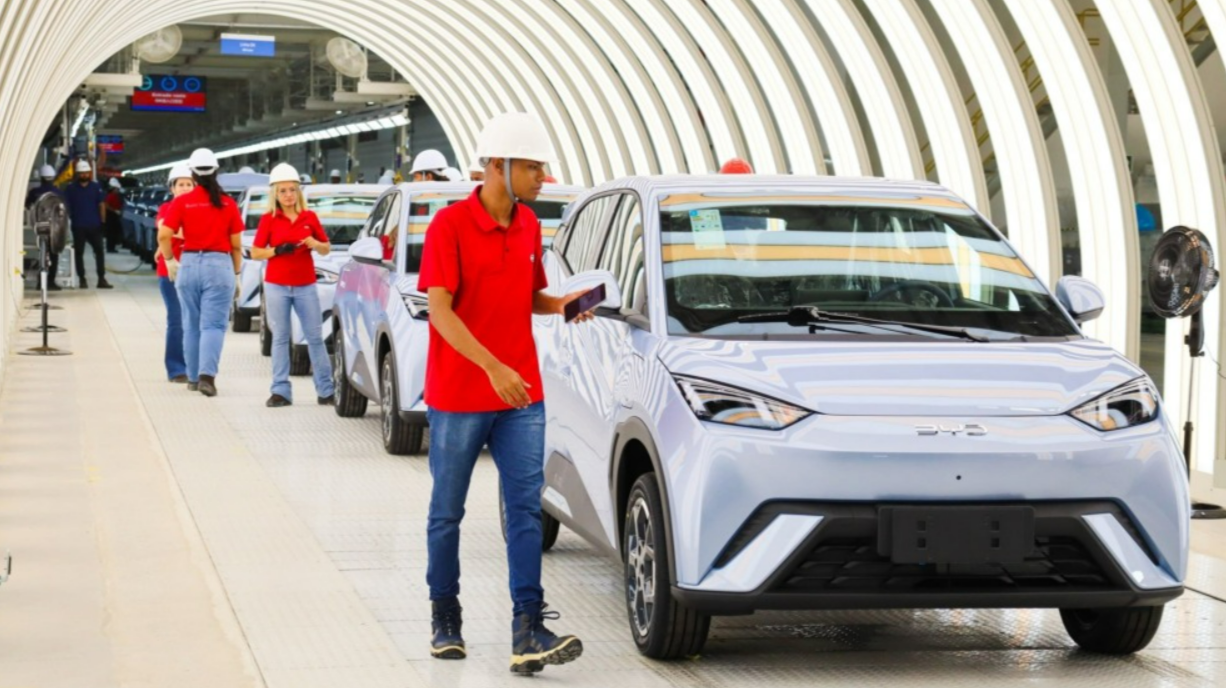
By Brazil Stock Guide – BYD Co. is seeking to restore tax benefits for imported electric-vehicle kits in Brazil, intensifying a policy dispute with the country’s auto industry as the Chinese carmaker works to scale up production at its factory in Bahia, according to UOL.
The company is trying to recover zero-duty treatment for imported EV kits, a benefit that expired in January. The request comes as BYD seeks more time to increase the local content of vehicles assembled in Brazil and qualify for federal incentives tied to domestic production.
For the request to advance, BYD needs approval from CAT, Brazil’s Tariff Alterations Committee, a technical advisory body within Camex, the Foreign Trade Chamber. CAT reviews tariff-change requests before they are submitted to Gecex, Camex’s executive management committee, which has authority over import-tariff decisions and other trade-policy measures.
BYD already benefits from ICMS tax incentives granted by the Bahia state government, where it is installing its manufacturing operation. The company is now pressing for additional federal relief while its local production remains below full capacity. Its vehicles are still being brought into the country largely assembled, according to the information available.
The lobbying effort gained traction on May 20, when Tyler Li, BYD’s president in Brazil, met with Geraldo Alckmin, then minister of development, industry, trade and services. Bahia Governor Jerônimo Rodrigues also attended the meeting. BYD pressed for the return of quota exemptions during the talks.
Government technicians defended the earlier decision to end the benefit. Rodrigues argued that the issue should be handled directly with the presidential palace. On Monday (15), BYD reiterated its position in a meeting with Marcio Elias Rosa, the current minister of development, industry, trade and services.
The zero-duty benefit for imported kits ended in January after a debate inside the government. Rui Costa supported BYD’s request, while Fernando Haddad opposed granting tax relief for imports.
The government ultimately granted the benefit for six months, although BYD had asked for three years. It also brought forward, from 2027 to July 2026, the increase in import taxes on fully built electric vehicles.
Anfavea criticizes EV tax breaks
Anfavea, Brazil’s national association of vehicle manufacturers, criticized any move to revive the exemptions. The group called for the full preservation of the tariff restoration schedule for imported electric cars and for maintaining the end of quotas that allowed imported kits to be used in vehicle assembly without full tax collection.
The association said the measures were the result of broad discussions on Brazil’s industrial policy and represented commitments made by the federal government to manufacturers operating in the country. In Anfavea’s view, preserving the rules is essential to ensuring predictability and stability for investment decisions.
The tariff transition policy for electric vehicles was created in 2023 and adjusted in 2025 after talks between the government and the productive sector. Anfavea says the current schedule balances the expansion of electrification with the need to stimulate local investment, quality jobs, income, innovation and long-term development.
The group argues that the tariff restoration does not close the Brazilian market. It says 11 new brands entered the country in the first quarter of this year alone, showing that competition has continued even as import taxes are being gradually restored.
Anfavea also pointed to rising inventories as a warning sign. Driven by imports, vehicle stocks reached 150 days in May 2026. The association says the lower-tariff period has been used by some companies to build inventories in advance, potentially distorting commercial conditions for competitors that produce in Brazil.
Local production race
The dispute comes as automakers with Chinese ties accelerate local manufacturing plans in Brazil. Stellantis NV, listed as STLAM IM and STLA US, has announced plans to produce Leapmotor vehicles in Pernambuco from 2027. Leapmotor is listed in Hong Kong as 9863 HK.
Renault SA, listed as RNO FP, and Geely will begin producing Geely’s EX2 and EX5 models in Paraná this year. Geely Automobile Holdings Ltd. is listed as 175 HK. Caoa, a privately held Brazilian group, brought Changan to Brazil and began producing the Uni-T in Goiás. Chongqing Changan Automobile Co. is listed as 000625 CH.
General Motors Co., listed as GM US, has also started producing the Spark in Ceará and announced plans to expand the operation with production of the electric Captiva. GM’s strategy has been to increase local content rather than rely primarily on imports.
BYD’s senior vice president in Brazil, Alexandre Baldy, said this week that some of the company’s vehicles may become more expensive if import benefits are not restored by the government. The models that could face price increases include the Seal, Sealion and Atto 8.
BYD has pledged to create 10,000 direct jobs at its Bahia factory by the end of this year. The operation currently employs about 5,000 workers.
Investment concerns
Anfavea says automakers in Brazil have announced more than 140 billion reais in investments through 2033. The funds are aimed at electrification, decarbonization, engineering, research and expansion of the supplier chain. The association says those commitments were made without requests for new quotas or changes to previously agreed rules.
The group says electrified vehicles produced in Brazil accounted for 26% of segment sales in 2025 and have already reached 40% in 2026. At the same time, registrations of imported electrified vehicles rose 214% between 2023 and 2025, which Anfavea says shows that the gradual tariff restoration has not prevented market growth.
Anfavea recognizes that imported kits can play a role in the early stages of industrial implementation. But the association argues that their use should evolve into productive integration, supplier development and technology incorporation, rather than become a high-volume model that distorts competition and weakens incentives for local value creation.
A study cited by the association estimates that large-scale vehicle production based on imported kits could lead to a potential loss of 96.8 billion reais in sales for the auto-parts sector, reduce federal tax revenue by 24.3 billion reais and eliminate about 68,000 direct jobs and 191,000 positions across the broader supply chain.
The industry group is calling for the full maintenance of the tariff restoration schedule, no renewal of zero-duty import quotas that ended in January 2026, no creation of ex-tariff mechanisms or equivalent tools to delay the schedule, and prior dialogue with the industry before any change to the conditions that supported announced investments.


Leave a Reply