
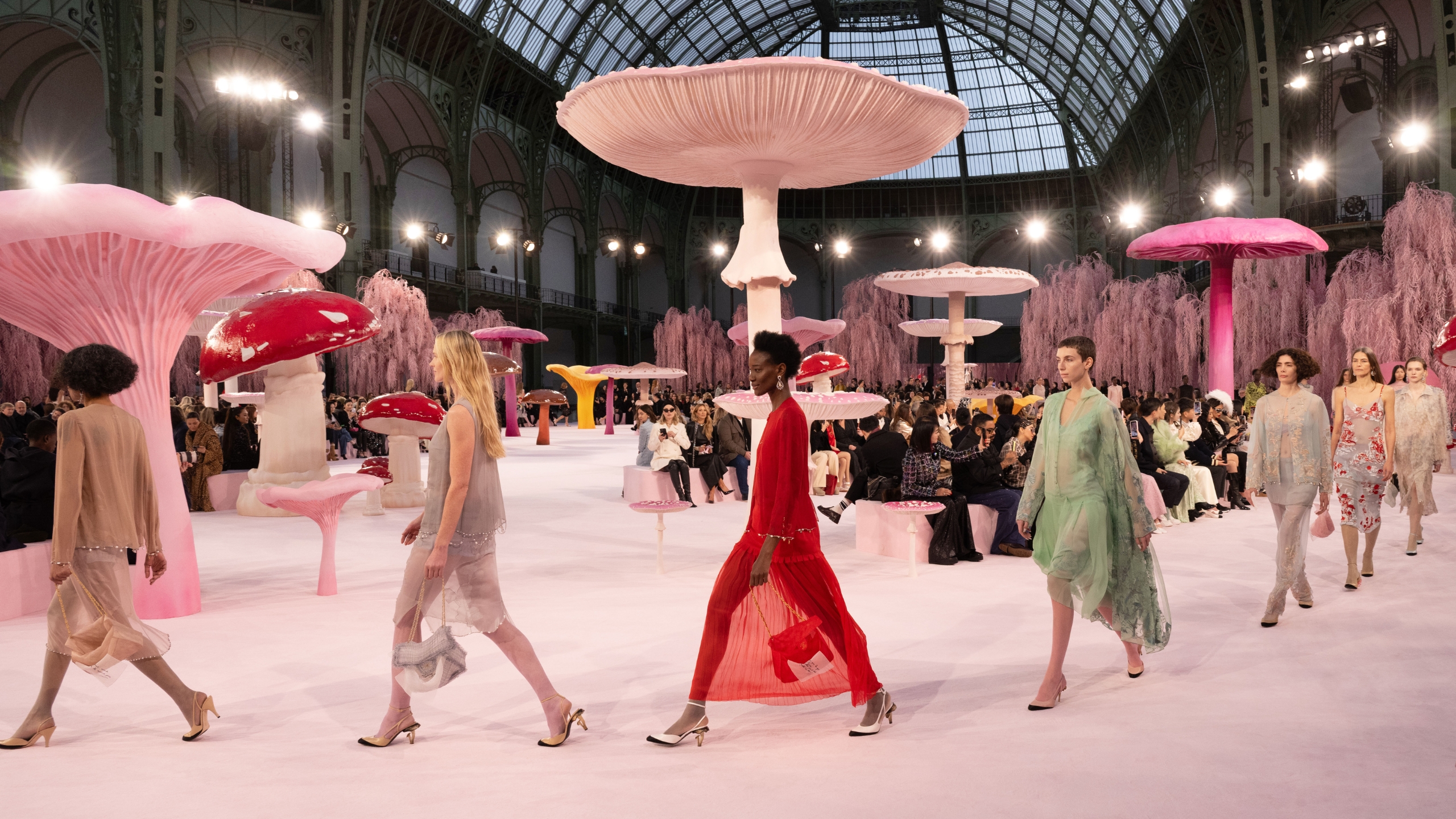
Chanel fashion show at the Grand Palais in Paris.
By Rodrigo Uchoa, special to Brazil Stock Guide
In October 2025, Matthieu Blazy walked through the backstage corridors of the Grand Palais as if taking possession of a foreign country. The Franco-Belgian designer, then in his early 40s, was becoming only the fourth creative director in the entire history of Chanel, a house founded in 1910. Over roughly the same period, Dior, for comparison, has had seven.
The collection was both a declaration of love and a gentle reckoning. It pushed Chanel’s familiar tweed off its pedestal — the same tweed endlessly cloned around the world — and stripped away the plaster-like camellias that had adorned bags and windows as if they were cemetery ornaments. In their place came softer proportions, a surprisingly red palette and fabrics that floated without affectation. Anna Wintour, the editor who inspired the mythology of The Devil Wears Prada, gave it a standing ovation. Financial markets tried to decide what to make of it.

Matthieu Blazy arrived with an idea that is, at its core, almost philosophical: craftsmanship as an act of subversion. At Bottega Veneta, he became known for creating leather pieces that looked like denim, flannel or cotton. It was trompe-l’oeil applied to fashion. The logic was elegant: the piece looks ordinary, but is extraordinary. The value lies in what cannot be seen.
In that sense, Blazy is almost anti-logo — exactly the kind of message Chanel, whose visual DNA is recognizable to almost any taxi driver in Tokyo, needed to hear at this particular moment.
His arrival is not just the arrival of a designer. It is the most visible symptom of a broader transformation running through luxury fashion — part deliberate strategy, part nervous response to worsening numbers.
In 2024, for the first time since the 2008–09 financial crisis, global sales of personal luxury goods contracted by 2%, reaching €363 billion, according to Bain & Company. Over the past two years, 50 million consumers left the market. They did not vanish all at once. They drifted away steadily, as brands kept raising prices while offering too much of the same thing.
Chanel is the emblematic case. It raised prices by 59% between 2020 and 2023, the sharpest increase in the sector, and paid the price in 2024: revenue fell 4.3% and operating profit dropped 30%. It was not alone. LVMH reported a 22% decline in net profit in the first half of 2025. Kering shares fell 39.4% over the course of 2024. Gucci saw sales fall 25% in a single quarter of 2025. China, the growth engine of the previous decade, recorded a 20% drop in luxury sales. But consumers did not disappear. Many simply moved to local brands. Chinese jeweler Laopu Gold grew 167% over the same period.

The financial crisis is only half the story. The other half is a change in the operating model — one that fashion houses prefer to describe as evolution, and more cynical analysts might call institutionalization.
For decades, luxury fashion was governed by a simple formula: find a genius, place him or her on the throne of a historic maison, and let the myth do its work. Karl Lagerfeld was Chanel for 36 years. His reign was so long that, for two generations of consumers, the distinction between the man and the brand almost ceased to exist. When figures like that left, fashion houses often looked as disoriented as countries after a coup.

That era is over.
What 2025 left behind was an unprecedented game of musical chairs. Jonathan Anderson, after 11 years at Loewe, became the first designer since Christian Dior himself to oversee Dior’s menswear, womenswear and haute couture at the same time. Georgian designer Demna moved from Balenciaga to Gucci. Glenn Martens replaced Galliano at Margiela. Pierpaolo Piccioli, who had left a deep mark on Valentino, took over Balenciaga.
They have one thing in common that many of their predecessors did not: they are manageable. Talented — some genuinely extraordinary — but not irreplaceable. LVMH and Kering, which together control dozens of brands and report results to shareholders every quarter, need creativity that can fit inside a spreadsheet.
HSBC captured the uncertainty with unusual bluntness. The bank said it had “no idea” whether the new collections would sell, but still expected the shows to generate enough traffic for sales teams to convert curiosity into purchases of whatever products were available. The designer, in other words, as bait.

The new buyer
If aspirational consumers were priced out, who are luxury brands now trying to win over?
Two groups stand out: the ultra-rich, who do not meaningfully distinguish between a €3,000 bag and a €4,500 one; and younger consumers in emerging markets. Bain expects Latin America, India, Southeast Asia and Africa to add more than 50 million new luxury consumers by 2030. That is almost exactly the number lost in mature markets.
Brazil is part of that shift. The country moved R$ 98 billion in luxury goods and services in 2024, across a broad spectrum ranging from private aviation to fashion, growing 12% a year — roughly four times the global average.
The quieter lesson, however, continues to come from brands that never promised exclusivity to consumers who could barely afford it. Hermès grew 9% in the second quarter of 2025. Brunello Cucinelli grew 10%. Gucci, by contrast, was shrinking by a quarter. Cucinelli calls its strategy “gentle, healthy and sustainable growth.”
Chanel’s circle
Chanel was founded by a woman who rejected the corset, shortened skirts and wore fake jewelry on purpose, as if to say that value belonged somewhere else. Coco Chanel reinvented elegance at a moment when the old rules of elegance had become unsustainable.
There is something circular in the fact that her house now needs to do the same — not with fabric, but with strategy. Blazy believes the extraordinary can disguise itself as ordinary; that leather can look like denim; that a century-old maison can suddenly appear new.
Whether this is the beginning of a new world for the great fashion houses, or merely the end of the old world on which they were built, depends on the light in which one chooses to look.


Leave a Reply