
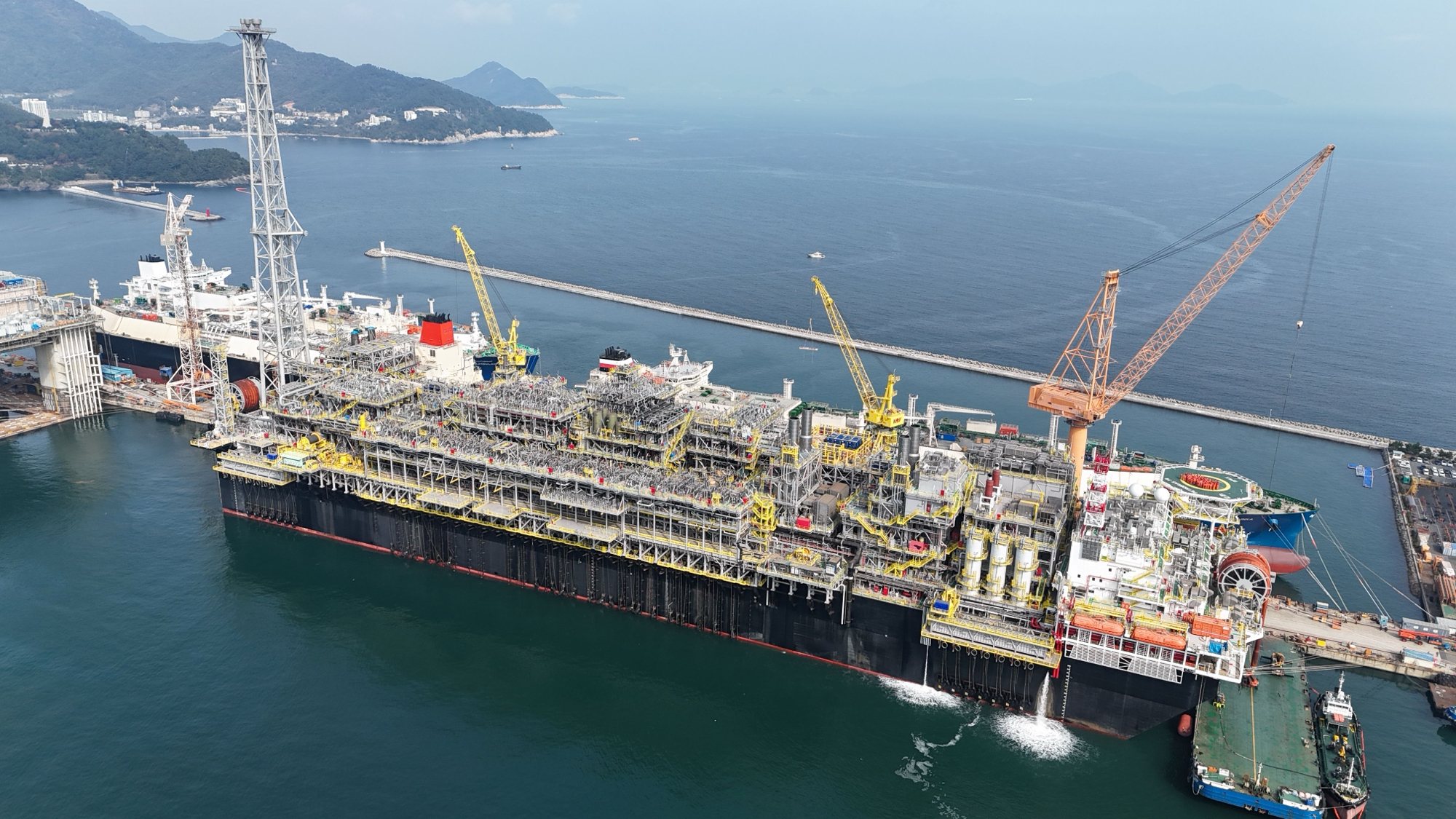
By Brazil Stock Guide – Petrobras (PETR3, PETR4) has started production from the P-79 platform in the Búzios field ahead of schedule, reinforcing the pre-salt’s role as the company’s main growth engine. The unit, also known as Búzios 8, began operations on May 1, ahead of the timeline set in Petrobras’ 2026–2030 Business Plan.
P-79 can produce up to 180,000 barrels of oil per day and compress 7.2 million cubic meters of gas daily. With the new unit, Búzios’ installed production capacity rises to about 1.33 million barrels of oil per day, consolidating the field as Brazil’s largest oil field by reserves.
Búzios gains scale
The impact goes beyond oil. The new platform will be able to export gas to the mainland through the Rota 3 pipeline, with the potential to increase Brazil’s domestic gas supply by up to 3 million cubic meters per day. In a market still constrained by infrastructure bottlenecks, that makes Búzios relevant not only as an oil field, but also as a strategic source of gas for Brazil’s energy system.
The early start-up also sends an operational message. P-79 arrived in Brazil in February from South Korea with commissioning and operating teams already on board. According to Petrobras, this strategy allowed the company to avoid a stop in sheltered waters in Brazil and advance system commissioning during the voyage, improving safety, reliability and operational readiness before first oil.
Offshore execution
P-79 is an FPSO with a newbuild hull and technologies designed to reduce emissions and improve operating efficiency. The Búzios 8 development project includes 14 wells — eight producers and six injectors — equipped with intelligent completion systems, which help optimize production management and reservoir performance.
The unit will be connected through rigid pipelines for production, injection and gas export, as well as flexible lines for service systems. The configuration is designed to support the high-capacity production expected from Búzios’ wells.
Pre-salt dominance
P-79 is the eighth platform operating in Búzios, Brazil’s largest oil field by reserves. Discovered in 2010, the field is located about 180 kilometers off the coast of Rio de Janeiro, in ultra-deep waters of the Santos Basin, at depths of more than 2,000 meters.
Búzios surpassed the milestone of 1 million barrels per day last year and has become the clearest symbol of Petrobras’ ability to produce oil at scale in the pre-salt. The field already operates with the FPSOs P-74, P-75, P-76, P-77, Almirante Barroso, Almirante Tamandaré, P-78 and now P-79. P-78 began production in December 2025.
More units are still coming. FPSOs P-80, P-82 and P-83 remain under construction, while Búzios 12 is under bidding. In total, the field is expected to operate with 12 FPSOs.
Cash-flow engine
For Petrobras, the early start-up of P-79 supports a central pillar of its business plan: concentrating capital in high-productivity assets with competitive lifting costs and stronger cash-generation potential. In an industry pressured by dividends, energy transition demands and capital discipline, Búzios remains Petrobras’ strongest case for growth with capital discipline.
The Búzios consortium is operated by Petrobras and also includes Chinese partners CNOOC and CNODC, as well as PPSA, the state-owned company that manages Brazil’s production-sharing contracts. The presence of Chinese partners reinforces the strategic weight of the field, which combines geological scale, technological complexity and geopolitical relevance.


Leave a Reply