
By Rodrigo Uchoa, special for Brazil Stock Guide
On the night of April 13th, in the ballroom of the Copacabana Palace hotel in Rio de Janeiro, Ivan Ralston took the stage with the expression of a man who had just heard his own name in a verdict that had taken years to deliver. The chef of Tuju, a São Paulo restaurant whose tasting menu traverses the Brazilian biomes like a botanical expedition with tucupi sauce, had just received three Michelin stars — the highest distinction awarded by the world’s most influential restaurant guide. Beside him, at the same ceremony, Luiz Filipe Souza, at the helm of Evvai, celebrated an identical achievement with the composure of a man who builds bridges between Brazil and Italy, dish by dish. For the first time in the guide’s history in Latin America, two restaurants had simultaneously reached the top of the hierarchy.

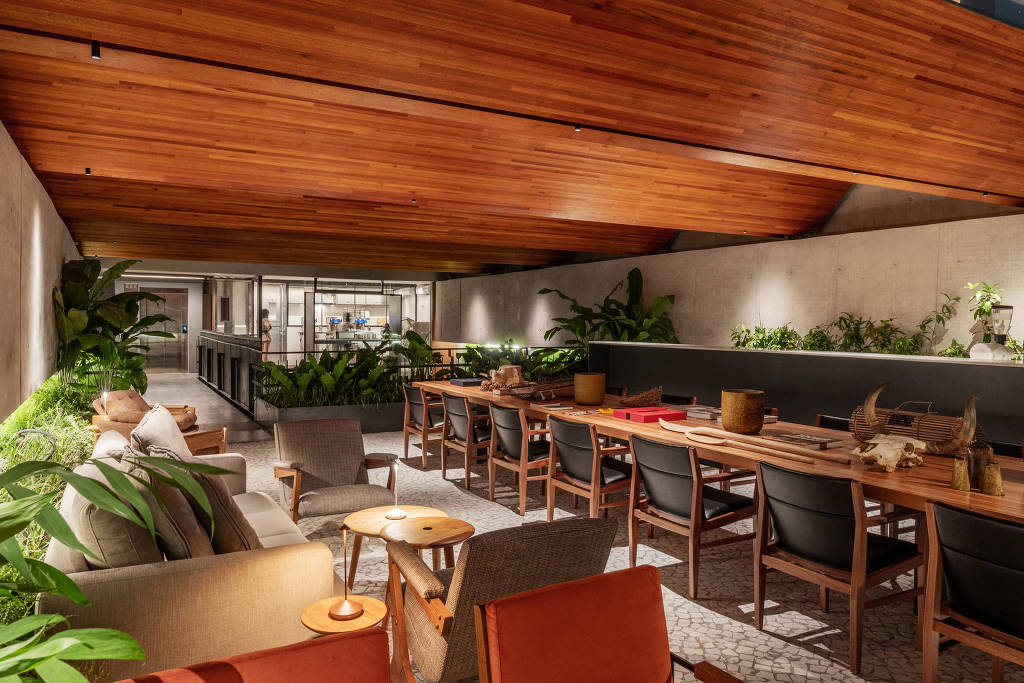
Tuju reopened in 2023, following a pandemic-era hiatus during which Ralston undertook a philosophical redesign of his restaurant. He began offering diners a journey through the floors of a house in the Jardim Paulistano neighbourhood, where vertical gardens frame each room. The menu changes four times a year, following the seasons of the Brazilian rains — a choice that, in a country of biomes as diverse as Brazil’s, transforms the menu into something approaching an edible scientific journal. Evvai, in the Pinheiros district, takes a different but equally Brazilian path: Italian immigration as sentimental raw material, reinterpreted through local ingredients. These are dishes that, in the words of those who have tasted them, “go beyond the obvious.”
The Michelin star map reveals a gastronomic geopolitics with few surprises and a great deal of symbolism. France, the native country of a guide originally created by a tyre manufacturer to encourage motorists to travel — and consequently wear out their rubber — holds the greatest number of three-star restaurants in the world: 34. Japan, which over recent decades transformed Tokyo into the city with the most Michelin stars on the planet, also counts more than 30 addresses with the maximum distinction. Italy, Spain and the United States follow.
Brazil, which until a few weeks ago did not appear on this map, now does. The question raised by critics with more discernment than diplomacy is: is that entirely good news?

The guide’s criteria are five: quality of ingredients, technical mastery, harmony of flavours, creative personality and — the most demanding of all — consistency over time. Anonymous inspectors visit restaurants many times, pay their bills like any ordinary customer and care nothing, at least in theory, for the décor, the price or the chef’s celebrity. What matters is the plate. Simple enough. Or it would be simple, were the result of this process not a system that, by its own logic, tends to reward a particular idea of sophistication — meticulous, restrained and expensive — while overlooking anything that might resemble improvisation, even when that improvisation is inspired.
The most persistent criticism of Michelin is precisely this: by defining universal criteria for excellence, the guide ends up exporting a culinary aesthetic — one largely identified with the French classical tradition or with Nordic fine dining — to cultures where that aesthetic is imported, not native. The result, the sceptics argue, is a kind of global gastronomic pasteurisation, in which restaurants in Bangkok, São Paulo or Cape Town gradually converge towards the same language of technique and presentation, calibrated to please Michelin inspectors. That Evvai built its reputation around an Italo-Brazilian cuisine, rather than a purely Brazilian one, does not escape, for some, a certain irony.
The experience of dining at a starred restaurant varies, naturally, with latitude. In a Parisian three-star — one of those establishments housed in palace hotels, where the bill arrives before the dessert has been fully digested — the ritual begins before the diner has even sat down. The maître d’ greets you by name, your coat is received with the reverence afforded to sacred relics, and the menu is presented as a document of state. The front-of-house service, trained over years in a tradition that confuses choreography with protocol, moves with a precision that oscillates between the sublime and the faintly unsettling. The wine is explained by sommeliers whose technical vocabulary suggests a doctorate from Burgundy. There is a deliberate background silence, as though speaking above a murmur were, in itself, a lapse of taste. Three hours, four courses, five hundred euros — at a minimum. And, at the end, the unmistakable sense of having taken part in something far greater than a meal.
In Latin America, the experience shares the same technical rigour, but is seasoned with something the French rarely manage to simulate: unscripted hospitality. At Central in Lima, or at the newly crowned Tuju in São Paulo, the chef may appear at the table not for a photograph, but to explain, with genuine enthusiasm, from which remote region a particular ingredient was sourced. The menu tells a story of territorial and political identity that transforms the meal into something beyond gustatory pleasure. There is music — discreet. The tables around you are having conversations. The bill, compared to its European equivalent, is considerably less painful.
What unites both experiences, however, is the weight they carry outside the restaurant.

In an era when dining at a starred restaurant has become progressively an act of identity curation, what is on the table matters less than the fact of having been there at all. The hard-won reservation, secured months in advance through some combination of persistence and connection, has become a currency of social prestige among a global class that has replaced safari trips and contemporary art acquisitions with gastronomic experiences as markers of cultural belonging. Knowing the chef’s name is valued, in certain circles, more highly than knowing the name of one’s own head of state. Conversation about the menus at Tuju or Evvai will circulate at parties in São Paulo and Rio for the coming seasons much as accounts of vernissage openings or first-class tickets once did.
Michelin, ironically, both fuels and critiques this phenomenon. The guide that was born to sell tyres has become a cultural arbiter whose decisions move markets and crush chefs under psychological pressure. The cases are well known: Bernard Loiseau took his own life in 2003 following rumours that he would lose a star; Sébastien Bras voluntarily asked to be removed from the guide in 2017. And yet the same guide possesses the power to transform cities into gastronomic tourist destinations overnight.
No sociological critique prevented reservations at Tuju and Evvai from selling out within hours of the April 13th announcement. After all, what use is a sociological critique when the table is already taken?
The Michelin Guide Rio de Janeiro & São Paulo is partially funded by the city governments of both cities, under a contract worth R$9 million running until 2026. A French tyre manufacturer, it bears noting, remains the final word in gastronomy.




Leave a Reply