
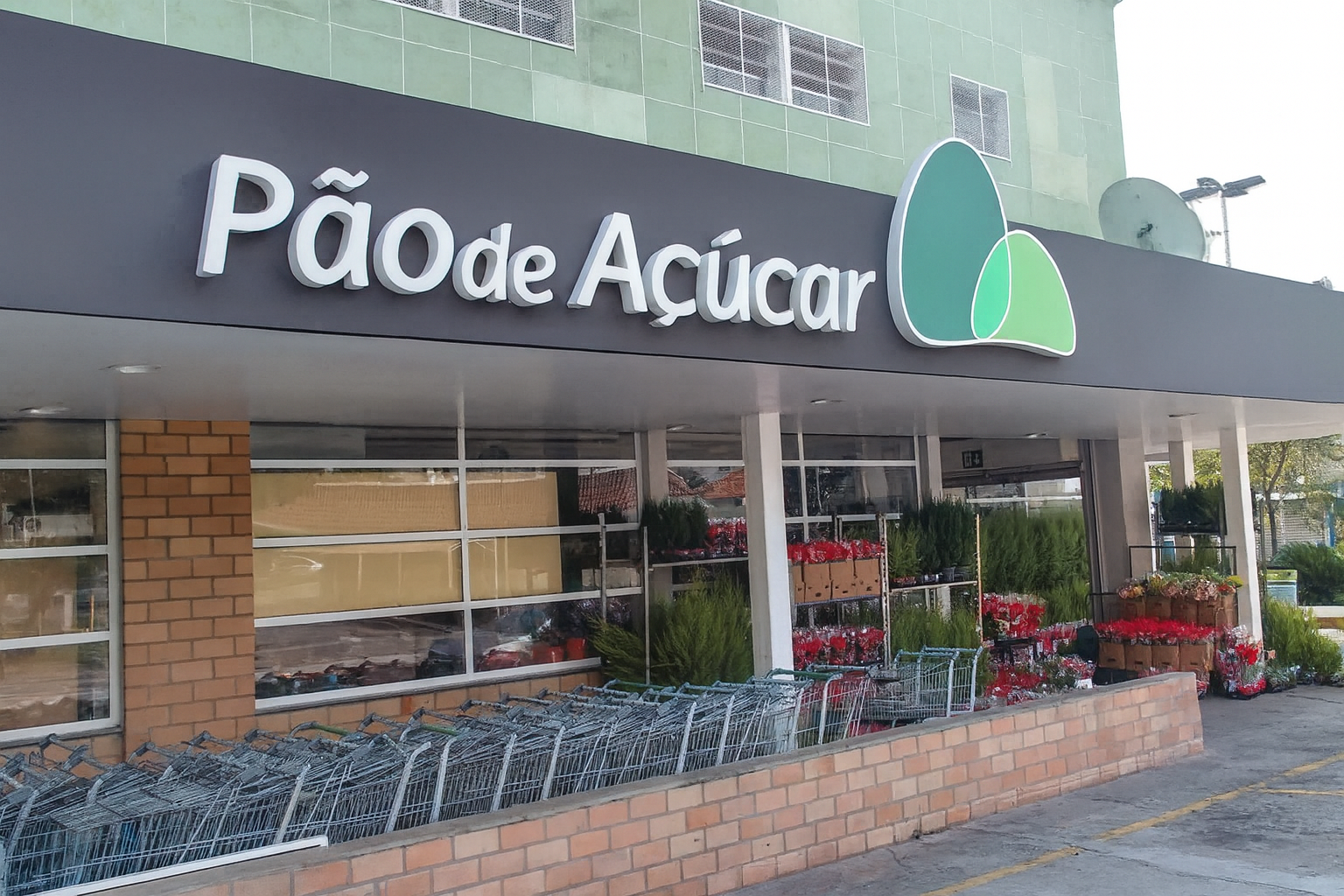
By Brazil Stock Guide – Brazilian food retailer GPA (B3: PCAR3), which operates the Pão de Açúcar and Extra Mercado supermarket chains, reported a consolidated net loss attributable to controlling shareholders of R$731 million in the third quarter of 2026, reversing a R$134 million profit a year earlier, as discontinued operations weighed on earnings and sales continued to decline.
Net revenue fell 9.6% to R$4.12 billion, compared with R$4.56 billion in the same period of 2025, according to financial results released Wednesday, November 4. Gross revenue declined 6.5% to R$4.60 billion, reflecting weaker same-store sales and the company’s decision to exit less profitable businesses.
Despite the losses, GPA reported stronger operating profitability. Adjusted earnings before interest, taxes, depreciation and amortization (EBITDA) rose 16.9% to R$482 million, while the adjusted EBITDA margin expanded by 2.7 percentage points to 11.7%.
The figures highlight the contrasting effects of GPA’s restructuring strategy, which has improved margins and reduced expenses but has yet to restore sales growth.
Discontinued Operations Drive Quarterly Loss
The company’s R$731 million consolidated loss included R$511 million from discontinued operations, primarily associated with former Extra hypermarkets and fuel stations.
A R$467 million provision accounted for most of the losses from those businesses, compared with an R$8 million loss from discontinued operations a year earlier.
Continuing operations recorded a R$220 million loss, reversing a R$142 million profit attributable to controlling shareholders in the third quarter of 2025.
However, the year-earlier result benefited from a nonrecurring R$418 million tax credit. Excluding that effect, GPA said its comparable loss from continuing operations narrowed by 20.3%, from R$276 million.
Financial expenses also remained a drag on profitability. The company’s net financial result deteriorated to a negative R$389 million from a negative R$317 million a year earlier, mainly reflecting lower financial income as average cash balances declined.
Same-Store Sales Fall as Supply Disruptions Persist
GPA reported a 1.4% decline in same-store sales during the quarter, as its debt restructuring process continued to disrupt supplier relationships and product availability.
The company said inventory shortages had eased compared with the second quarter but remained above levels recorded before its out-of-court debt restructuring announcement.
Management also cited elevated household indebtedness and pressure on consumers’ purchasing power as factors affecting demand.
Pão de Açúcar, GPA’s largest supermarket banner, generated R$2.46 billion in gross revenue, representing 53.6% of total sales. Same-store sales declined 0.7%, excluding calendar effects.
Extra Mercado reported R$1.51 billion in sales, with same-store revenue falling 1.9%. Its performance was particularly affected by inventory shortages.
GPA’s proximity-store division, which includes Minuto Pão de Açúcar and Mini Extra, generated R$581 million in revenue. Comparable sales declined 2.9%.
The company attributed 4.9 percentage points of its overall 6.5% sales contraction to strategic changes, including the discontinuation of its Aliados business model, the termination of a fulfillment partnership and the sale of loyalty platform Stix.
Cost Reductions Lift Operating Margins
GPA’s cost-cutting program continued to produce gains during the quarter, helping offset weaker revenue.
Gross profit increased 0.4% to R$1.26 billion, while the gross margin expanded to 30.7% from 27.6% a year earlier.
The improvement reflected a shift toward higher-margin sales channels, changes in the treatment of certain products under Brazil’s ICMS tax system and the closure of less profitable operations.
Selling, general and administrative expenses declined 7.8% to R$821 million from R$890 million in the same period last year.
The company said workforce reductions accounted for the largest share of savings, alongside renegotiated technology contracts, lower logistics expenses and reduced operating costs.
During the first nine months of 2026, GPA achieved R$365 million in efficiency gains, equivalent to approximately 88% of its R$415 million annual cost-reduction target.
Capital expenditure totaled R$226 million during the nine-month period, down 56% year over year. GPA maintained its full-year investment guidance of R$300 million to R$350 million.
Debt Restructuring Could Cut Net Debt by 67%
GPA’s debt restructuring remains central to its financial recovery strategy.
The company’s out-of-court restructuring plan received judicial approval in October 2026, establishing revised payment conditions and longer maturities for obligations covered by the agreement.
At the end of September, GPA reported net debt of R$3.76 billion, including credit-card receivables that had not been advanced, with financial leverage at 3.7 times adjusted EBITDA before IFRS 16.
On a pro forma basis, incorporating the restructuring terms and an expected R$293 million debt repayment from the sale of its stake in FIC, net debt would decline to approximately R$1.25 billion.
That represents a potential reduction of 67%, with leverage falling to 1.2 times adjusted EBITDA.
The restructuring would also extend the average debt maturity from 2.1 years to 6.4 years, while reducing scheduled payments through 2028 from R$5.2 billion to approximately R$400 million.
Average borrowing costs would decline from CDI plus 1.8% annually to CDI plus 0.5%.
These figures are pro forma estimates rather than the debt levels recognized in September’s financial statements. The FIC transaction remained subject to approval by Brazil’s central bank.
GPA expects the financial effects of the court-approved restructuring to be recognized in the fourth quarter of 2026.
E-Commerce Revenue Falls 13.7%
GPA’s digital operations generated R$517 million in sales during the third quarter, a 13.7% decline from a year earlier.
Sales through third-party platforms contracted 20.4%, while the company’s first-party channel recorded a smaller 4.3% decline.
Despite the lower sales volume, the company reported improved e-commerce profitability as it reduced exposure to lower-margin distribution channels.
The first-party channel increased its share of digital sales by 4.5 percentage points, while e-commerce accounted for 11.6% of total company sales, down 1.4 percentage points year over year.
Store Closures and Regional Restructuring
GPA ended September with 717 stores, down from 726 at the end of the second quarter.
The company closed one Pão de Açúcar supermarket, one Extra Mercado location, six Minuto Pão de Açúcar stores and one Mini Extra unit, citing underperformance.
Management has also begun implementing a regional operating strategy intended to improve product availability and adapt merchandise selections to local demand.
Rio de Janeiro was selected for the initial rollout of a revamped Extra Mercado strategy, which includes price reductions on more than 2,000 products.
The company is seeking greater flexibility in negotiations with local suppliers while simplifying its distribution network. Its logistics restructuring plan targets a reduction of approximately 50% in the total area occupied by distribution centers by 2028.
Nine-Month Loss Reaches R$2.42 Billion
For the first nine months of 2026, GPA recorded a consolidated net loss attributable to controlling shareholders of R$2.42 billion, compared with a R$252 million loss in the corresponding period of 2025.
Net revenue declined 9.1% to R$12.72 billion.
Adjusted EBITDA, however, increased 12% to R$1.39 billion, with the adjusted margin expanding to 10.9% from 8.9%.
Chief Executive Officer Alexandre Santoro identified the recovery of sales and normalization of supplier relationships as key priorities as GPA enters the final quarter of the year.
The company expects its recently approved debt restructuring to improve financial flexibility, support inventory availability and allow management to focus more closely on rebuilding commercial performance.


Leave a Reply