
By Brazil Stock Guide — Petrobras has entered uncharted territory for a Brazilian company. After reaching R$800 billion in market capitalization on Wednesday (October 14), the state-controlled oil producer has brought a once-distant milestone into view: a R$1 trillion valuation. The gap may look enormous in absolute terms, but it would require a further 25% increase in the company’s share price.
The prospect has become increasingly plausible following an extraordinary year on the Brazilian stock market. Since January, Petrobras’ common shares have gained approximately 110%, while its preferred shares have risen about 100%. In just 12 days, between October 2 and October 14, the company’s market value climbed from R$700 billion to R$800 billion.
The speed of that rally helps explain why a trillion-real valuation no longer seems out of reach. But it also raises a fundamental question for investors: how much of the increase reflects a lasting improvement in Petrobras’ underlying value, and how much depends on unusually favorable market conditions?
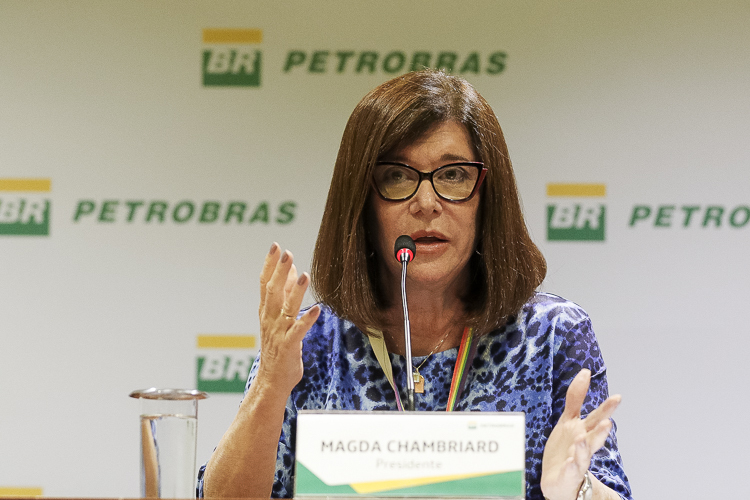
Petrobras CEO Magda Chambriard has expressed confidence in the company’s performance. Commenting on the latest record on Thursday (October 15), she reiterated an earlier warning to investors against betting on a decline in its shares.
“Anyone betting against Petrobras would lose money,” Chambriard said, adding that the company has demonstrated its ability to create value through consistent results.
Her confidence is supported by operating figures. Petrobras’ own oil production in Brazil reached 2.7 million barrels per day in the second quarter, up 15% from a year earlier. In the first half of 2026, the company reported net income of R$85.1 billion, an increase of 37.6% year-on-year.
The performance has coincided with a period of elevated global oil prices, boosting revenue and profit margins. But it also reflects expanding production from Brazil’s deepwater pre-salt fields, which have transformed Petrobras’ economics over the past two decades.
The pre-salt region contains vast, highly productive reservoirs that allow Petrobras to extract substantial volumes of crude at competitive costs. That advantage is particularly important in an industry where relatively small changes in international oil prices can produce significant swings in cash flow.
What Would a Trillion-Real Valuation Mean?
With approximately 12.89 billion shares outstanding, a R$1 trillion market capitalization would imply an average valuation of roughly R$77.59 per share. In practice, Petrobras’ common and preferred shares trade at different prices, but the calculation illustrates the scale of the additional gains required.
One path toward that valuation would involve a combination of rising output and international oil prices remaining at elevated levels.
Another would require a shift in investors’ perception of risk. As a federally controlled company, Petrobras’ valuation is influenced by expectations surrounding fuel-pricing policies, investment decisions and dividend distributions.
That political dimension has become particularly relevant ahead of Brazil’s presidential runoff election on October 25. The result could reshape expectations about economic policy and the relationship between the federal government and Petrobras, although the actual impact on the company’s shares would depend on subsequent policy decisions.
What Could Stand in the Way?
The biggest risk lies in one of the very factors behind the recent rally: oil prices. A sharp decline in international crude benchmarks would weigh on Petrobras’ revenue, margins and projected cash flow, potentially prompting investors to reconsider how much they are willing to pay for its shares.
Another challenge is balancing production growth with financial discipline. Developing new oil frontiers, expanding refining capacity and investing in the energy transition all require substantial capital. The returns generated by those projects, rather than the amount spent, will ultimately determine how much economic value the company creates.
The recent oil discovery off Brazil’s northern coast, in the Equatorial Margin region, adds potential to Petrobras’ portfolio. However, it remains too early to assign a precise economic value to resources whose size, production potential and commercial viability have yet to be established.
For investors, there is therefore an important distinction between Petrobras briefly reaching R$1 trillion during a favorable market rally and sustaining that valuation over time.
The first scenario depends largely on market expectations. The second requires sustained growth in free cash flow, profitable investments and confidence in the company’s corporate governance.
The R$800 billion milestone shows that investors are willing to assign Petrobras a substantially higher valuation than at the beginning of the year. Reaching R$1 trillion would require convincing the market that the company’s future earnings and cash-generating potential still contain significant value that has yet to be fully reflected in its share price.
A trillion-real valuation is no longer an implausible proposition. The question now is whether Petrobras’ operating performance can justify the additional R$200 billion needed to bridge the gap between its latest record and that milestone.


Leave a Reply