
By Brazil Stock Guide – COSCO Shipping Ports Limited is urging Brazilian authorities to reject any blanket ban on shipping lines in the auction of Tecon Santos 10, arguing that ex ante restrictions lack competitive justification and risk weakening both rivalry and proceeds in what is set to be the country’s most strategic port concession.
In a formal submission to Administrative Council for Economic Defense, the company says Brazil’s own antitrust and regulatory agencies have consistently concluded that vertical integration between shipping lines — vessel operators that also act as cargo carriers — and terminals is not illegal per se and should be assessed on a case-by-case basis. According to COSCO, a broad exclusion of such operators would contradict technical opinions issued by National Waterway Transport Agency and by the competition watchdog itself.
Strategic Asset at Stake
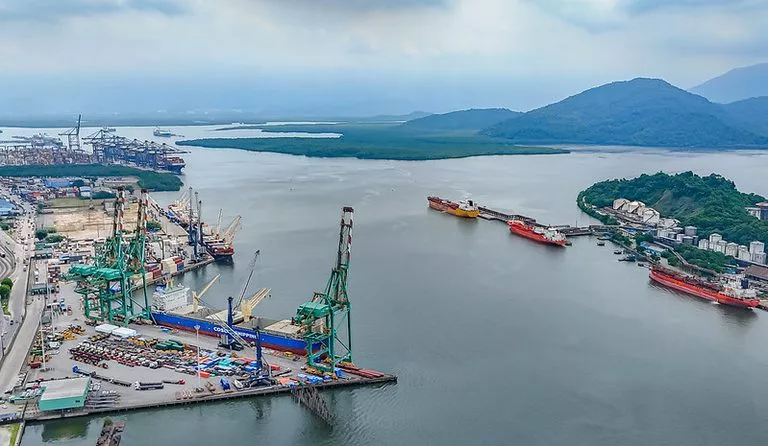
The Tecon Santos 10 project is located at the Port of Santos, which handles roughly a third of Brazil’s containerized foreign trade and serves regions accounting for more than half of national GDP. Designed as a greenfield megaterminal, the project foresees capacity of about 3.25 million TEUs per year and total investments of R$ 6.45 billion, aimed at easing congestion at a gateway that already operates close to its logistical limits.
Brazil’s federal government plans to auction the concession in the coming months after incorporating recommendations from the Federal Court of Accounts to mitigate excessive concentration and set a minimum concession fee of R$ 500 million.
Antitrust Lines Drawn
COSCO argues that competitive risks differ sharply between incumbent operators already active in Santos and new entrants without local terminal assets. Allowing non-incumbent shipping lines to participate would not raise intraport concentration and could instead increase contestability and bidding pressure, the company says.
Recent antitrust precedents support that view. Brazilian competition authorities have repeatedly found that vertical integration between shipping groups and container terminals does not automatically justify intervention, concluding that potential foreclosure risks can be addressed through regulatory safeguards rather than outright bans.
Case-by-Case Remedies
Rather than a general prohibition, COSCO advocates proportionate remedies focused on incumbents, including conditional participation tied to divestments, transparency obligations and post-auction monitoring mechanisms. Any residual concerns, it notes, would remain subject to CADE’s full ex post merger-control powers — similar to those exercised by antitrust authorities in the U.S. and the European Union.
The debate has implications beyond a single concession. As Brazil’s main container hub, Santos is central to the country’s trade flows, making Tecon Santos 10 a test case for how policymakers balance competition policy, infrastructure scale and foreign investment at a time of rising demand and tightening logistics capacity.


Leave a Reply