
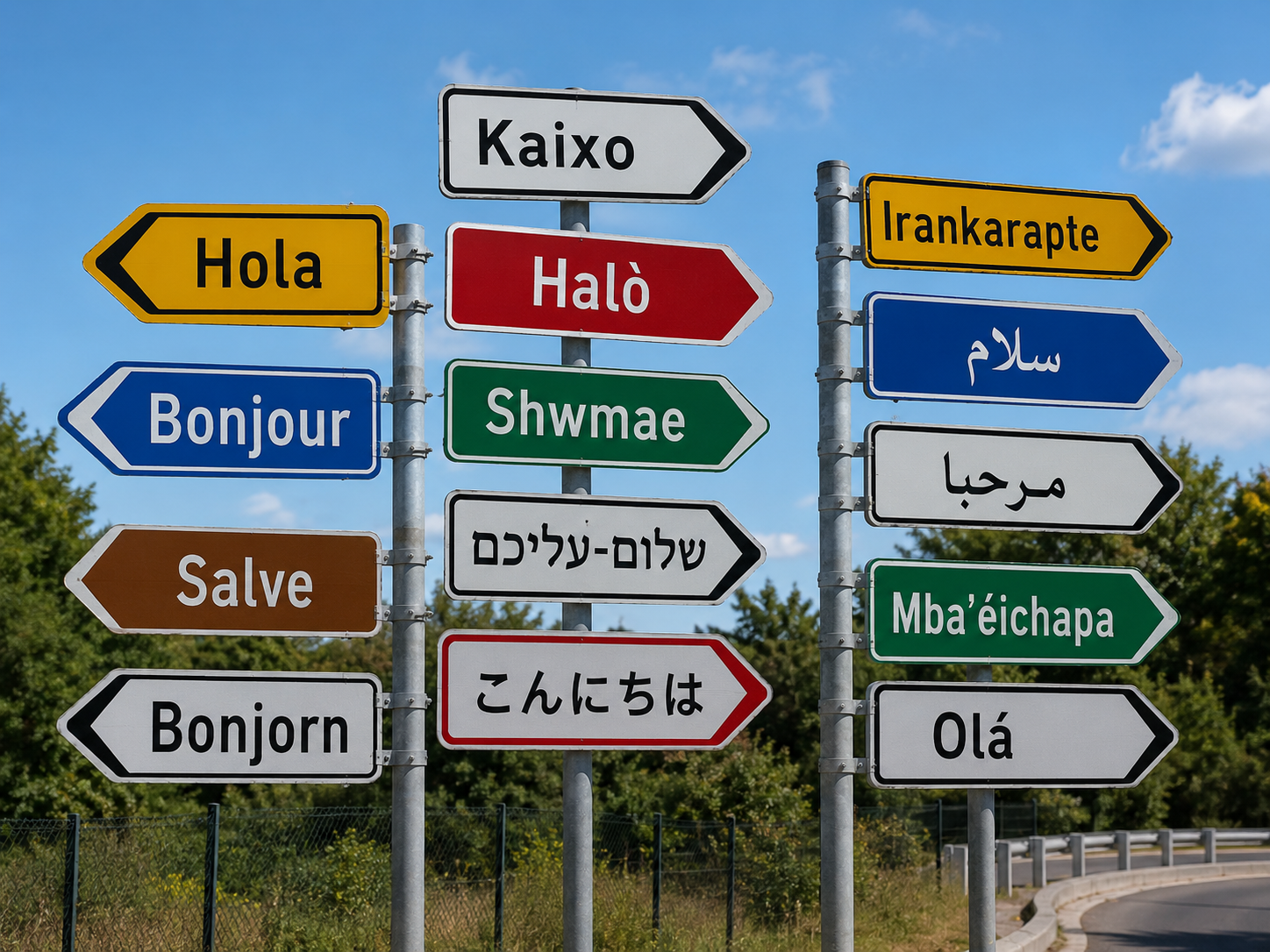
By Rodrigo Uchoa, special for Brazil Stock Guide
My surname has Basque origins: otxoa, meaning “wolf” in Euskara, the Basque language. Some years ago, before travelling to northern Spain, I tried to teach myself the language using whatever resources the internet had to offer at the time. It was little more than a curiosity, a way of winning the goodwill of bar staff in Donostia — San Sebastián — while ordering txakoli and pintxos, the local white wine and those small bar snacks meant to disappear in a couple of bites.
I had no greater ambition than that. The family name has been in Brazil “since the beginning of time”, as my grandfather liked to exaggerate, so there was no realistic prospect of tracing an ancestral village or finding long-lost relatives left behind who knows when. Nor was Euskara likely to improve my CV. Listing it among my languages would have amounted to something close to the deception at the heart of Lima Barreto’s The Man Who Knew Javanese.

Euskara is a language isolate, with no known relationship to any other language family on Earth. Spanish, French and Latin offer no shortcuts. Every word is a smooth wall.
I gave up fairly quickly. But the frustration left me with a provocative question: why would a government spend serious money keeping alive a language that, for all practical purposes, nobody needs to know?
Because governments do.
The Public Office of the Basque Language approved a budget of more than €4.7 million for 2025 alone. And that is in France, a country whose attachment to linguistic centralisation has historically come close to a republican article of faith. Just ask speakers of Occitan, once widely spoken across southern France and progressively displaced by the dominance of standard French.
Scotland devotes around £5.5 million a year to Gaelic through its Gaelic Specific Grants programme, supporting schools, signage and other services in a language spoken by only a small fraction of the population. Add the cost of BBC Alba, the Gaelic-language broadcaster, and the annual bill rises above £30 million.
Wales, meanwhile, has set itself the official goal of reaching one million Welsh speakers by 2050 — all, one might joke, to ensure that everyone can pronounce Llanfairpwllgwyngyllgogerychwyrndrobwllllantysiliogogogoch: “St Mary’s Church in the hollow of the white hazel near the rapid whirlpool and the Church of St Tysilio by the red cave”, in a loose translation.

None of these languages opens many professional doors outside its own homeland. And yet public money keeps flowing towards them.
The question, then, is not whether these languages have value. Clearly they do. The question is whether that value justifies the cost.
There is also the more fundamental question of power.
The line most often quoted in this context is associated with the Yiddish linguist Max Weinreich: “A language is a dialect with an army and a navy.” Weinreich said he had heard the remark during a lecture, and it stayed with him in large part because he thought it captured something true.
Power and language have travelled together throughout history with uncomfortable consistency. Latin displaced local languages across much of the Roman world. Castilian expanded at the expense of many of the languages of the Iberian Peninsula. In twentieth-century Japan, decades of assimilationist policies — from restrictions in schools to social pressure and the reorganisation of entire communities — helped push Ainu out of everyday use in Hokkaido.
And yet there are too many exceptions to treat the rule as a law.
The most interesting example, to my mind, is Persian.
After Arab armies overthrew the Sasanian Empire, Arabic became the language of administration, religion and much intellectual life across what is now Iran. By the logic of political power, this is precisely the kind of situation in which a language might be expected to fade away within a few generations.
Persian did not.
Its survival owed something to the patronage of non-Arab dynasties. Over time, it re-emerged as a language of immense literary prestige, producing poets such as Ferdowsi, Rumi and Hafez, figures whose place in Persian culture can be compared, however imperfectly, with that of Homer, Shakespeare and Camões in the Western literary tradition.

Persian went on to exert a profound influence across Islamic civilisation, becoming a major language of literature, administration and court culture far beyond Iran itself and leaving traces in the vocabularies of neighbouring languages.
Persian endured not because a conquering army marched back to restore it, but because people kept writing it, reading it and passing it on.
Guaraní is another exception, though of a very different kind.
Across most of Spanish America, Indigenous languages retreated before Spanish in a process that was often coercive and deeply assimilative. Paraguay, however, followed a different path. Guaraní became an official language alongside Spanish and today is spoken by a large share of the country’s non-Indigenous population. Many Paraguayans with no direct Guaraní ancestry speak the language simply because speaking it has become part of what it means to be Paraguayan.
Faced with examples like these, international organisations tend to reach for the language of cultural heritage.
Unesco treats the disappearance of a language as the loss of knowledge, accumulated history and unique ways of organising human experience. The argument is persuasive. It is also easy to repeat without examining the price.
And the price is real.
Teachers must be trained. Public documents translated. Bilingual signs maintained. Media content produced. Educational programmes funded.
The economist François Grin has written extensively about precisely this dilemma. The issue is not that minority languages have no value. It is that every pound spent sustaining one language is a pound that cannot be spent somewhere else.
Some push that logic further, describing many language-preservation policies as a form of artificial maintenance: taxpayers’ money keeping languages alive long after they have entered linguistic intensive care.
The reasoning is straightforward. No public policy can, by itself, recreate a community’s desire to speak a language at home, at work or with its children. If that desire has already disappeared, public funding cannot simply manufacture it.
But then we return to Ainu.
Japan has since reversed course. It now funds efforts to train speakers and teachers and officially recognises the Ainu as an Indigenous people. To dismiss such policies as “artificial” overlooks the fact that the language’s decline was itself, to a significant extent, artificial: it was accelerated by deliberate state policies rather than arising solely from the spontaneous choices of individuals.
Once that is acknowledged, it becomes difficult to argue that any revival must be entirely spontaneous in order to be legitimate.
This is what a purely economic argument struggles to accommodate: languages are not merely tools of work. They are also the raw material from which memory is made.

Yiddish may be the clearest example of all. It was the language Weinreich himself carried with him throughout his life. The Holocaust destroyed much of the European Jewish world in which Yiddish had flourished as an everyday language. And yet Yiddish survives, in religious communities, universities, literature, theatre and cultural life.
Few people learn Yiddish today because they expect it to give them an advantage in the labour market.
They learn it because a language can be one of the few tangible ways of touching a collective memory that might otherwise survive only in history books.
By this point, I can already imagine the reader’s frustration on realising that I am not going to arrive at a firm conclusion about how the economic value of a language ought to be measured.
I share that frustration. And I remain incapable of ordering a txakoli without eventually falling back on Spanish.
So I am forced to lean on the finest literary crutch I know for such occasions and turn to Walt Whitman:
“Do I contradict myself?
Very well then I contradict myself,
(I am large, I contain multitudes.)”
Multitudes, after all, speaking in many different languages.


Leave a Reply