
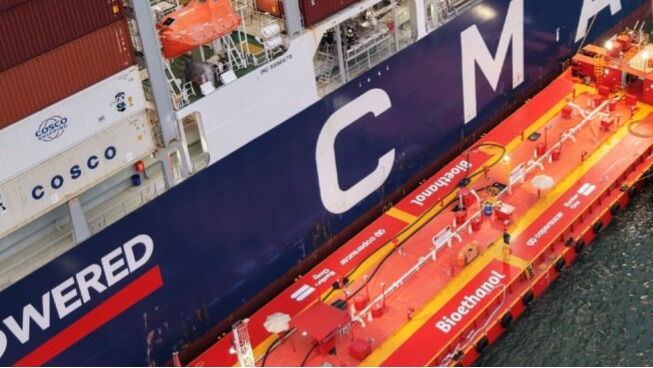
By Brazil Stock Guide – Brazil has taken a first practical step toward turning its vast ethanol industry into a supplier of low-carbon fuel for global shipping, after a large containership was bunkered with sugarcane-based bioethanol at the Port of Santos.
The CMA CGM Iron, a 13,000-container vessel operated by French shipping group CMA CGM, received the fuel on July 12 in what the companies described as the first bioethanol bunkering operation for a deep-sea containership in Brazil and the first commercial operation of its kind in Latin America.
Copersucar, the Brazilian company, supplied the ethanol, while marine-fuel trader Bunker One conducted the ship-to-ship transfer using the Dona Isa bunker barge. AGEO Terminais handled storage, and the operation took place at Santos Brasil’s Tecon Santos container terminal.
Bunker One said it delivered 500,000 liters of anhydrous ethanol. Brazilian coverage from the event put the volume at approximately 500 metric tons, equivalent to about 635,000 liters. The difference between the publicly disclosed figures was not immediately explained. The fuel will be used during part of the vessel’s journey from Brazil toward Colombo, Sri Lanka, after a stop in Paranaguá.
The significance of the operation goes beyond a single voyage. It tests whether Brazil can extend an industry built largely around road transportation into the much larger and increasingly regulated market for marine fuels.
Brazil produced 38.2 billion liters of ethanol in 2025, according to the government’s Energy Research Office, or EPE. Almost one-quarter came from corn, while the remainder was produced predominantly from sugarcane. The country already has mills, storage terminals, pipelines, rail connections and export infrastructure capable of supplying the fuel at industrial scale.
That established production base could give Brazilian ethanol an advantage over lower-carbon marine fuels that still face limited availability or require entirely new supply chains. Green methanol, renewable ammonia and synthetic fuels are attracting investment, but their production remains small and their costs are generally substantially higher than conventional bunker fuel.
Ethanol, by contrast, is already a global commodity. For Copersucar, one of the world’s largest sugar and ethanol trading groups, shipping would represent a new source of demand alongside Brazil’s automotive market and fuel exports to countries including the United States.
The CMA CGM Iron was delivered in 2025 and is the first of a series of 12 vessels with capacity for 13,000 twenty-foot equivalent units, or TEUs. Its Everllence-B&W engine was initially designed around methanol technology and has now been certified to operate with conventional marine fuel, methanol or ethanol. CMA CGM expects to have about 200 containerships capable of using lower-carbon energy sources by 2031.
That flexibility matters because shipowners are reluctant to commit to one fuel before they know which technologies, suppliers and regulatory standards will prevail. Vessels able to switch among conventional and alternative fuels provide operators with a hedge against changes in fuel prices and availability.
The Santos operation also demonstrated that the challenge is not confined to engines. Bioethanol had to be transported to the port, stored in dedicated infrastructure and transferred through a specialized barge.
Before the bunkering, the Dona Isa underwent technical modifications that included cargo-tank preparation, new transfer procedures, crew training and emergency planning for a low-flashpoint fuel. Bunker One also adopted a dedicated safety checklist developed for alternative-fuel operations.
Those arrangements show that Brazil has the basic components needed to develop a marine-ethanol supply chain. They do not yet amount to a regular commercial market.
The operation was authorized as a pilot and required specific approvals. Repeating it at scale will require standardized regulations, permanent safety protocols and a network of ports where ships can refuel without disrupting routes or schedules. The economics will also depend on the price of ethanol relative to conventional bunker, methanol and other alternatives.
Ethanol contains less energy per unit of mass than traditional marine fuel, meaning ships must carry a larger volume to travel the same distance. Its climate advantage must also be measured over the full production and transportation cycle rather than only when the fuel is burned onboard.
Brazilian sugarcane ethanol can offer substantial lifecycle emissions reductions compared with fossil fuels, particularly when mills use sugarcane residues to generate their own energy. Actual savings, however, vary according to farming practices, land-use effects, logistics and the methodology used to certify the fuel.
International regulation will be critical to determining whether those environmental benefits translate into a lasting price advantage.
The International Maritime Organization has set an ambition of reaching net-zero greenhouse-gas emissions from international shipping by or around 2050. Its strategy calls for zero- and near-zero-emission fuels to represent at least 5%, and preferably 10%, of the sector’s energy use by 2030.
A proposed global framework combining progressively stricter fuel-emissions standards with a greenhouse-gas pricing mechanism was approved in principle in 2025. Formal adoption was subsequently delayed, however, and negotiations are due to resume in December 2026. That uncertainty complicates investment decisions because shipowners still lack a definitive global carbon price or compliance regime.
Even so, interest in ethanol is spreading beyond the Santos demonstration.
Brazilian iron-ore producer Vale said in April that it had reached an agreement with Shandong Shipping Corporation for large ore carriers designed to use ethanol as their primary fuel. The first vessels are expected to enter service from 2029 and will also be able to operate with methanol and conventional bunker fuel.
Bunker One estimates that around 70 vessels currently capable of running on methanol could potentially use ethanol, while approximately 400 additional alternative-fuel vessels are expected to leave shipyards over the next several years. Converting that theoretical fleet into demand will depend on engine certification, fuel specifications and the availability of bunkering infrastructure at major ports.
Santos is an obvious candidate to become one of those hubs. It is Latin America’s largest port and handles a substantial share of Brazilian trade. Tecon Santos, the terminal where the fueling took place, is controlled by CMA CGM following the French group’s acquisition of Santos Brasil in 2025.
The terminal can handle vessels of as many as 14,000 TEUs and has annual capacity of roughly 2.5 million TEUs, with room for expansion. CMA CGM’s ownership brings together a major global shipowner, a large container terminal and potential demand for alternative fuels at the same location.
For Copersucar, the immediate volume supplied to one ship is immaterial compared with the billions of liters traded through its broader network. The strategic value lies in proving that Brazilian ethanol can move through a port, meet marine safety requirements and power an ocean-going vessel.
The next test will be commercial rather than technological: whether the companies can repeat the operation, secure recurring contracts and offer the fuel at a price that compensates shipowners for its lower energy density and the cost of adapting vessels and infrastructure.
The voyage of the CMA CGM Iron does not establish ethanol as the winning fuel for maritime decarbonization. It does, however, put Brazil into a contest in which production scale, logistics and reliable supply may prove as important as the fuel technology itself.


Leave a Reply