
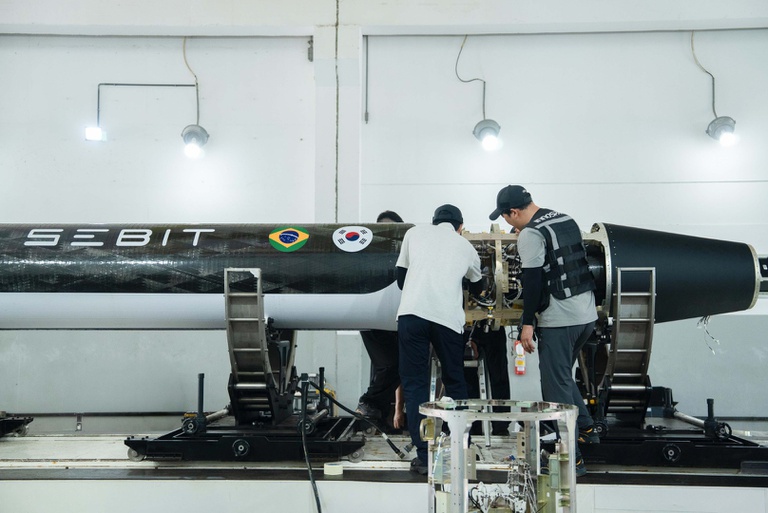
By Brazil Stock Guide — Brazil’s Ministry of Defense has formally approved a new launch campaign at the Alcântara Launch Center in the northeastern state of Maranhão, with plans for two flights of South Korea’s SEBIT MTR-3000 rocket between November 16 and December 11. The authorization was issued by the Brazilian Air Force’s Department of Aerospace Science and Technology (DCTA).
The campaign, designated Supersonic Rider II, will be conducted under an agreement between the Alcântara Launch Center and Alada, a Brazilian state-owned company tasked with developing commercial opportunities for the country’s aerospace infrastructure.
The new campaign marks the resumption of testing by South Korea’s INNOSPACE at Alcântara following an unsuccessful SEBIT flight on August 19. The rocket initially lifted off as planned but subsequently deviated from its intended trajectory, prompting the Brazilian Air Force to activate its flight termination system. The vehicle fell into a designated maritime safety zone, with no injuries or property damage reported.
INNOSPACE has announced plans to conduct its next launch on November 29. The upgraded SEBIT will feature a hybrid rocket engine with a thrust rating of four metric tons, up from three metric tons in the previous configuration, along with modifications to its flight control algorithm. The final launch date will depend on weather conditions and operational readiness.
The SEBIT is a single-stage suborbital rocket measuring 8.7 meters (28.5 feet) in length, designed to carry payloads to altitudes of up to 100 kilometers (62 miles). Unlike orbital launch vehicles, which place satellites into orbit, the SEBIT is intended to provide commercial services for technology testing, equipment validation and scientific research at high altitudes and in microgravity conditions.
Listed on South Korea’s KOSDAQ market, INNOSPACE is developing a commercial business focused on launch services and space transportation. The company is also working on the HANBIT-Nano, a rocket designed to carry small satellites into orbit, with its next flight currently scheduled for the first half of 2027.
The campaign represents another step in Brazil’s efforts to establish Alcântara as an international commercial launch hub. Beyond generating revenue from the use of its launch infrastructure, the initiative could support the development of aerospace technology, engineering and logistics services in Brazil. Turning that potential into a sustainable business, however, will depend on reliable launch operations, a strong safety record and the ability to attract international customers.


Leave a Reply