
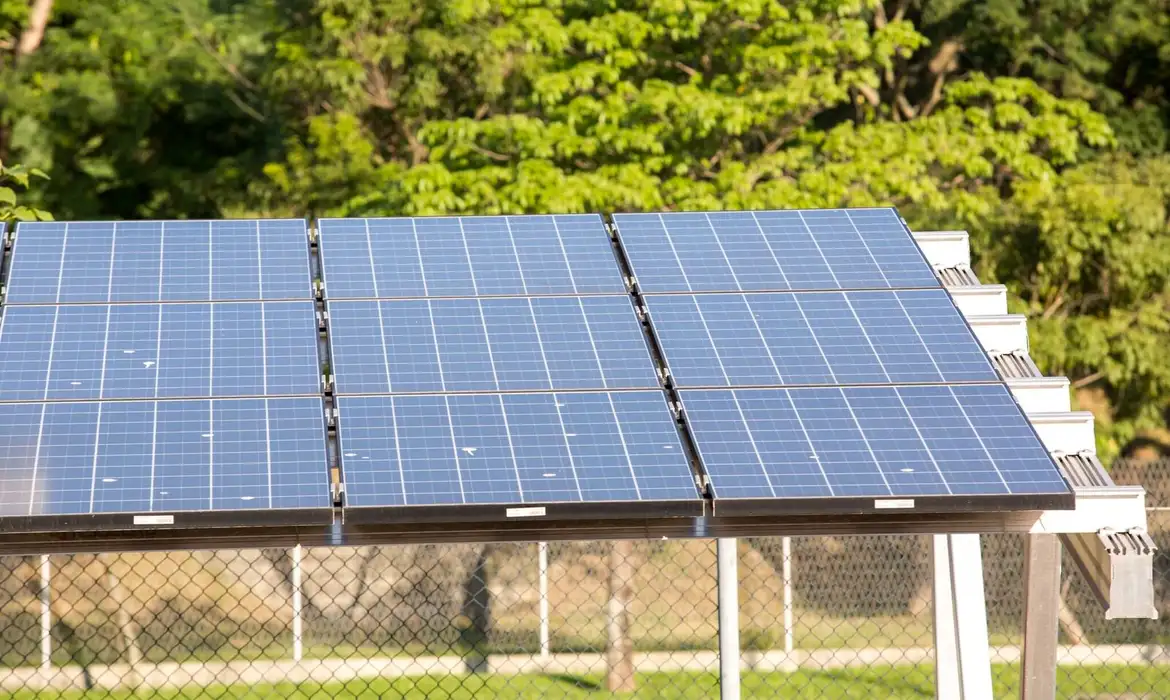
By Brazil Stock Guide – Brazil’s expanding solar power industry has cleared 31,300 hectares of native vegetation in the Caatinga biome through 2025, raising concerns about the environmental costs of the country’s renewable energy transition. The semi-arid region accounted for 79% of all native vegetation converted into solar power installations nationwide, according to the latest land-use data from MapBiomas, reported by Agência Brasil on Wednesday, November 18.
The findings, published in MapBiomas’ 11th collection of annual land-cover and land-use maps, highlight the growing footprint of utility-scale solar projects in one of Brazil’s most environmentally vulnerable ecosystems. Although the cleared area represents just 0.06% of the Caatinga’s remaining 54.1 million hectares of native vegetation, the concentration of solar-related clearing has raised questions about land-use planning and biodiversity protection.
Of the 52,400 hectares occupied by solar installations across the Caatinga, approximately 60% involved the removal of native vegetation. The remaining installations were built on land previously cleared for other purposes.
Solar power has also overtaken wind energy in terms of land occupation within the biome. By 2025, solar facilities represented 53% of the total area occupied by energy-generation projects in the Caatinga, surpassing the footprint of wind farms.
Renewable energy expansion faces environmental challenges
The findings illustrate a challenge for Brazil’s energy sector as the country seeks to expand renewable electricity generation while protecting ecosystems that have already experienced extensive land conversion.
Washington Rocha, MapBiomas’ Caatinga coordinator, said solar energy plays a fundamental role in Brazil’s economic development and energy security. However, he emphasized that additional capacity should be developed without compromising native vegetation, particularly areas of high conservation value.
“With planning, it is possible to expand clean energy generation without giving up protection of the biome,” Rocha said.
The research highlights the importance of project location in determining the environmental consequences of renewable energy investments. Solar facilities established on previously cleared land can limit additional vegetation loss, while developments involving native habitats contribute to the biome’s accumulated environmental degradation.
Caatinga loses 880,700 hectares of vegetation in 2025
The expansion of solar infrastructure comes against a broader backdrop of vegetation loss across the Caatinga.
According to MapBiomas, approximately 880,700 hectares of native vegetation were cleared in 2025, while 420,000 hectares of secondary vegetation regenerated on land previously affected by deforestation.
The recovery of vegetation cover, however, does not necessarily indicate the restoration of the biome’s original ecological conditions.
Rocha warned that livestock grazing can degrade the Caatinga without producing outright deforestation. Recovering the ecosystem’s ability to sustain biodiversity and other natural processes may take decades.
“It is not enough to count how many hectares of Caatinga remain. We need to know how much Caatinga still functions as Caatinga,” Rocha said.
Between 1985 and 2025, the biome recorded a cumulative net loss of 9.8 million hectares of native vegetation, after accounting for clearing and regeneration.
Of the Caatinga’s original 86.3 million hectares, approximately 54.1 million hectares remained covered by native vegetation in 2025, equivalent to 62.7% of its original extent. In 1985, that proportion stood at 74.1%.
Despite the decline, the Caatinga ranks third among Brazil’s biomes in native vegetation preservation, behind the Amazon, which retains 81.3% of its original cover, and the Pantanal, at 79.6%.
Agriculture remains the largest driver of land conversion
While solar energy development has become an increasingly visible source of vegetation loss, agriculture and livestock production remain the dominant uses of previously converted land in the Caatinga.
In 2025, agricultural activities occupied approximately 30.1 million hectares, representing 97% of the biome’s land area that was no longer covered by native vegetation.
Of that total, 13.9 million hectares were cleared between 1985 and 2025, according to the MapBiomas assessment.
Over the same four-decade period, approximately 4.4 million hectares previously used for agricultural activities returned to native vegetation cover.
The figures show how the Caatinga’s landscape has been reshaped by agricultural expansion and, more recently, energy infrastructure, even as natural regeneration has restored vegetation to some previously converted areas.


Leave a Reply