

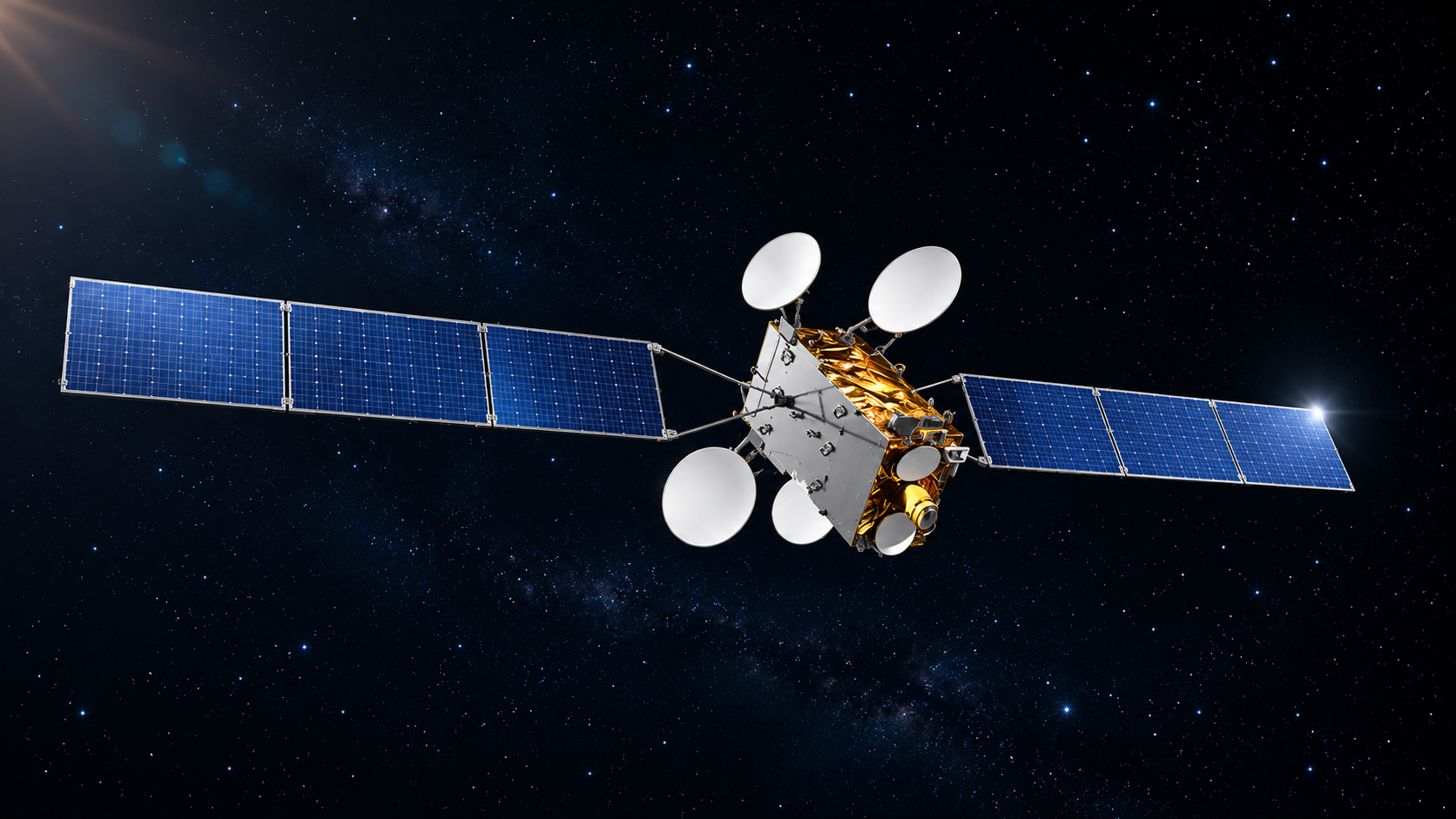
Brazil’s federal government took a step on Tuesday (November 17) toward developing a new defense and strategic communications satellite, a project for which the Ministry of Communications is seeking $540 million in financing from the New Development Bank (NDB), the Shanghai-based lender established by the BRICS nations.
Decree No. 13,167, signed by Vice President Geraldo Alckmin while serving as acting president, establishes a new Defense and Strategic Communications Satellite System designed to coordinate the development and operation of government satellites.
The measure replaces a governance framework introduced in 2012 for Brazil’s first Geostationary Defense and Strategic Communications Satellite (SGDC-1), launched in 2017, with a broader structure capable of accommodating additional satellites and coordinating long-term investment in the country’s space infrastructure. The NDB is headed by Dilma Rousseff, Brazil’s former president.
The proposed $540 million loan appears on the agenda of the 191st meeting of Brazil’s Commission on External Financing (Cofiex), scheduled for December 3. The financing request, submitted by the Ministry of Communications, identifies the NDB as the prospective lender for the National Strategic Satellite Infrastructure and Digital Inclusion Program, known as SGDC-2.
The proposal is scheduled for a preliminary review on November 27. Approval by Cofiex would allow the project to proceed through further preparation and negotiations with the bank, but would not constitute a finalized loan agreement.
“The satellite system is important for Brazil to maintain its autonomy and independence,” a person familiar with the matter told Brazil Stock Guide, speaking on condition of anonymity.
Foreign satellite operators play a substantial role in Brazil’s communications infrastructure. According to data from telecommunications regulator Anatel, 30 of the 46 geostationary satellites authorized to operate in Brazil as of May 2026 were classified as foreign — nearly two-thirds of the total. While the figures do not necessarily reflect operators’ market shares, they underscore the significance of international satellite networks in the Brazilian market. The country currently operates just one government-owned geostationary defense and strategic communications satellite, SGDC-1.
While the United States, China and major European powers maintain extensive satellite capabilities, Brazil is still working to expand its own government-controlled infrastructure. SGDC-2 could improve the security of military communications, extend connectivity to remote areas and support the development of Brazil’s aerospace industry.
The project could also reduce dependence on foreign suppliers and technologies, although building a nationally controlled satellite would not eliminate the need for internationally sourced components and services.
The decree also addresses a regulatory obstacle that has weighed on the project for seven years.
In July 2019, Brazil’s Federal Court of Accounts (TCU), the country’s federal public spending watchdog, ordered state-owned telecommunications company Telebras not to proceed to the commercial bidding stage for SGDC-2 until it had met several conditions. One of those requirements was a new presidential decree establishing the project’s governance framework.
The watchdog also identified shortcomings in financial planning, the definition of project requirements and the demonstration of economic viability.
The new regulations establish a permanent decision-making structure, including a steering committee bringing together the ministries of Communications; Defense; Science, Technology and Innovation; and Development, Industry, Trade and Services. The committees’ detailed composition and responsibilities will be established through subsequent joint regulations.
Telebras will be authorized to contract suppliers for satellite manufacturing, integration and launch services, as well as for the development of ground infrastructure. Operation of satellites serving both civilian and military purposes will be shared by Telebras and the Ministry of Defense, through the Brazilian Air Force, within their respective areas of responsibility.
The decree also calls for a technology absorption and transfer plan involving the Brazilian Space Agency (AEB), the National Institute for Space Research (Inpe), the Air Force and Telebras.
The plan will establish rules governing intellectual property and the participation of Brazilian companies, potentially increasing domestic technological capabilities in an industry dominated by foreign manufacturers.
Telebras intends to award the SGDC-2 contract in 2027 and begin construction between 2028 and 2029, according to a timetable presented in September by company president Hermano Albuquerque.
The new satellite is expected to operate at the 57 degrees West orbital position, which is currently unoccupied but associated with Brazilian international satellite filings approaching critical deadlines.
One filing associated with Telebras faces a deadline in 2030, while another, linked to military communications, has a deadline in 2031.
If Brazil fails to meet the International Telecommunication Union’s (ITU) requirements for bringing the relevant satellite network into operation, it could lose the international priority attached to the orbital position and associated frequency assignments, potentially jeopardizing their future use under the existing arrangements.
The deadlines put considerable pressure on the project’s timetable.
According to Telebras, manufacturing a geostationary satellite can take three to four years, followed by another year to 18 months for launch preparations and orbital deployment. The complete process takes approximately five years, making further delays in SGDC-2 procurement particularly consequential.
Telebras’ own schedule highlights the challenge. If manufacturing begins only in 2028 or 2029, the satellite might not become operational until after the 2030 and 2031 deadlines. The company would therefore need to accelerate the project or identify technically feasible alternatives consistent with ITU regulations to preserve Brazil’s orbital filings.
Despite representing an institutional advance, the decree does not itself authorize SGDC-2 construction or guarantee financing.
Telebras must still demonstrate compliance with the remaining requirements imposed by the TCU, including the definition and approval of technical specifications, budget planning and evidence of the project’s financial and economic viability.
The Cofiex review and the establishment of a firm procurement timetable will be the next tests for a project intended to combine secure national communications, digital inclusion and the development of Brazil’s domestic space industry.
Beyond securing funding for another satellite, the government’s central challenge will be turning its newly established governance framework into operational capabilities before Brazil risks losing strategically important orbital rights.


Leave a Reply