
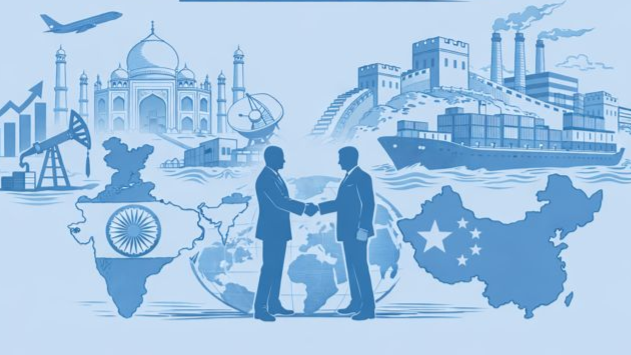
The question has returned to the center of Brazil’s foreign-policy debate after Luiz Inácio Lula da Silva decided to lead, between February 19 and 21, a large business mission to India, bringing together more than 200 corporate representatives. The comparison is tempting: is Brazil facing today what China represented in the early 2000s?
The short answer is: partly — and that is precisely why it matters.
Twenty years ago, China was not merely a large market. Newly integrated into World Trade Organization rules, it was an economy in structural acceleration, marked by incomplete urbanization and rapidly rising demand for energy, food and basic inputs — exactly the areas in which Brazil was, and remains, highly competitive. Bilateral trade surged. Dependence followed. Over time, this relationship coincided with a clear re-primarization of the Brazilian economy, increasingly anchored in agriculture, mining and oil, while manufacturing lost relative density.
India now sits earlier on that same curve. With roughly 1.43 billion people, it has overtaken China, whose population stands at about 1.41 billion. The difference lies in the cycle. While China’s growth has slowed to around 5%, India has been expanding at 6.5%–7%, driven by domestic consumption, investment and ongoing urban expansion.
As China once did, India combines demographic scale, incomplete urbanization and elevated growth. Its demand for oil, food, fertilizers and minerals is structural rather than cyclical. For Brazil, the productive fit feels familiar: exporting what rises with income and industrialization, not merely with global swings.
The crucial difference is the model. China pursued heavy manufacturing, aggressive exports and competitive substitution. India’s growth is more fragmented, with a heavier reliance on services, technology and its domestic market. That reduces direct competitive pressure on Brazil and increases complementarity — though it also means growth is unlikely to be as explosive as China’s was two decades ago.
This shift does not occur in a vacuum. In recent years, Brazil has actively rebalanced its external ties, deepening relations with China while rebuilding bridges with the United States and Europe. The recent progress on the Mercosur–European Union agreement underlines that strategy: reducing excessive dependence without severing ties with core partners.
Geopolitics adds another layer. China in the early 2000s was, for Brazil, largely a commercial partner. Today, its centrality comes with greater geopolitical sensitivity, in a world shaped by renewed great-power competition. Washington’s effort to reassert economic and strategic influence in Latin America, under Donald Trump’s leadership, raises the cost of over-reliance on any single external axis.
Here lies India’s appeal. It offers relevant growth without rigid alignment, latent sanctions or systemic confrontation. The counterpoint is access. Protectionism, high tariffs and bureaucracy make India a difficult market. China opened doors quickly; India negotiates inch by inch. The prize exists, but it demands patience, local presence and active trade diplomacy.
India is not the new China in speed — but it may be China before dependence set in. For Brazil, that is less spectacular in the short term, yet strategically healthier. The mistake would be to expect the same miracle. The opportunity lies in avoiding the same trap.


Leave a Reply