

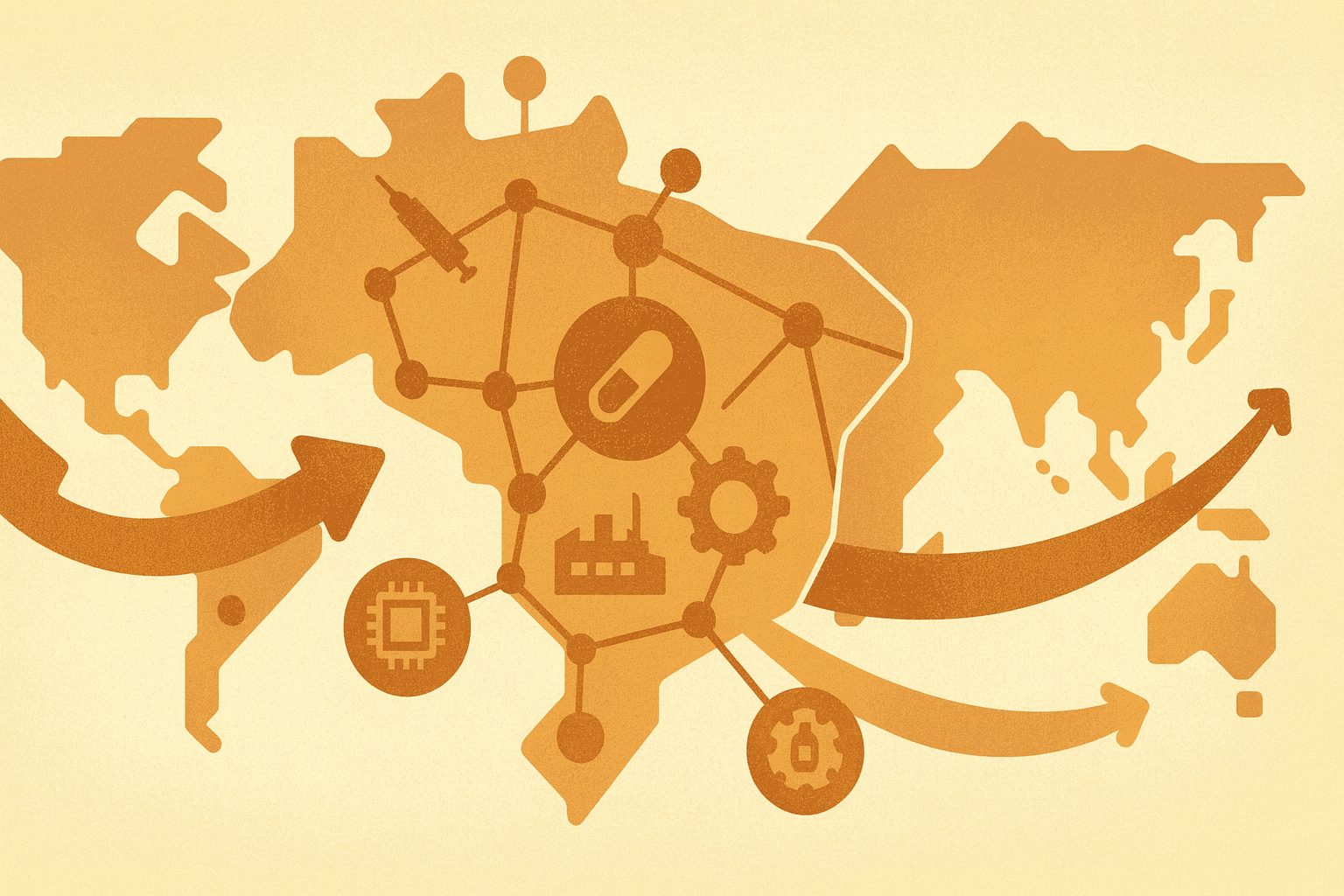
The Brazilian government, through its Ministry of Health, has taken a commendable step in reviving the idea of strengthening both the public and private health systems by reinstating the Executive Group of the Health Economic-Industrial Complex (Geceis). The initiative rightly aims at establishing a state policy that would allow the country to achieve two major strategic goals: expanding public access to healthcare goods and services, and opening a new front for technological and economic development capable of integrating Brazil into global value chains.
Yet capitalism thrives on signals—and the clarity of those signals is crucial. Even as the government speaks of attracting investment in fine chemicals (active pharmaceutical ingredients and intermediates) and rebuilding the domestic pharma-chemical hub, it continues to issue tenders to importing drugs not approved or registered by Anvisa, Brazil’s health regulator. Such practices reverberate negatively, creating uncertainty and discouraging local production.
Meanwhile, while pledging to foster innovation in Brazil’s pharmaceutical industry, officials have also revived the outdated and failed notion of compulsory licensing of medicines—this time in response to “Trump’s tariff surge”—casting a shadow over the business environment.
Few things could be more counterproductive, from both a health and economic standpoints. No entrepreneur invests in an environment clouded by uncertainty, lacking predictability and legal security. This duality of purpose only deepens mistrust.
This rule is especially true in the pharmaceutical industry, given the high costs and long maturation periods inherent in developing complex, innovative drugs. Without intellectual property protection or a stable consumer market offering the prospect of recouping large the sums invested, no company will assume the high risks associated with research and development. It is a fiction to believe that the state can bear the burden of such high-risk investment. That is the realm of private capital, not public power.
Indeed, it is the international patent system that has driven the availability of cutting-edge medicines—such as COVID-19 vaccines and treatments for rare diseases, to cite recent examples. Patents do not inhibit access to medicines and vaccines; quite the opposite. Studies show that innovative drugs made possible through intellectual property protection have a positive impact on quality of life and reduce overall treatment costs, offsetting both public and private spending. Patent protection in the pharmaceutical field is, in fact, socially and economically beneficial.
These are high-technology products, the result of proven expertise that begins at research benches, continues through sophisticated manufacturing processes and equipment, and is safeguarded by rigorous quality control. This know-how is rooted in knowledge and experience accumulated over decades by the pharmaceutical industry—expertise that cannot be built overnight or through bureaucratic decrees.
During the pandemic, while explaining the complex process behind producing COVID-19 vaccines and the futility of suspending intellectual property rights for prevention and treatment products, the renowned health expert Natalia Pasternak summed it up succinctly: “You can’t make vaccines by decree—you must first invest in science, development, and industry.”
In practice, by sending contradictory signals regarding its policy for promoting the Health Economic-Industrial Complex, the government inadvertently weakens its own plan. The persistence of these mixed messages has fostered an environment of uncertainty that hinders growth and innovation. Brazil must restore the competitiveness of its industry by setting out a realistic growth strategy that addresses social challenges, including access to healthcare.
Achieving this overarching goal—advancing the pharmaceutical and healthcare industries—demands a favorable environment for cooperation among domestic and international companies and investors. This is a process that unfolds over the short, medium, and long term and requires clear, stable rules—state policy, not merely government policy.
Within this framework, intellectual property protection, adherence to sanitary regulations, and legal security are tools for fostering technological and industrial capacity and, in turn, essential mechanisms for Brazil’s social and economic development. The urgency of aligning these signals and charting a cohesive path for the country’s pharmaceutical sector has never been greater.
Nelson Mussolini is the executive president of the Pharmaceutical Products Industry Union (Sindusfarma) and a full member of the National Health Council (CNS).
(The opinions expressed in this article are the sole responsibility of the author and do not necessarily reflect the position of Brazil Stock Guide)


Leave a Reply