
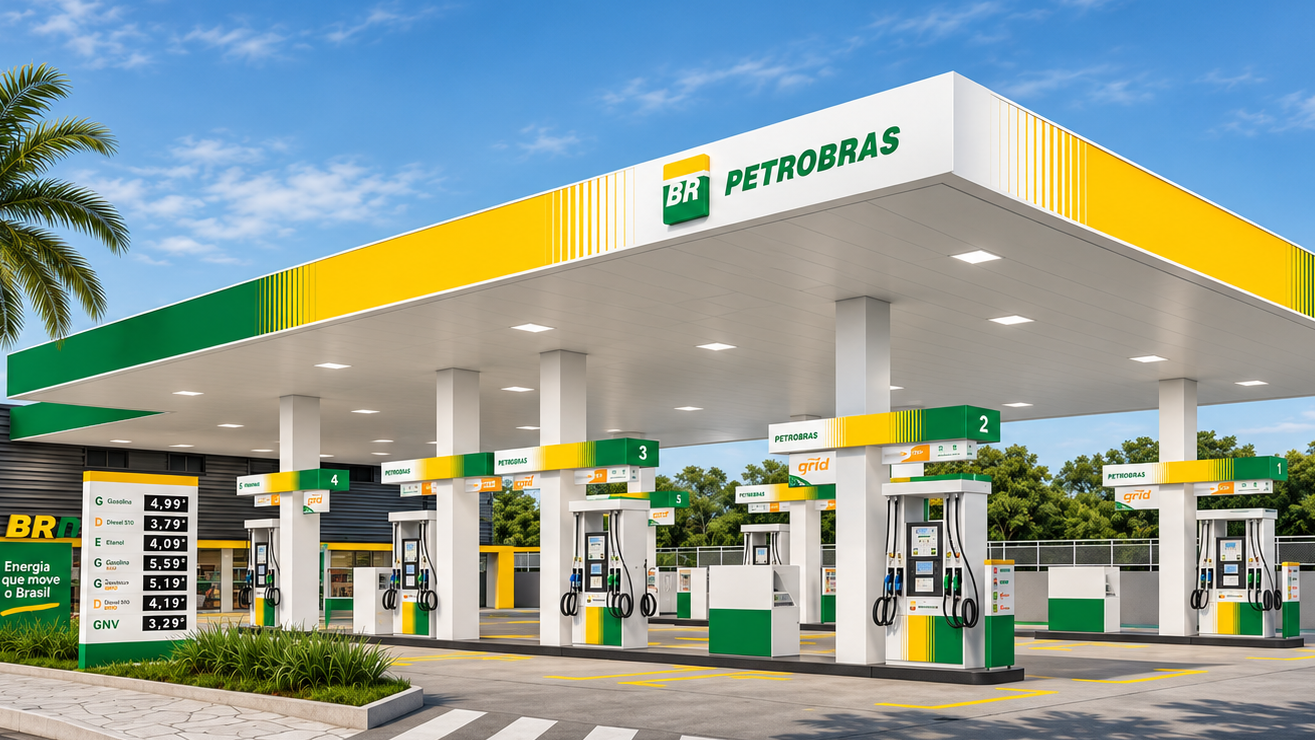
By Brazil Stock Guide — Vibra Energia (B3: VBBR3), one of Brazil’s largest fuel distributors, has no intention of giving up the BR brand. And the company is hardly trying to hide it. Although Petrobras has already indicated that it does not intend to renew the licensing agreement under its current terms, Vibra continues to bet on a deal that would allow it to retain the familiar brand displayed at thousands of service stations across Brazil.
On Thursday, Vibra CEO Ernesto Pousada made that preference unmistakably clear. Speaking during the company’s third-quarter earnings call, he described renewing the agreement as an “absolute priority.” Plans A, B and C all involve keeping the brand, he said. Removing it from the network would be Plan D.
The problem is that negotiations have yet to begin. Pousada acknowledged that formal discussions with Petrobras have not started. Meanwhile, the clock is ticking: the licensing agreement expires on June 28, 2029, the same date on which contractual restrictions preventing Petrobras from reentering the fuel distribution business will come to an end.
BR is one of the most established and recognizable brands in Brazil’s fuel retail market. Much of its strength comes from its longstanding association with Petrobras, the state-controlled oil company that spent decades building consumer recognition and trust.
The former BR Distribuidora ceased to be controlled by Petrobras in 2019, during Jair Bolsonaro’s presidency, and Petrobras sold its remaining stake in 2021. The distributor subsequently adopted the Vibra name, but ownership of the BR and Petrobras brands remained with the oil company, which licensed their use to its former subsidiary.
Now the landscape could change again. With President Luiz Inácio Lula da Silva reelected for a fourth term, Petrobras is looking to regain a foothold in fuel distribution, a business it exited following BR Distribuidora’s privatization. Should that strategy move forward, the BR brand could become even more valuable to Petrobras, potentially shifting from an identity licensed to Vibra back into a central element of the oil company’s own distribution operations.
Another factor is reshaping the competition. Brazil’s fuel market is undergoing a gradual shift toward greater regulatory compliance and formalization, driven by stronger enforcement, efforts to curb tax evasion and a crackdown on fuel fraud. That trend tends to favor established distributors with reliable logistics, compliant supply chains and recognizable national brands.
BR competes with other major retail brands, including Shell, operated in Brazil by Raízen, and Ipiranga, controlled by Ultrapar. As consumers place greater value on fuel quality, traceability and the reliability of suppliers, the commercial appeal of a trusted national brand becomes increasingly important.
For Vibra, BR therefore remains a critical commercial asset. The company ended September with 7,686 service stations in its network, having added 595 outlets during the first nine months of the year. In its third-quarter report, Vibra explicitly highlighted “brand strength” as one of the factors attracting independent station operators, alongside supply reliability and fuel quality.
The concern is understandable. Replacing a nationally recognized brand involves considerably more than changing signs, pumps and employee uniforms. Vibra would also need to preserve consumer trust, persuade station operators to remain within its network and prevent the transition from creating opportunities for competitors.
A Separation That Could Take Years
The disagreement has already reached Brazil’s securities regulator, the Comissão de Valores Mobiliários (CVM). In October, Vibra disclosed that the two companies disagree over the deadline for submitting a plan to remove Petrobras branding from its network.
Petrobras argues that its decision not to renew the licensing agreement triggered a 180-day period for Vibra to present such a plan. Vibra disputes that interpretation. According to the distributor, the obligation applies only to specific circumstances involving contractual termination or expiration, rather than advance notification that one party does not intend to renew.
The distinction is far from academic. Pousada has previously said Vibra believes the transition could extend for six years beyond the contract’s expiration, reflecting commitments made to its service station operators. Under that scenario, BR branding could remain visible at some stations until 2035.
That, however, is Vibra’s interpretation of its contractual rights, not a timetable agreed upon with Petrobras.
There is also a financial dimension. According to a filing published by Brazil’s National Institute of Industrial Property (INPI), the contractual royalty for use of the brands is equivalent to 0.03% of Vibra’s total net operating revenue.
Applied to Vibra’s consolidated accounting revenue of R$162.1 billion during the first nine months of 2026, that percentage would imply approximately R$48.6 million ($8.8 million at an illustrative exchange rate of R$5.50 per dollar).
This is a reference calculation, not a confirmed amount actually paid by Vibra. Nevertheless, it provides an indication of the economic scale of the licensing arrangement.
The potential cost of losing the brand is considerably harder to calculate. Vibra has not disclosed how much it would need to invest in rebranding its network, nor has it estimated the possible impact on fuel sales. The challenge also involves whether independent station operators would be willing to remain affiliated with a newly branded network.
For now, Vibra’s apparent strategy is to buy time while continuing to push for an agreement. Petrobras, meanwhile, has its own ambitions in fuel distribution and has given no indication that it is prepared to maintain the existing arrangement on current terms.
Vibra’s Quarterly Profit Surges More Than 500%
The battle over the BR brand comes as Vibra reports a sharp improvement in financial performance.
The company posted net income of R$2.46 billion in the third quarter of 2026, a 504% increase from R$407 million a year earlier. Adjusted net income reached R$2.43 billion, up 345%.
Adjusted earnings before interest, taxes, depreciation and amortization (EBITDA) climbed 137% year over year to R$4.29 billion, while adjusted net revenue increased 17% to R$56.9 billion. Total fuel sales volumes rose 4% to 9.61 million cubic meters.
Profitability benefited from favorable fuel pricing and supply conditions, as well as progress in combating irregularities in the sector. Even excluding nonrecurring items, recurring adjusted EBITDA increased 148% to R$3.66 billion.
Vibra also accelerated its debt reduction. Net debt fell R$1.7 billion from the previous quarter to R$14.4 billion, bringing its net debt-to-EBITDA ratio down to 1.0 times, compared with 2.7 times a year earlier. Return on invested capital (ROIC) in the fuel distribution business reached 32.8%.
The company also announced R$499 million in interest on equity, a tax-efficient form of shareholder distribution commonly used in Brazil, during the quarter. That brought total shareholder distributions announced in 2026 to approximately R$1.5 billion.
The results underscore Vibra’s improving financial position at precisely the moment it is preparing to negotiate the future of one of its most valuable commercial assets: the BR brand.


Leave a Reply