By Rodrigo Uchoa, special for Brazil Stock Guide
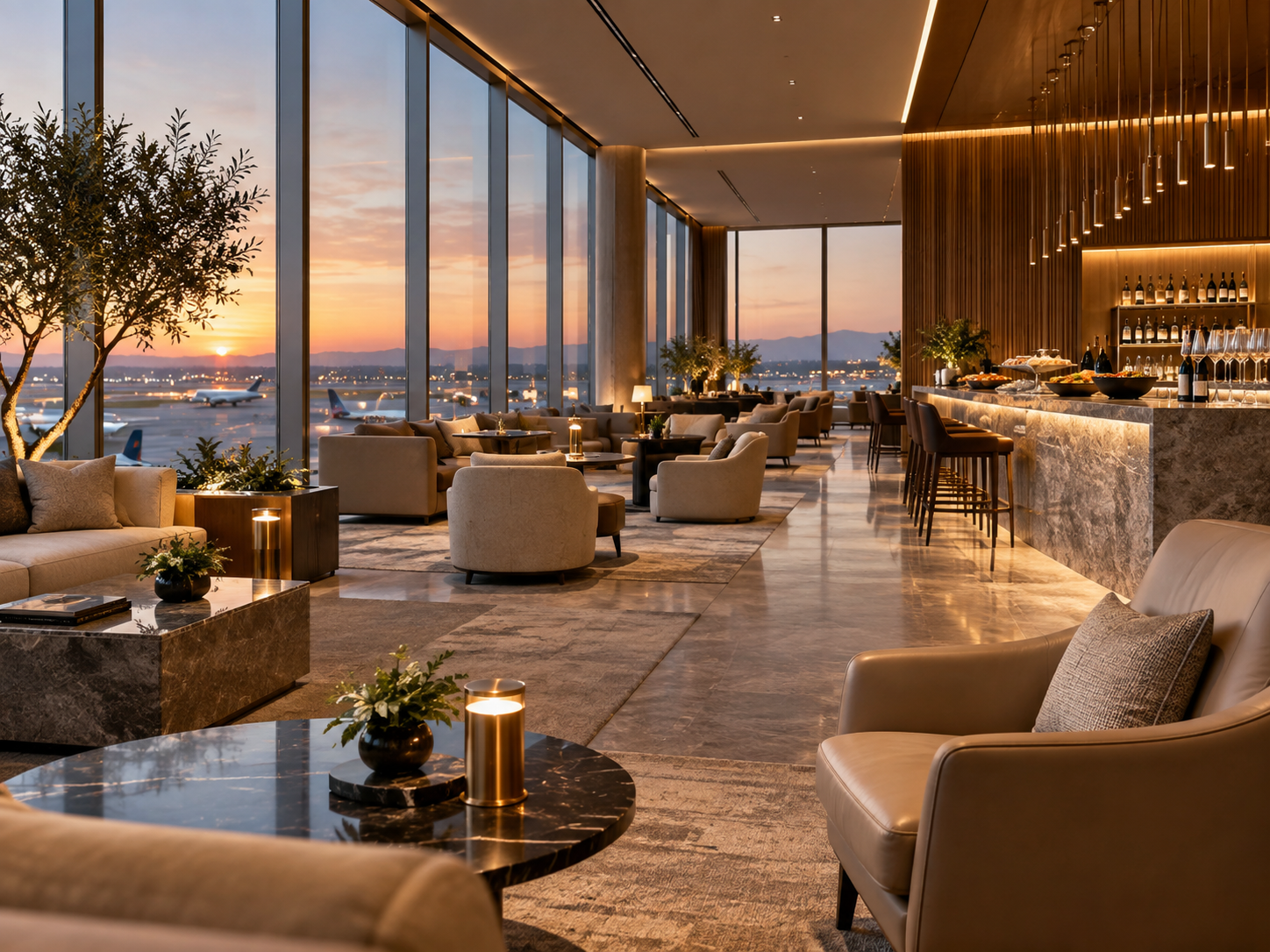
Anyone taking the escalator opposite the duty-free shops in Terminal 3 at São Paulo’s Guarulhos Airport arrives at a glass-fronted mezzanine level. Since 1 May, it has housed Casa BB, Banco do Brasil’s first proprietary airport lounge. The space previously belonged to Safra and, before that, the Star Alliance, and little has changed structurally. Gabriel Dias, who runs the travel website Cartões, Milhas e Viagens and has followed the sector for nearly two decades, measured the lounge at 1,350 square metres, decorated with wood, rope and natural fibres. Through the glass, travellers can look down on the terminal below as if from a private box.

The buffet leans heavily Brazilian. Gabriela Alves, from the travel site Melhores Destinos, visited on a Sunday at two in the afternoon and found chicken soup, farofa and even feijoada. She also found brigadeiros which, in her words, “win my heart every time”. They were running low, however, and nobody seemed to be on their way to replenish them.
At launch, the bank highlighted a “Tranquillity Area” featuring sofas, open work pods and private rooms, as well as a capacity of 320 passengers. Dias believes it can hold even more, perhaps as many as 410. Because Banco do Brasil granted access to holders of all its main credit cards, the lounge fills up in the evenings, queues form at the entrance and waiting times can exceed half an hour. “The queue completely undermines the sense of exclusivity a lounge is supposed to provide,” he says.
The economist Fred Hirsch had a name for this phenomenon. In Social Limits to Growth (1976), he described positional goods as things whose value depends on relatively few people having access to them. The classic example is a deserted beach: if everyone gains the right to visit it, it ceases to be deserted, and nobody receives what they were promised in the first place.
For years, premium credit cards sold pre-flight tranquillity as a perk, and it worked while the club remained small. Then Nubank, Inter, BTG and Nomad began courting customers whom the established banks had long taken for granted. Premium cards multiplied, but airport lounges did not grow with them. Each lounge visit costs the card issuer somewhere between US$20 and US$40, depending on the contract and the airport. More problematic than the expense, however, is the fact that every additional customer slightly diminishes the experience for those already inside. Watch closely and you may catch the occasional look of disdain cast by travellers sprawled comfortably on sofas towards the newest arrivals.


The industry response has been to raise the bar. Since September 2025, Mastercard lounges in Terminal 3 have been free only to customers who spent at least R$15,000 during the previous quarter, a rule also adopted for Black card holders by Bradesco and BTG. That amounts to R$60,000 a year. At Santander, spending R$3,000 across the previous three statements was enough until June. Since 1 July, the threshold has risen to R$15,000 for Unique customers and R$30,000 for Unlimited cardholders.
The market calls this strategy “primacy”: the attempt to persuade customers to concentrate their financial lives with a single institution. There is nothing anti-competitive about it. It is a strategy of inducement rather than coercion. The contest involves publicly listed companies: Banco do Brasil, Bradesco, BTG, Itaú and Santander in São Paulo, and Nubank and Inter in New York. For all of them, the airport lounge has become a central battleground, and the logic is straightforward: silence retains its value only while it remains scarce.
BTG grasped this particularly quickly, investing R$80 million in a dedicated terminal alongside Terminal 3. Entry costs US$590, and reservations must be made at least 72 hours in advance.

BTG Pactual lounge at Guarulhos: the VIP of VIPs
The scramble for silence extends well beyond airports. Hilton surveyed more than 14,000 travellers across 14 countries for its 2026 trends report. “Rest and recharge” emerged as the most frequently cited reason for leisure travel, mentioned by 56 per cent of respondents, and the hotel group coined the term “hushpitality” to describe the phenomenon. In Umbria, Eremito charges guests by taking things away: the hotel has no Wi-Fi, no television and no mobile signal, while dinner is served in silence to the sound of Gregorian chant. The Silent Book Club sells a week of reading on the Italian Riviera for around US$4,200.
The American philosopher Matthew Crawford begins The World Beyond Your Head with an airport lounge. What struck him was the absence of screens and advertisements competing for his attention, while outside the door the entire terminal seemed to be clamouring for it.
There was a time when silence could be found in a public library. Today, it may require meeting a minimum spending threshold on a credit card.





Leave a Reply