
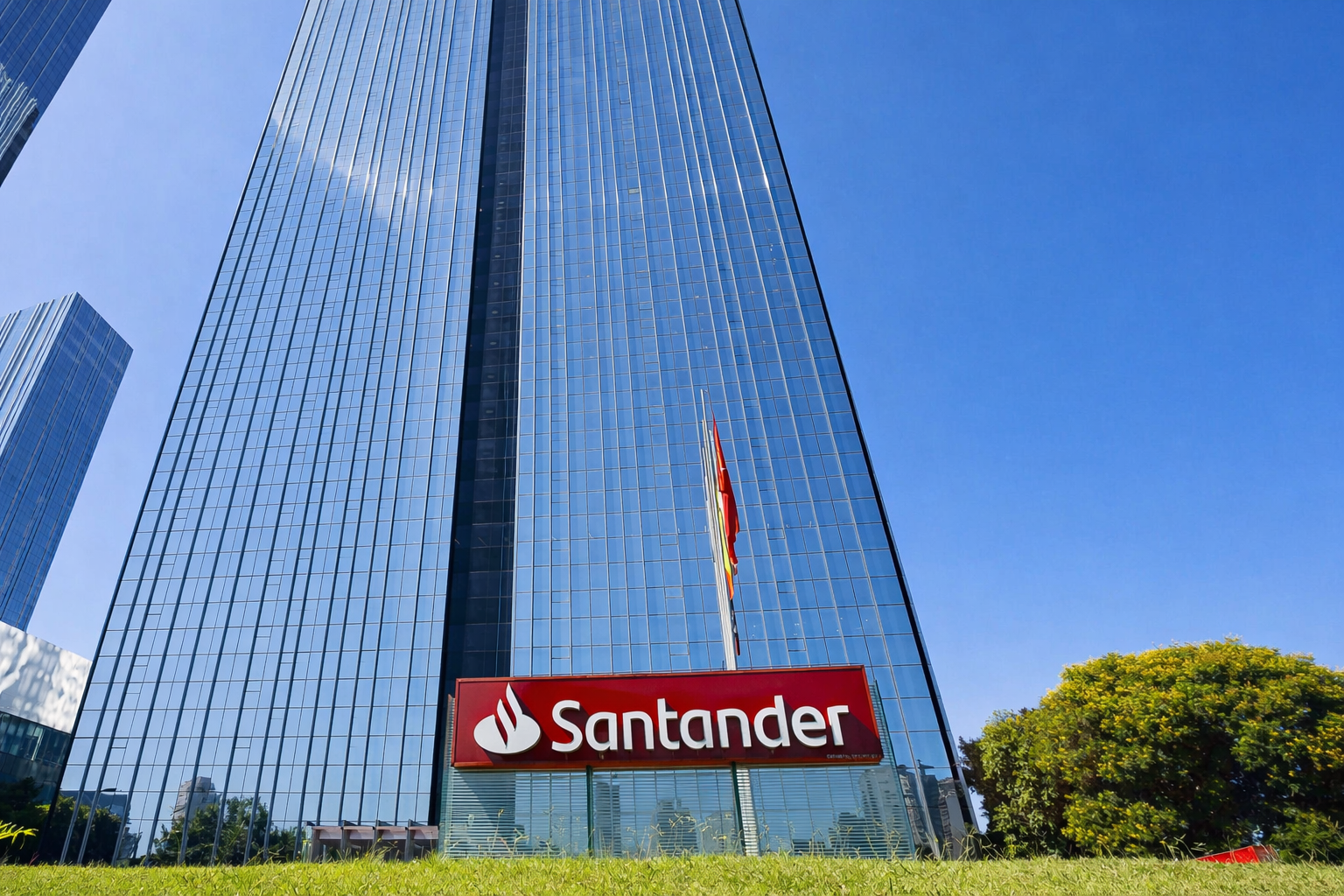
By Brazil Stock Guide – Santander Brasil (SANB11) posted managerial net income of R$3.8 billion in the first quarter of 2026, down 1.9% from a year earlier and 7.3% from the fourth quarter. The result shows a bank that remains profitable, but is still operating in an environment where credit, high interest rates and delinquency continue to weigh on the Brazilian unit of the Spanish banking group.
The profit decline did not come from a single line item. Santander’s total revenue was broadly stable, rising 0.9% year over year to R$21.2 billion, while expenses remained under control. But net interest income fell 0.7% from a year earlier, return on average equity dropped to 16.0%, and loan-loss provisions remained elevated. In practice, the bank improved in some areas, but not enough to fully offset the cost of operating through a still difficult credit cycle.
Mixed Margin
Net interest income totaled R$15.8 billion, up 3.1% from the previous quarter but down 0.7% over 12 months. The sequential improvement came mainly from the market-related margin, helped by a more favorable sensitivity to lower interest rates and stronger treasury results. On an annual basis, however, the bank was still affected by the negative sensitivity to Brazil’s high interest-rate environment and weaker treasury performance.
Client-related margin had a better year-on-year performance. It rose 4.8% over 12 months, supported by volume, portfolio mix and pricing discipline, but fell 1.4% from the fourth quarter, affected by fewer business and calendar days. It is a typical picture of a bank in gradual recovery: spreads are improving, but growth is still being managed cautiously.
Services Help
Fees and commissions were one of the stronger points of the quarter. The line rose 5.8% year over year to R$5.4 billion, although it fell 5.5% from the fourth quarter due to seasonality, especially in cards. The annual increase was driven by cards, insurance, asset management, consortium products, funds and pension plans. Card fees rose 9.8% over 12 months, insurance advanced 12.2%, asset management climbed 17.7%, and funds and pensions grew 20.9%.
That performance helps explain Santander’s broader strategy. The bank is trying to depend less on pure loan-book expansion and more on a diversified revenue base, with a greater contribution from services, client relationships, cards, insurance and investments.
Selective Credit
Santander’s expanded loan portfolio ended March at R$705.6 billion, down 0.4% from the previous quarter but up 3.4% over 12 months. Growth was selective. Consumer finance rose 14.2% year over year, mortgage lending increased 10.6%, credit cards advanced 9.1%, and small and medium-sized companies grew 9.9%.
That matters. Santander is not accelerating credit indiscriminately. The bank says it continues to apply discipline in capital allocation, with a focus on strategic businesses, portfolio risk management and profitability. In an environment where households remain heavily indebted, slower growth can be part of the defense of future earnings.
Risk Still Weighs
Credit quality remains the main point of attention. Loan-loss provisions totaled R$6.3 billion, up 3.9% from the previous quarter, although 0.7% lower than a year earlier. Cost of credit stood at 3.73%, stable both quarter on quarter and year on year, but still at a high level.
The over-90-day delinquency ratio rose to 3.3% in March, from 3.1% in December and 2.8% a year earlier. In individuals, the ratio reached 4.9%, while 15-to-90-day delinquency in the segment stood at 5.2%. Santander attributed the pressure to first-quarter seasonality, a challenging macroeconomic backdrop, especially among lower-income borrowers, and a smaller individual loan-book base.
Costs Contained
On expenses, Santander delivered an important line of defense. General expenses were stable from the fourth quarter and rose only 0.9% over 12 months, below inflation. The efficiency ratio stood at 37.7%, improving 1.1 percentage points from the fourth quarter, although still 0.5 percentage point worse than a year earlier.
That discipline helped prevent a sharper profit decline. In other words, the bank did not lose earnings because of cost slippage. The problem lies more in the combination of still-pressured annual margin, elevated provisions and lower return on capital.
Larger Base
Santander also continued to expand its relationship base. The bank reported a 6% increase in total clients, to 75.2 million, and a 3% rise in active clients, to 34.2 million. Its strategy remains centered on becoming the main bank for more clients, with a focus on transactionality, credit and investments, supported by initiatives such as Santander Rewards to reinforce cards and relationship depth.
The quarter therefore carries two messages. The first is positive: Santander is more disciplined, growing in services, preserving capital and keeping costs under control. The second is more cautious: the recovery in profitability has not yet fully gained traction. Profit fell only slightly over 12 months, but it still fell. And as long as consumer delinquency remains under pressure, operational improvement may continue to appear only gradually in the bottom line.


Leave a Reply