
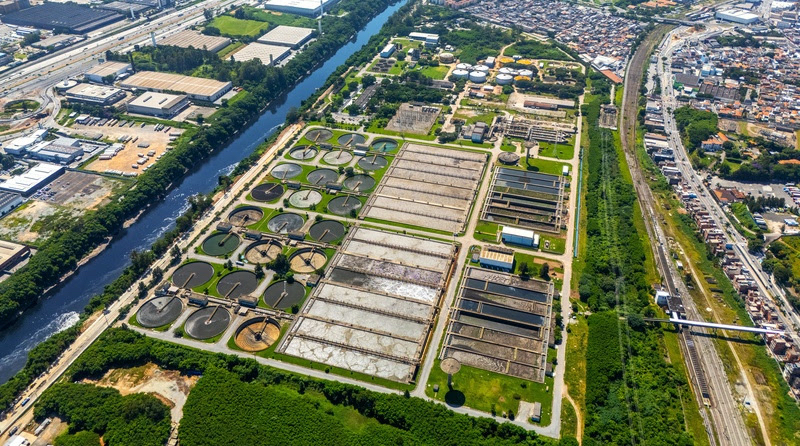
By Brazil Stock Guide – Sabesp (SBSP3) supplied 1.035 billion liters of reclaimed water in 2025 through 30 active contracts, according to company materials. More than 860 million liters were delivered via direct pipeline connections, with the remainder transported by truck. The total volume is equivalent to supplying about 18,900 people for an entire year, based on average urban consumption.
Production is concentrated in major wastewater treatment plants in Greater São Paulo — including Barueri, São Miguel, Parque Novo Mundo and ABC — with an estimated capacity of 84.5 million liters per day.
Sabesp, which was privatized in 2024, has been increasing investments in the São Paulo metropolitan region, particularly to expand the capacity of its wastewater treatment infrastructure — the foundation for scaling reclaimed water supply.
Denis Maia, director of clients and technology, said in a statement that reuse is becoming a central pillar of the company’s strategy to serve new industrial demand. “Each cubic meter of reclaimed water we deliver is one cubic meter of drinking water preserved for the population’s supply,” he said in the statement.
Barueri data center
In 2026, Sabesp signed a contract to supply 11 million liters per month of reclaimed water to a data center in Barueri. Initial deliveries will be made by truck, with a planned future connection to the Barueri wastewater treatment plant, the largest in Latin America.
The company did not disclose the client. The volume is consistent with estimated consumption of hyperscale data centers in the region, which can exceed 10 million liters per month depending on cooling systems.
The project is located in an area that hosts major digital infrastructure operators and could include facilities such as those of Scala Data Centers, one of the largest data center campuses in the region, although Sabesp has not confirmed the customer.
Sabesp said in a statement that the water will be used for cooling systems, reflecting growing demand driven by artificial intelligence and cloud computing infrastructure.
Industrial contracts
Sabesp has also signed a contract with Jervois Brasil to supply 40 million liters per month of reclaimed water through a direct connection from the São Miguel wastewater treatment plant.
Jervois operates the São Miguel Paulista refinery, described as the only Class 1 nickel and cobalt electrolytic facility in Latin America. The site is expected to resume operations following a $130 million investment, with ramp-up projected through 2027. The company said in a statement that the use of reclaimed water in industrial operations helps reduce reliance on potable water.
Large clients repricing
Following its privatization in 2024, Sabesp moved to revise contracts with large industrial customers, notifying clients of potential termination or renegotiation under a new tariff framework.
The company said that previous arrangements created distortions, with some large users paying proportionally less per cubic meter than residential consumers. Within this framework, Sabesp has been positioning large industrial clients — including reclaimed water contracts — as a key growth segment. Unlike residential water supply, which is subject to regulation and universalization targets, contracts with large consumers are negotiated on a bilateral basis, allowing greater pricing flexibility and commercial terms.
Pedro Amaral, head of large clients, said in a statement that demand is being driven by sectors linked to the new economy, including data centers and critical minerals. “Reclaimed water is becoming a strategic input for sectors leading the new economy,” he said in the statement.
Water context
The expansion comes as reservoir levels in São Paulo end the rainy season at around 56% of capacity, according to recent public data, highlighting ongoing concerns over water security. At the same time, the rapid growth of data centers has intensified debate over the resource footprint of digital infrastructure, particularly in water- and energy-constrained urban regions.


Leave a Reply