
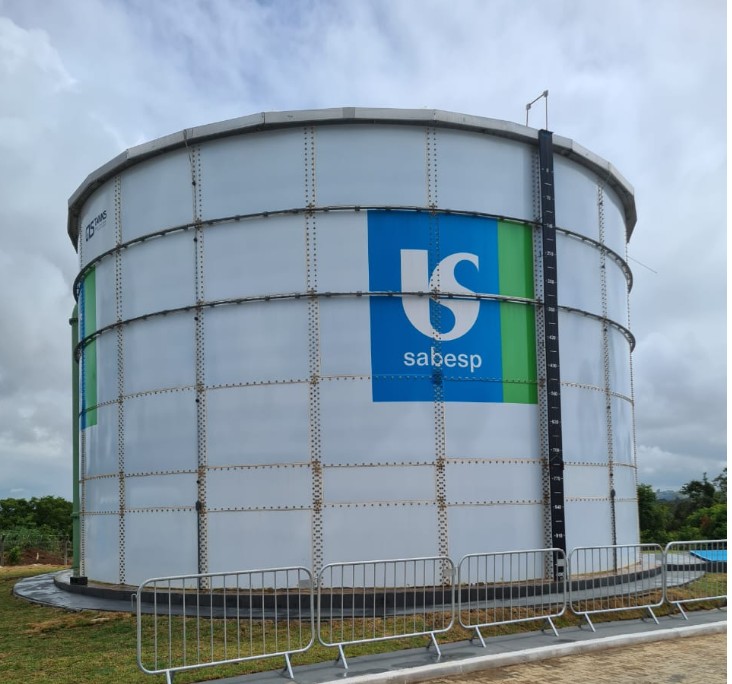
By Brazil Stock Guide – Brazil’s state-controlled water utility Companhia de Saneamento Básico do Estado de São Paulo, known as Sabesp (SBSP3), plans to begin injecting treated sewage water into rivers to bolster water security in the metropolitan region of São Paulo within the next two years.
The plan, unveiled on Thursday and reported by Valor Econômico, calls for the utility to connect effluent from its Suzano and Barueri treatment plants into the Taiaçupeba and Cotia rivers, in a process executives described as “aquifer recharge.”
“This water doesn’t reach potable quality, but it meets the standards of the receiving rivers,” said Samanta Souza, Sabesp’s executive director of institutional relations and sustainability. “It is regenerated water that returns to the cycle in the same quality as the river.”
Roberval Tavares, executive director of engineering and innovation, said the initiative is designed to create a long-term buffer against recurring droughts in the country’s most populous state.
Breaking taboos in water use
Débora Longo, Sabesp’s executive director of operations and maintenance, said the initiative represents a cultural shift in how water resources are managed in Brazil.
“The return of treated sewage water is a break with taboos, but in practice it’s already done in many cities worldwide and even in the Tietê River,” she said. “This is a very valuable resource that we can use. It’s a change in perspective, but today it’s very common.”
Capital expenditure and projects
Sabesp currently has around 1.9 billion reais ($336 million) in ongoing works to expand water sources. Projects include the interconnection of the Rio Grande and Alto Tietê systems, expected to add 4,000 liters per second, and the revitalization of the Baixo Cotia system, which could deliver an additional 1,000 liters per second.
Executives said that while the Tietê River could eventually become a new source of water, it is not under consideration at this stage.
Water scarcity and operational measures
Greater São Paulo’s integrated reservoir system is currently at 31% of capacity. Even so, Longo ruled out near-term rationing, a measure she said would cause severe disruption. Instead, Sabesp has lowered water pressure during nighttime hours since late August, saving more than 13.3 billion liters — the equivalent of a month’s supply for São Bernardo do Campo, Diadema and part of Santo André.
“Today we have more robust systems, better prepared,” Longo said. “Rationing is an operational tool, but it’s not what Sabesp would like, because it causes a very big impact.”



Leave a Reply