
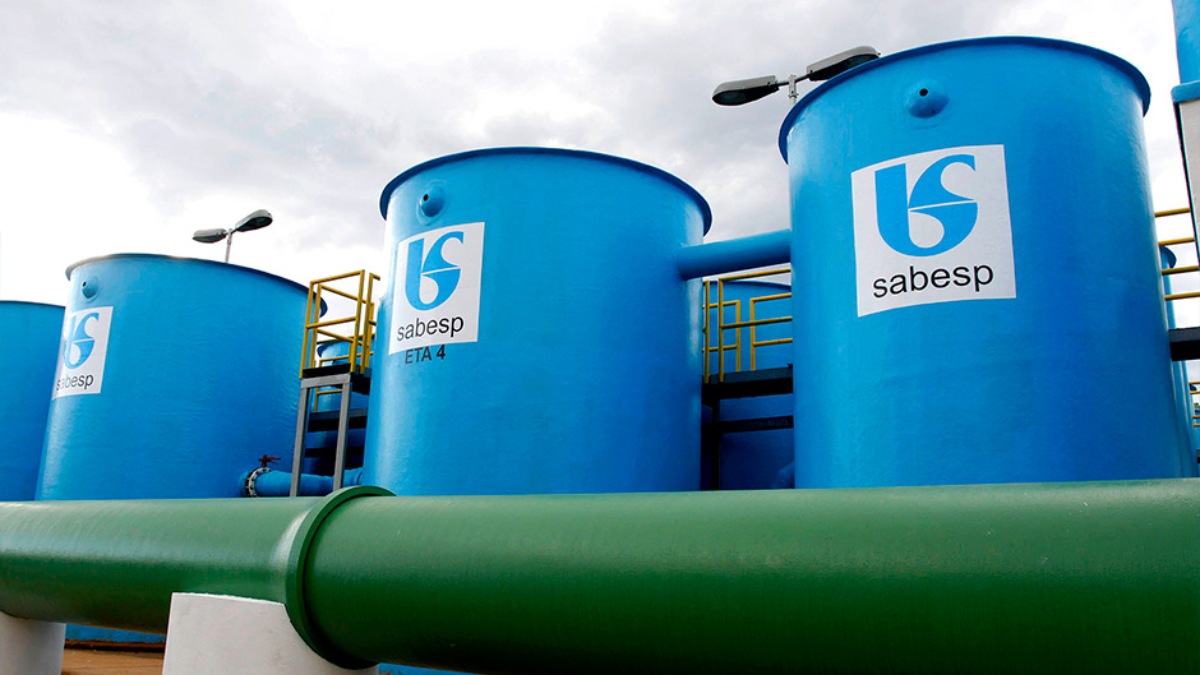
By Brazil Stock Guide – A week before COP30 in Belém, Companhia de Saneamento Básico do Estado de São Paulo – Sabesp (SBSP3) announced its 2035 decarbonization goals, based on verified emissions data and focused on new wastewater technologies, self-generation, and clean energy use. The plan aims to reduce total emissions across Scopes 1, 2, and 3 by 15% relative to 2024 levels, even as the company expands sewage treatment to achieve universal service coverage.
Under the plan, emissions intensity — the amount of CO₂ equivalent released per thousand cubic meters of treated sewage — will fall 41%, from 1.61 tCO₂e/1,000 m³ in 2024 to 0.94 tCO₂e/1,000 m³ by 2035. In Scope 2, which covers electricity use, Sabesp expects a 43% reduction through three simultaneous fronts: self-generation, higher use of renewables, and efficiency gains. Overall, the combined emissions decline across Scopes 1, 2, and part of 3 will reach 15% compared to the baseline year.
Sabesp’s climate challenge lies in expanding wastewater treatment — a process that naturally raises emissions, especially methane — while reducing overall impact. The strategy includes modernizing treatment plants, tightening control of fugitive emissions, expanding digital monitoring, and advancing an energy transition through long-term renewable contracts. The company will also invest in reforestation of key water basins, strengthening water quality, ecosystem services, and climate adaptation.
“The plan combines delivery, governance, and measurable results,” said Samanta Souza, Executive Director of Institutional and Sustainability Relations. “We went beyond standard practice by including the impact of untreated sewage in our emissions inventory. Our reforestation of water basins reinforces the link between climate, water, and people.”
For Sustainability Director Rachel Sampaio, the goal reflects engineering and management advances: “Cutting 41% in emissions intensity while treating more sewage demands more efficient plants, better methane control, and a cleaner energy matrix.” CFO and IR Officer Daniel Szlak added that the financial logic is clear: “The 43% cut in Scope 2 comes from self-generation and efficiency. Process improvements sustain the 41% intensity reduction. These are auditable goals, tied to the universalization investment cycle.”
Sabesp’s announcement also signals sectoral leadership. By including uncollected sewage in its inventory and linking it to a structural reduction plan, the company provides a replicable model for megacities balancing growth, justice, and sustainability. With R$70 billion in modernization investments slated through 2029, Sabesp arrives at COP30 positioned as a benchmark in climate transparency and sustainable finance.




Leave a Reply