

By Brazil Stock Guide – Six weeks before Apex Partners’ financial crisis became public, PwC had already flagged serious audit limitations at a fund managed by a group affiliate. The auditor disclaimed an opinion on the financial statements of BRM Carbyne Crédito Estruturado, a structured-credit fund of funds, after failing to obtain sufficient evidence to assess investments representing 86.45% of its net asset value.
The report, signed on June 25, examined the fund’s financial position as of March 31, 2026. At the time, the vehicle had NAV of R$60.3 million and held R$52.1 million across six underlying funds.
The first set of holdings, worth R$28.6 million, consisted of investments in Mib Fundo de Investimento em Direitos Creditórios and Contea Capital Genova D45. Together, they represented 47.47% of the fund’s NAV.
Another R$23.5 million, or 38.98%, was invested in Contea Capital Verona, Amalfi FIDC, FIDC Canaan and FC Money. PwC said it did not have audited or sufficiently recent financial information to verify the financial positions of those vehicles or properly assess the fair value of the investments, according to the report reviewed by Brazil Stock Guide.
Without that evidence, the auditor said it could not determine whether adjustments were required to the carrying value of the assets, the reported investment results or, consequently, the fund’s NAV per unit.
The technical distinction matters. A disclaimer of opinion is neither a finding of fraud nor proof that the investments were worth less than their reported value. It does mean, however, that PwC lacked sufficient evidence to express an audit opinion on the financial statements. The report was also limited to the fund and did not constitute an audit of Apex Partners’ consolidated accounts.
BRM Carbyne Crédito Estruturado began operating in December 2025 and was restricted to investors classified as qualified under Brazilian regulations. Its portfolio was managed by BRM Carbyne Gestão de Recursos, an Apex affiliate, while BTG Pactual served as fiduciary administrator.
Between March and June, despite the valuation limitations identified by PwC, the fund more than doubled in size. Data filed with Brazil’s Securities and Exchange Commission, known as the CVM, showed NAV reaching R$148 million on June 30, an increase of 145.3% from March.
The portfolio reported to the CVM contained 10 underlying-fund positions. A single investment, valued at R$104.1 million, accounted for 70.36% of total NAV.
On Aug. 6, BTG closed the fund to redemptions. In a regulatory notice, the bank attributed the decision to a “mismatch between the liquidity profile of the portfolio and the volume of redemption requests.”
Closing the fund does not amount to a declaration of insolvency, but it temporarily prevents investors from withdrawing their capital.
BTG said it would continue monitoring liquidity and could call an investor meeting to consider the alternatives available under CVM regulations. The bank also ended the commercial partnership through which it had distributed Apex financial products since 2019.
Removal and resignation from CVC
The fund was closed on the same day Apex said an internal review had uncovered “financial inconsistencies.”
The Partnership, a group formed by Apex equity partners, removed Fernando Antonio Kulnig Cinelli as president. The board then formalized the founder’s removal and also dismissed Chief Financial Officer Eduardo Siqueira. Senior partner Marcelo Murad took over as interim chief executive.
That same day, Cinelli resigned from the board of CVC, Brazil’s largest travel operator, to which he had been elected in May. CVC said the seat would remain vacant until a replacement was appointed.
Cinelli’s CVC board seat had represented the high point of his national expansion strategy. Through six Carbyne-managed funds and a personal stake held by the founder, Apex had accumulated roughly 15% of the travel company.
In April, the group entered into a shareholders’ agreement with GJP, a fund linked to CVC’s founding Paulus family, which owned approximately 20.3% of the company. Together, the two blocks controlled more than 35% of CVC’s share capital.
Part of Apex’s investment was funded from its own balance sheet, while another portion came through a private investment in public equity, or PIPE, fund that had raised R$78 million from clients and was targeting R$130 million.
A challenge to the Rio–São Paulo financial axis
Fernando Cinelli built Apex around a bold proposition: challenge the concentration of Brazil’s financial industry in Rio de Janeiro and São Paulo by creating, in Vitória, a platform capable of attracting business owners and wealthy families from the country’s regional economies.
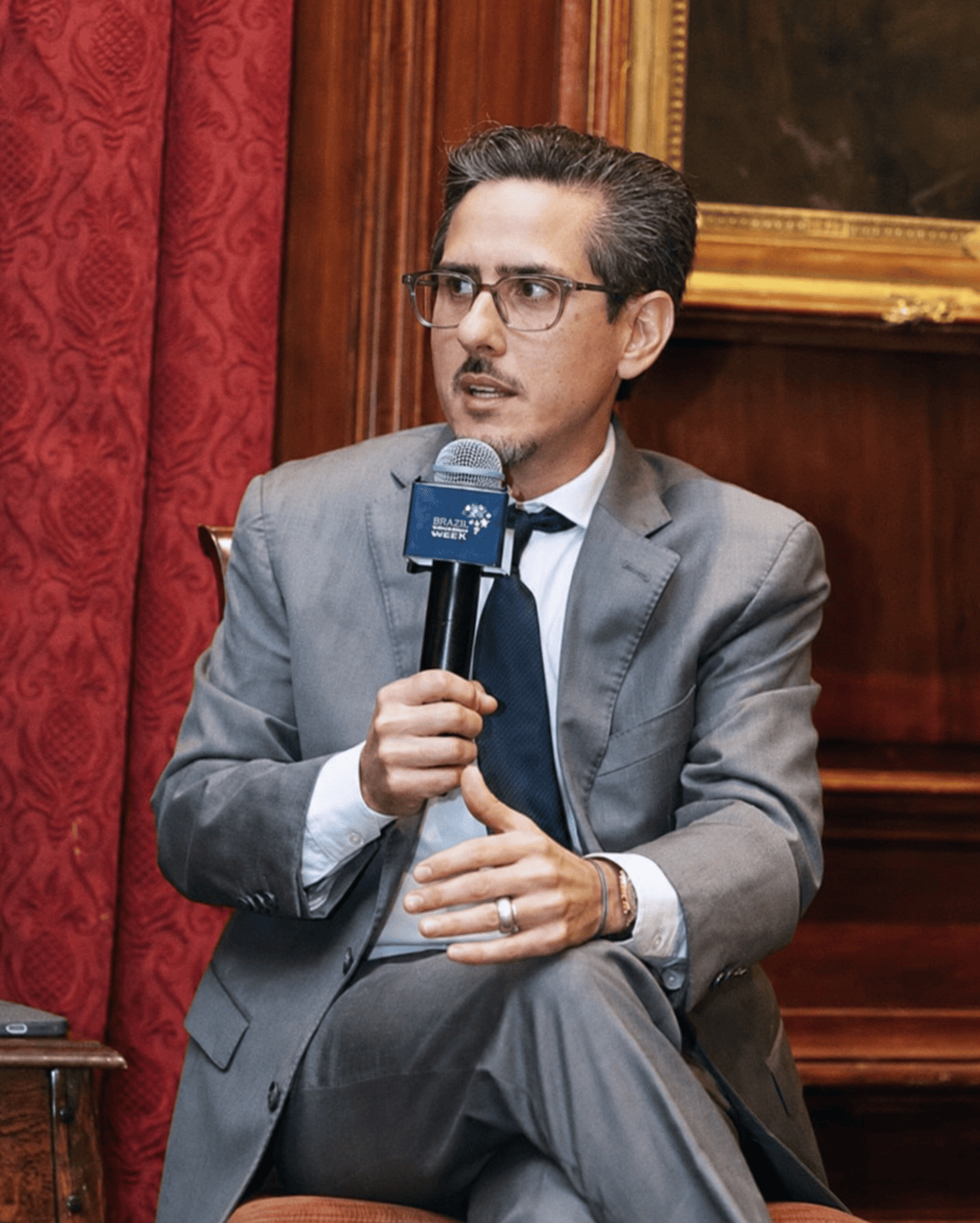
Founded in 2013, Apex sought to turn business owners from Espírito Santo into clients, investors and deal partners. It later expanded the model into markets outside Brazil’s main financial corridor, including Paraná, Santa Catarina, Rio Grande do Sul, Minas Gerais, Goiás, Mato Grosso and Mato Grosso do Sul.
The expansion covered investment advisory, private equity, venture capital, private credit, capital markets, real estate and wealth management. Apex’s ecosystem also came to include research firm Instituto Futura, whose studies were used to map regional economies and provide a statistical foundation for the group’s commercial strategy. The institute also conducted electoral polling.
In May, less than three months before the crisis, Apex described itself as a platform overseeing R$19 billion across assets under management and advisory mandates.
That figure did not consist solely of fund assets. According to rankings compiled by Anbima, Brazil’s capital-markets association, Carbyne had approximately R$1 billion effectively under management in June.
Cinelli also carefully cultivated his public image. On social media, at events and in society columns, he appeared alongside far better-known business leaders and bankers. In a photograph published in 2022, he was pictured at Harvard with billionaire Jorge Paulo Lemann. Elsewhere, Apex was highlighted as one of more than 40 investors associated with a proposal to create a corporate structure for the Fluminense football club, a list that also included André Esteves.


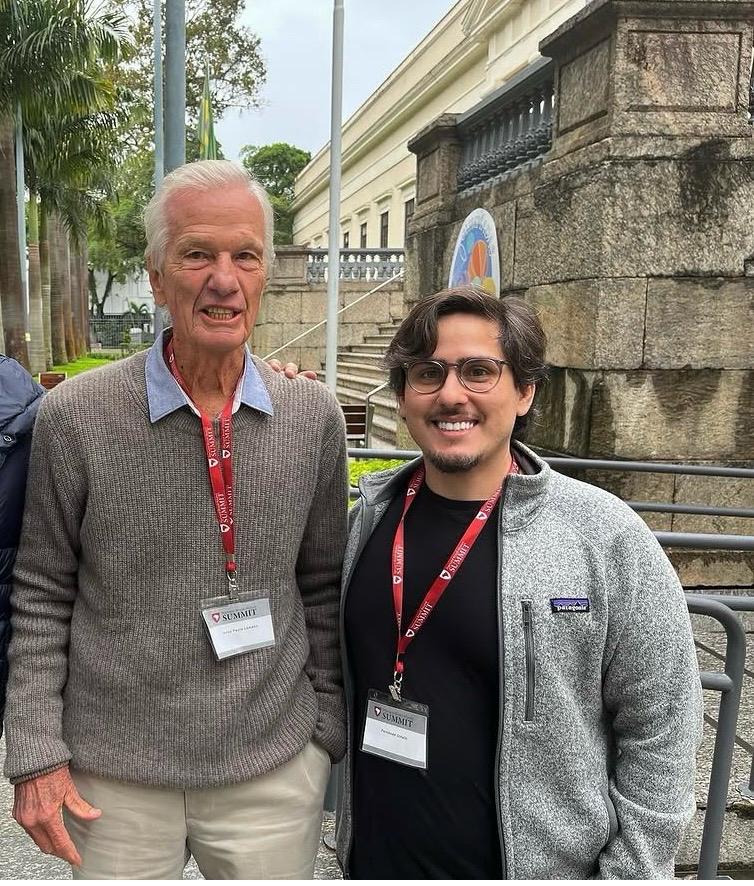
From left to right: In New York in May: a delegation of business owners and investors; At a Harvard summit with Jorge Paulo Lemann, and Meeting André Esteves in Italy
Those images carried more symbolic than evidentiary value. They functioned as public displays of adulation and self-promotion, associating Cinelli’s image with Brazil’s corporate elite and allowing proximity itself to be used as a credential.
It was the construction of a persona: a bold regional entrepreneur with national ambitions. The crisis, however, exposed the distance between that image and the questions now surrounding the group’s financial controls.
Preliminary liabilities of R$985.6 million
On Aug. 7, one day after the removals, Apex obtained a protective injunction from a bankruptcy and judicial reorganization court in Vitória.
The order stayed enforcement proceedings and barred asset freezes, attachments, seizures and search-and-seizure measures against the companies covered by the decision.
Apex said the injunction was preventive, intended to preserve the group’s assets and allow operations to continue while an external audit was being commissioned.
The order did not, at that stage, place Apex into a formal judicial reorganization — Brazil’s court-supervised restructuring process, broadly comparable to Chapter 11 in the United States.
Nevertheless, the court required the group to file for judicial reorganization within 30 days or lose the protection. A court-appointed adviser was also given 20 days to produce a report on the companies’ actual operating conditions and organizational structure.
Figures submitted by Apex itself to the court and reported by Estadão indicated preliminary liabilities of R$985.6 million.
Apex cautioned that the amounts still had to be reconciled against contracts and accounting records and did not consist solely of overdue or immediately payable obligations.
The amounts cited included R$452.1 million in debentures issued through Rhino Securitizadora, a securitization company. The securities offered returns ranging from 110% to 130% of CDI, Brazil’s benchmark interbank rate, or inflation as measured by the IPCA index plus 1.1% to 1.3% a month.
Some of the securities were backed by shares in Apex Partners and BRM Apex Investimentos. According to information submitted by the company, those shares had not been independently valued, and there was no evidence that the pledges had been properly perfected in the relevant registries.
The filing also cited R$309.8 million in obligations classified as “cashback,” spread across approximately 1,600 client positions.
Those transactions offered returns of up to 125% of CDI and were linked to funds and products including Carbyne Voyage, Carbyne Mercados Privados, Apex Crescimento Mercados Regionais, Apex Malls, Carbyne Crédito Privado and NewSun WTE debentures.
Another R$201.7 million consisted of bank debt involving Sicoob, BTG Pactual and Banco Daycoval. The documentation also referred to R$35.2 million in tax liabilities.
Because the figures are preliminary and some categories may overlap, they should not be added together mechanically.
Apex also reported R$78.2 million in redemption requests from regulated investment funds, with settlement dates concentrated between Aug. 12 and Sept. 30. Those requests were not necessarily limited to the fund administered by BTG.
Net debt more than doubled
According to the figures presented to the court, Apex’s consolidated net debt increased from R$413 million in January 2025 to R$975 million in June 2026.
That represents an increase of R$562 million, or 136%, over approximately 18 months — meaning net debt more than doubled.
In 2025, R$187 million of a R$262 million increase was reportedly directed into funds, investment vehicles and mergers and acquisitions that did not generate cash for the group during the period.
In the first half of 2026 alone, Apex reportedly raised another R$300 million in debt. Of that amount, according to the company’s own assessment, R$80 million funded the operating deficit and R$95 million covered financing and tax-related carrying costs, without creating matching assets.
The protective filing, according to Estadão’s account, also indicated a deterioration in the expected value of Apex’s assets.
Of a portfolio with a nominal value of R$261.5 million in June, Apex estimated that R$190.1 million would be recoverable through divestments. The R$71.4 million difference represented 27.3% of the reported value.
The company also identified R$38.1 million in receivables, spread across 65 positions, that it considered unrecoverable. It estimated liquidity haircuts of between 30% and 60% on some of the remaining assets. All those figures remain subject to independent verification.
The court protection does not extend to the ring-fenced assets of investment funds, fiduciary estates backing receivables certificates or assets segregated within special-purpose vehicles.
It also does not restrict the authority of the CVM, Anbima or fiduciary fund administrators.
Allegations and response
Apex’s current management has accused Cinelli of “reckless management and bad faith.” The company said it intended to file a liability lawsuit against its founder and seek a preventive freeze of his assets.
Its initial statement also referred to possible measures aimed at establishing civil and criminal liability.
Cinelli’s defense said he remained “dedicated and committed” to preserving the company and protecting its investors and shareholders. According to the statement, the founder intends to help clarify the issues raised with “complete transparency and integrity.”
So far, no court has found either Cinelli or Eduardo Siqueira responsible for wrongdoing.
Nor has any independent investigation established the precise origin of the inconsistencies, the eventual size of any losses or the ultimate destination of the money raised.
The external audit will have to establish who authorized the rapid increase in debt, how the money moved among the dozens of companies and funds linked to the group, which guarantees were properly created and how much of the assets can ultimately be recovered.


Leave a Reply