
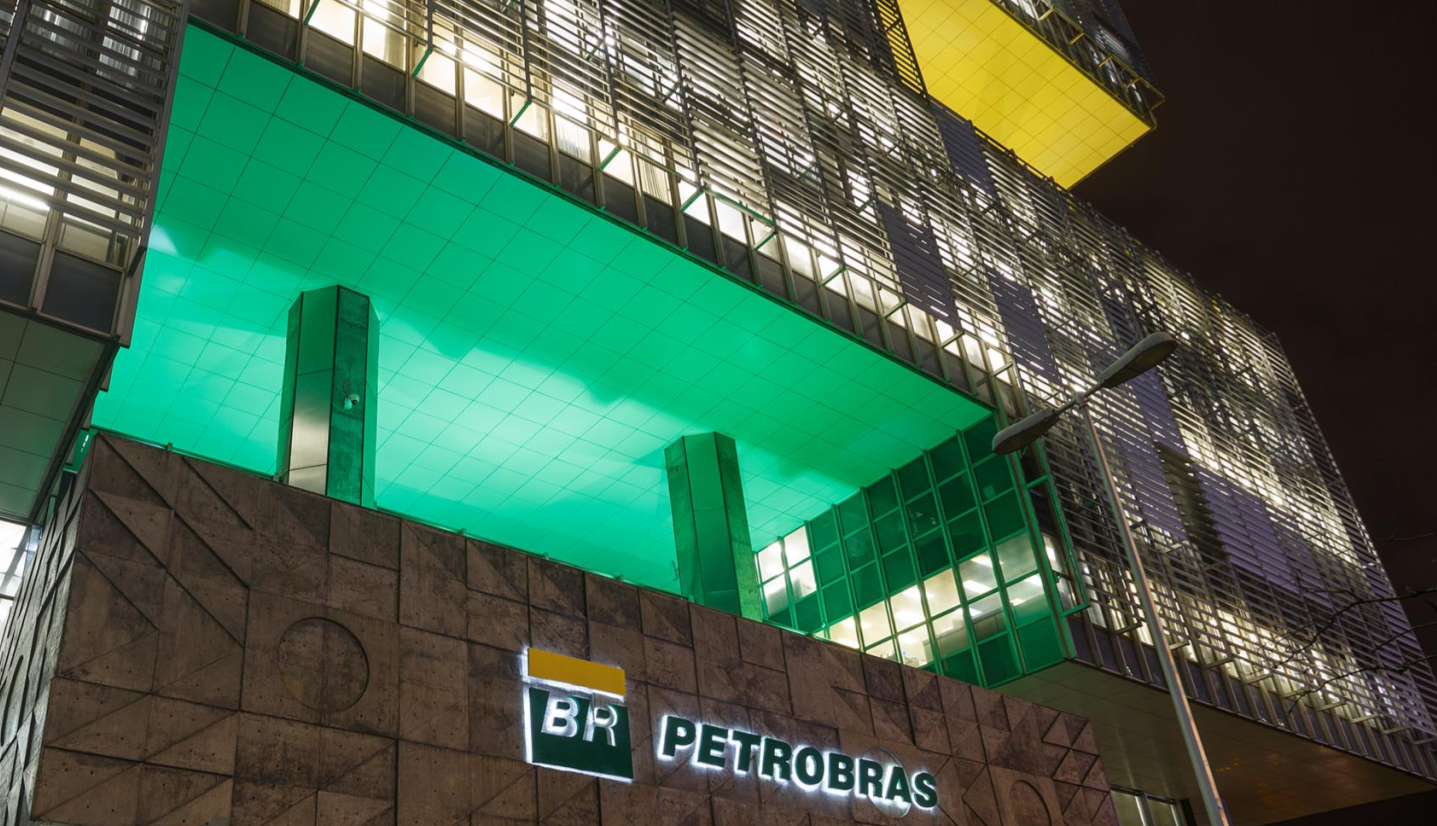
By Brazil Stock Guide – Petrobras (B3: PETR4; NYSE: PBR) reported net income of R$15.6 billion in the fourth quarter of 2025, a sharp decline from the previous quarter but significantly stronger than the loss recorded in the same period a year earlier.
The Petrobras 4Q25 results cap a year in which the Brazilian oil giant generated R$110.1 billion in net income, or R$100.9 billion excluding one-off events, highlighting the resilience of its operations despite a challenging oil price environment.
The results illustrate how Petrobras continues to rely on production growth and operational efficiency to protect profitability when global oil prices weaken.
Oil price pressure
Brent crude averaged US$63.69 per barrel in the fourth quarter, down nearly 8% from the previous quarter and almost 15% compared with the same period in 2024.
Lower oil prices directly affect Petrobras because the majority of the company’s upstream revenue is linked to international crude benchmarks.
The price decline therefore weighed on profitability during the quarter.
Adjusted EBITDA reached R$59.9 billion in the fourth quarter, down 6.2% from the third quarter, reflecting weaker crude prices and lower domestic fuel sales.
Even so, the company maintained robust margins compared with global peers.
Production growth engine
The main factor supporting Petrobras’ results in 2025 was the strong expansion in oil and gas production.
Total output increased 11% during the year, driven by new offshore platforms and ramp-ups in Brazil’s prolific pre-salt fields.
Much of this growth came from the Búzios and Mero fields, two of the most productive offshore assets in the world.
New floating production units started operating or expanded output during the year.
These included the FPSOs Almirante Tamandaré, Marechal Duque de Caxias and Alexandre de Gusmão, as well as the P-78 platform, which began producing first oil in December in the Búzios field.
Together, these new units added roughly 585,000 barrels per day of nominal production capacity.
The additional output helped offset weaker oil prices by increasing export volumes.
Record exports
Exports became a key pillar of Petrobras’ performance in the fourth quarter.
The company reached record oil export volumes, approaching one million barrels per day.
This helped compensate for seasonal softness in Brazil’s domestic fuel demand.
Diesel consumption in particular tends to decline toward the end of the year, which affected refinery sales.
Higher crude exports therefore played an important role in stabilizing revenues.
Strong cash generation
Despite lower oil prices, Petrobras continued to generate large amounts of cash.
Operating cash flow reached R$54.9 billion in the fourth quarter, reflecting strong operational efficiency and high production levels.
Free cash flow totaled R$19.3 billion during the period, even after major investments and shareholder distributions.
For the full year, Petrobras generated R$200.3 billion in operating cash flow and R$91.6 billion in free cash flow.
This financial strength allows the company to simultaneously invest in new projects and distribute dividends.
Investment expansion
Petrobras significantly increased its investment program during 2025.
Total capital expenditures reached US$20.3 billion, representing an increase of more than 22% compared with the previous year.
About 84% of investments were allocated to exploration and production, particularly projects aimed at expanding pre-salt output.
These investments include new offshore platforms, drilling campaigns and subsea infrastructure.
The strategy reflects Petrobras’ focus on high-return assets with some of the lowest extraction costs in the global oil industry.
Balance sheet stability
Despite higher investments, Petrobras maintained relatively conservative leverage.
The company ended 2025 with gross debt of US$69.8 billion and net debt of US$60.6 billion.
This corresponds to a net debt-to-EBITDA ratio of roughly 1.42 times, a level considered comfortable for a major oil producer.
Average debt maturity remained long at about 11.7 years, while financing costs stayed broadly stable.
The structure provides Petrobras with significant financial flexibility.
Dividends and shareholder returns
Alongside the earnings release, Petrobras announced a new proposal to reward shareholders.
The board approved the submission to the annual shareholders’ meeting of a proposal to distribute R$8.1 billion related to the fourth-quarter results.
If approved, the total shareholder remuneration for 2025 would reach about R$41.2 billion.
The payments will be made in two installments in May and June 2026, both in the form of interest on equity.
Each installment will correspond to R$0.31311454 per share, totaling R$0.62622908 per share before Selic adjustments.
The proposal follows Petrobras’ dividend policy, which allows the company to distribute 45% of free cash flow to shareholders when debt levels remain within strategic limits.
Outlook
Looking ahead, Petrobras expects production growth to remain the main driver of earnings.
Several new offshore projects are scheduled to begin operating in the coming years, especially in the Búzios and Atapu fields.
These developments should allow the company to increase output while maintaining competitive extraction costs.
In other words, even if oil prices remain volatile, Petrobras’ expanding pre-salt portfolio suggests the company will continue generating strong cash flows.
For investors, the Petrobras 4Q25 results reinforce a key point: the company’s deepwater assets remain among the most profitable oil resources in the world.



Leave a Reply