

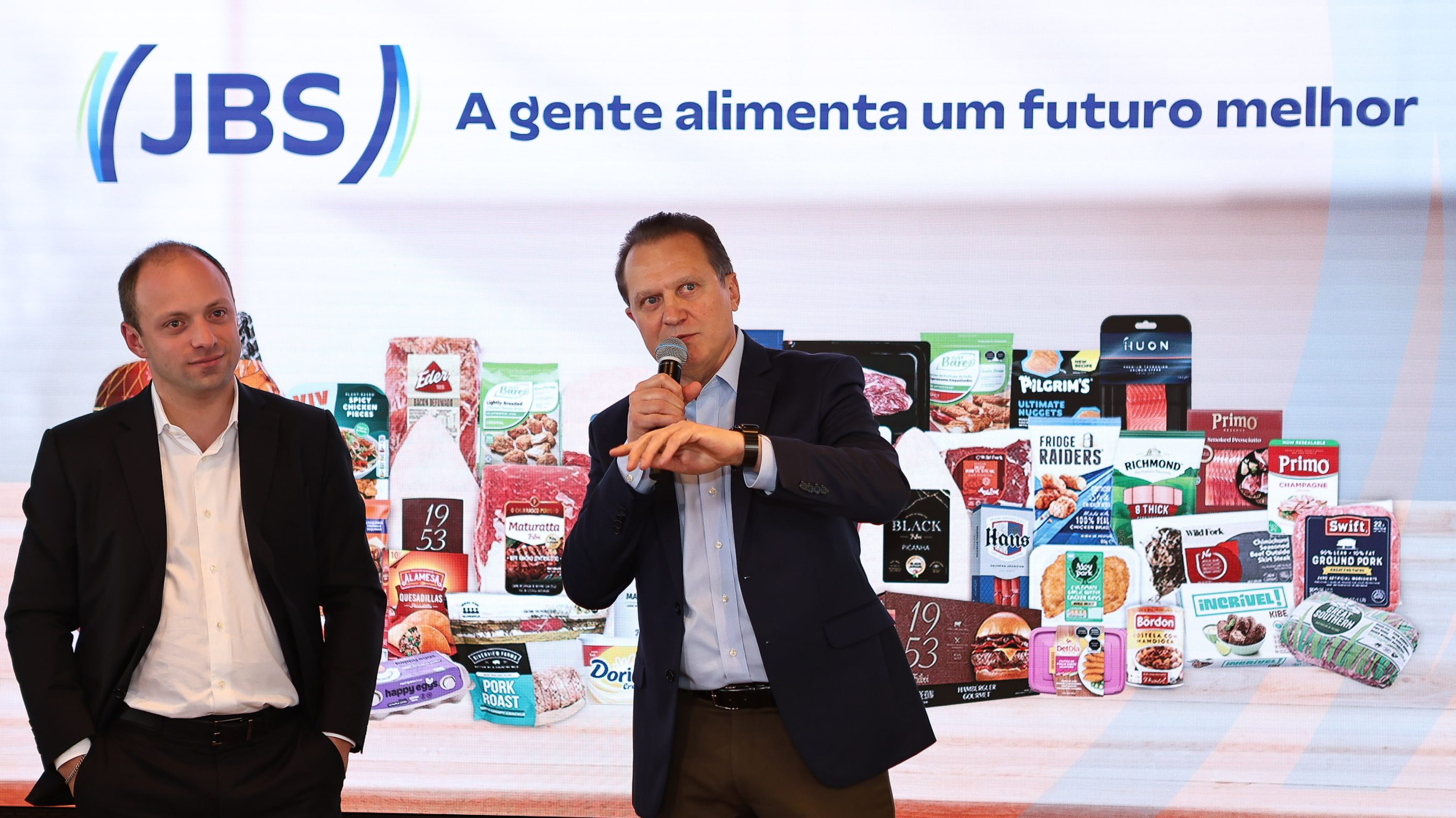
After two decades of expansion that transformed a Brazilian meatpacker into the world’s largest protein producer, JBS (NYSE: JBS; B3: JBSS32) is preparing for a leadership transition without a significant shift in strategic direction.
Wesley Batista Jr., who will take over as global CEO in January 2027, plans to accelerate growth in prepared foods, build on the company’s newly established foothold in Southeast Asia and expand into businesses that bring the food industry closer to biotechnology and healthcare.
Speaking to journalists on Wednesday (Nov. 25) in São Paulo, Wesley and current CEO Gilberto Tomazoni presented a shared vision for the company’s future. Both executives emphasized a management model in which building teams, decentralizing decision-making and developing leaders are as important as the industrial scale JBS has achieved.
“There is no JBS of Wesley, no JBS of Tomazoni, no JBS of Wesley Batista Jr. And there won’t be, because the real strength of JBS lies in our teams and the people we have,” the incoming global CEO said.
While the company’s international expansion was largely driven by his father, Wesley Batista, and its diversification across protein categories and New York Stock Exchange listing took shape under Tomazoni, Wesley Batista Jr. made clear that the underlying strategy remains unchanged.
Wesley and Tomazoni have worked together for more than a decade, helping formulate and execute the strategic decisions that have shaped JBS into the company it is today.
Tomazoni will step down after eight years as global CEO but will remain actively involved in the business. He will become vice chairman of the board, serve as a senior advisor on strategic and operational matters, and remain chairman of Pilgrim’s Pride, one of the largest poultry producers in the United States and a JBS-controlled company.
He will also chair the board of Instituto J&F, an institution focused on education and professional development. The role will extend one of the central priorities of his tenure: developing the next generation of leaders to sustain the company’s growth.
Global Scale, Local Autonomy
JBS’s international expansion has created an organizational structure that Tomazoni considers a difficult-to-replicate competitive advantage. Beyond assembling industrial assets across multiple countries, the company has built local teams capable of managing businesses with distinct operating and market characteristics.
“When we are in Australia, we are Australian. When we are in the United States, we are American,” Tomazoni said.
JBS combines global scale with operational autonomy. Its corporate headquarters maintains a lean structure, while executives overseeing operations in each country have considerable latitude to make decisions and respond to local market conditions.
“We need to operate with the agility and speed of smaller companies,” Tomazoni said. The model, however, requires a strong corporate culture to keep the organization aligned despite decentralized decision-making.
“When someone asks me what JBS’s strategy is, I say our strategy is to have the best people and put them where the best opportunities are,” Tomazoni said. In his view, the combination of industrial diversification and the ability to deploy talent allows the company to pursue multiple growth opportunities simultaneously.
The Next Geographic Frontier
Southeast Asia stands out as one of the incoming management team’s most significant growth opportunities. Together with Oceania, the region is home to approximately 750 million people. Yet JBS’s industrial footprint in Southeast Asia remains limited, including a small tannery in Vietnam.
The company intends to expand through its partnership with Indonesia’s sovereign wealth fund, Danantara. Australia, where JBS operates a diversified production platform, provides an important springboard for that expansion.
“It has every potential to become our next major geographic market,” Wesley said.
The company’s geographic revenue mix illustrates the scale of the opportunity. The United States currently accounts for approximately 50% of JBS’s revenue, while Brazil represents around 25%. Australia ranks among its largest production platforms, with operations spanning beef, prepared foods and salmon.
The United Kingdom, one of JBS’s lesser-known international businesses, generates approximately $5 billion in annual revenue, according to Wesley, with operations in pork, poultry and prepared foods. The company also has significant businesses in Canada, Mexico and other European markets.
Food Security as a National Priority
JBS’s international expansion comes as food security has moved to the center of government strategies worldwide. According to Tomazoni, pandemic-related supply chain disruptions and geopolitical conflicts have reinforced efforts by countries to become more self-sufficient in food production.
“Food security is a matter of national policy. It is a strategic issue,” Tomazoni said.
JBS’s initiatives in Oman and Indonesia, both involving sovereign wealth funds, reflect this approach. Rather than simply establishing new production facilities, the company aims to participate in national food security programs, bringing its industrial capabilities and technological expertise to meet local needs.
The model combines domestic production with the use of existing industrial infrastructure across multiple regions. Not every country can competitively produce all the food it needs, creating opportunities for companies capable of integrating production platforms and balancing local requirements with global efficiency.
Seara as a Global Testing Ground
Another avenue for growth is the international rollout of the prepared-foods and brand-building model JBS developed in Brazil, particularly through its Seara business. The company has been replicating elements of that approach in the United States, Australia and the United Kingdom, and sees similar opportunities in the Middle East.
“Brazil has undoubtedly been at the forefront of JBS’s efforts in prepared foods, value creation and brand development,” Wesley said.
Brazil has also become a reference market for building consumer brands around fresh meat. Unlike in most international markets, Brazilian consumers have come to recognize specific brands when purchasing beef, pork and poultry — a shift JBS helped drive through Friboi and Seara.
In the United States, the prepared-foods strategy is already delivering results. According to Wesley, the company’s Just Bare brand has captured approximately 13% of the breaded chicken market in roughly three years, rising from virtually zero in a category dominated by established brands.
Just Bare was designed to bring the chicken products consumers enjoy at restaurants and foodservice chains into American grocery stores, combining convenience, taste and health-conscious positioning. JBS sees similar opportunities through its Primo brand in Australia and its prepared-foods operations in the United Kingdom.
In Brazil, the company is beginning to reap the benefits of a period of industrial investment across Seara, Friboi and Swift. Wesley highlighted the beef processing facility in Campo Grande, the poultry plant in Rolândia and the pork facility in Dourados as flagship operations. JBS is also capitalizing on changing consumer habits, forecasting approximately 15% growth in sales of barbecue products during Brazil’s year-end holiday season.
From Food to Longevity
One of JBS’s emerging growth opportunities lies in expanding beyond proteins traditionally served at the center of the plate. The company has been investing in biotechnology, dietary supplements and ingredients designed for targeted applications in human nutrition.
A major investment in this area is its collagen production facility in Presidente Epitácio, in the state of São Paulo. JBS has developed proprietary technologies to produce bioactive collagen peptides, seeking to extract greater value from raw materials generated by its industrial operations.
According to Wesley, the opportunity extends well beyond the traditional sports performance and beauty supplements markets. Aging populations and growing consumer interest in health and longevity are expected to drive demand for precision nutrition products.
The incoming CEO sees this business as central to JBS’s future rather than a peripheral diversification effort. Entering the market broadens the range of industrial applications for the proteins the company already produces.
Management also views the growing popularity of GLP-1 weight-loss drugs as a potentially positive development for the business. In Wesley’s assessment, these medications are accelerating a consumer trend that has been gathering momentum over the past decade: greater attention to the nutritional composition of food and the importance of protein intake.
For Tomazoni, the next stage of the food industry’s evolution will increasingly be defined by the intersection of taste and biotechnology. JBS has been investing in this field in Brazil and Spain, targeting functional foods and bioactive ingredients. At the same time, it intends to continue expanding across categories including eggs, seafood and aquaculture.
“Wherever there is protein, you can expect JBS to be there, developing the market, challenging it and doing something new,” Wesley said.


Leave a Reply